



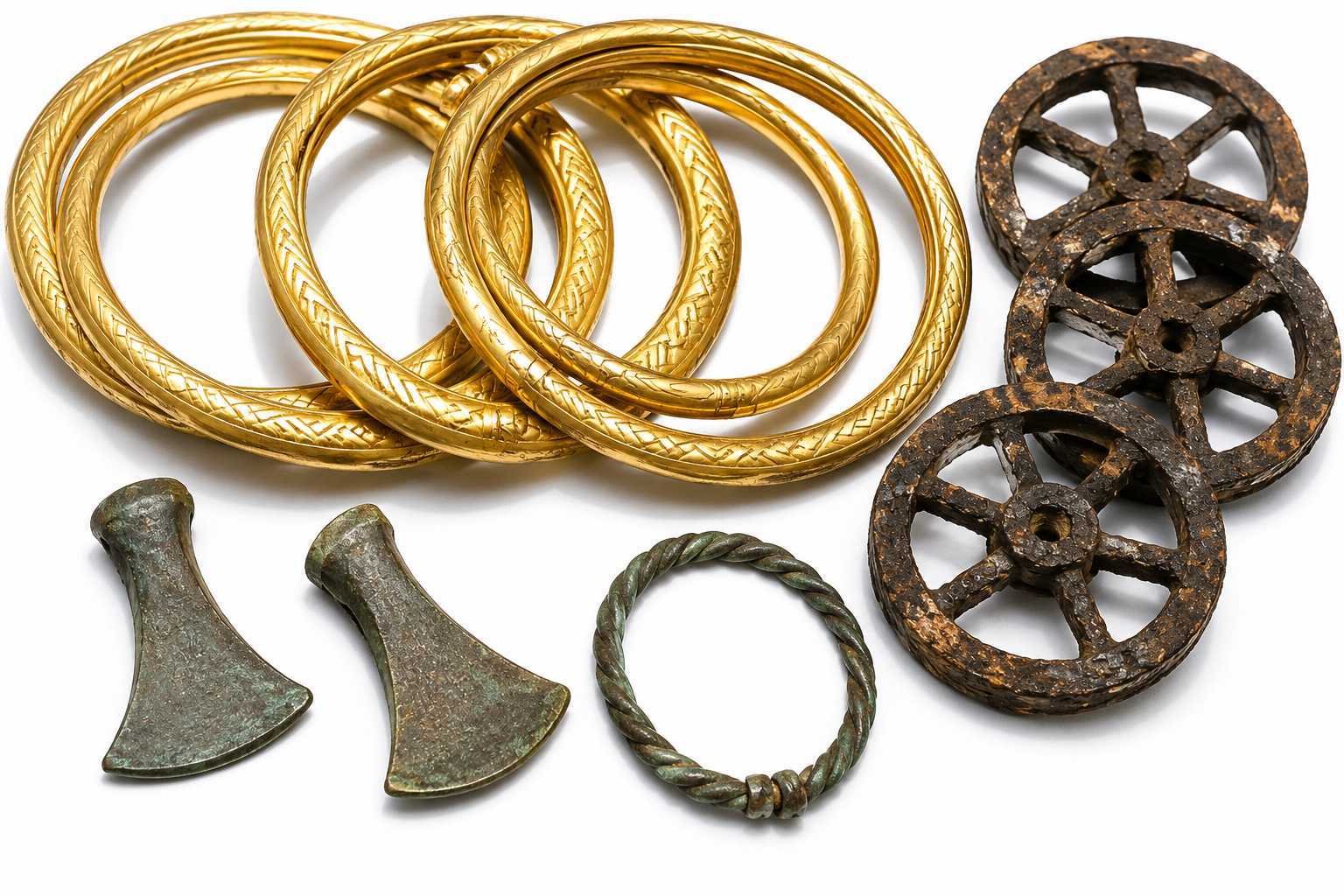
A metal detectorist in Romania has uncovered a rare 3,000-year-old hoard containing gold necklaces and other artifacts that archaeologists say could reshape understanding of the region’s Bronze Age and early Iron Age timeline.
The discovery was made in Prahova County, northeast of Bucharest, on an isolated hill near Marginea Pădurii, close to the town of Urlați. The hoard includes three large gold neck ornaments weighing more than 300 grams in total, along with iron wheels, two small axes, and a bronze bracelet.
Researchers described the find as exceptional because of both its richness and the unusual combination of objects buried together.
Discovery on a remote hill
The hoard was first found during a Sunday afternoon search by an authorized metal detectorist exploring a remote area with no visible road or nearby settlement.
His detector gave a strong signal near a large stone. After digging about 25 centimeters into the ground, he uncovered several small iron wheels arranged around a compact group of artifacts.
Inside were three tightly rolled gold spirals. The objects first appeared to be bracelets. Later examination showed they were actually gold collars or neck rings that had been compressed to fit into a small, buried space.
The finder searched the surrounding area but discovered no additional objects. The next morning, he handed the hoard to the Prahova County Directorate for Culture, as required under Romanian heritage law.
Archaeologists study an unusual hoard
The artifacts were later transferred to the Prahova Museum of History and Archaeology, where specialists began studying the objects.
Archaeologist Alin Frînculeasa, a prehistoric archaeology researcher active in Prahova, described the discovery as one of the most important recent finds in Romania.
Researchers say the dating of the hoard presents a major challenge. According to Frînculeasa, the artifacts appear to belong to a broad period spanning the middle and late Bronze Age and the early Iron Age.
A metal detectorist in Romania uncovered a rare 3,000-year-old hoard containing gold necklaces, iron wheels, axes and a bronze bracelet buried on a remote hill.
Archaeologists say the unusual mix of artifacts could reshape understanding of the Bronze Age and early Iron Age. pic.twitter.com/OcrbAvZXkW
— Tom Marvolo Riddle (@tom_riddle2025) May 28, 2026
That raises a key question. The objects may have been created centuries apart and later buried together. Another possibility is that archaeologists may need to revise the dating of similar artifacts from the region.
Objects appear intentionally buried
The arrangement of the hoard suggests the artifacts were deliberately placed rather than accidentally lost.
Researchers believe the gold collars were carefully rolled and deposited in a confined space. The iron wheels appear to have framed or protected the group, while a bronze bracelet rested at the bottom of the pit.
Specialists also suspect the objects may once have been stored inside a container, although no preserved box has yet been identified.
One of the gold necklaces bears stamped decoration similar to patterns found on Bronze Age ceramics. Other pieces resemble forms known from silver artifacts linked to different periods. That mixture of styles and materials has increased archaeological interest in the hoard.
Researchers investigate its purpose
Archaeologists are now considering whether the hoard was a ritual offering or a hidden treasure buried during a time of danger.
The hill where the objects were found has been added to a list for future archaeological investigation. Researchers hope to determine whether a settlement, burial ground or cult site once existed nearby.
The next stage of research will focus on the composition of the gold itself. Scientists hope the analysis will reveal where the metal originated and how it was worked.
The findings could offer new insight into trade routes, mobility, and goldworking traditions in prehistoric Romania.
After conservation and study are completed, the artifacts are expected to be displayed publicly at the Prahova Museum of History and Archaeology.
See all the latest news from Greece and the world at Greekreporter.com. Contact our newsroom to report an update or send your story, photos and videos. Follow GR on Google News and subscribe here to our daily email!

