



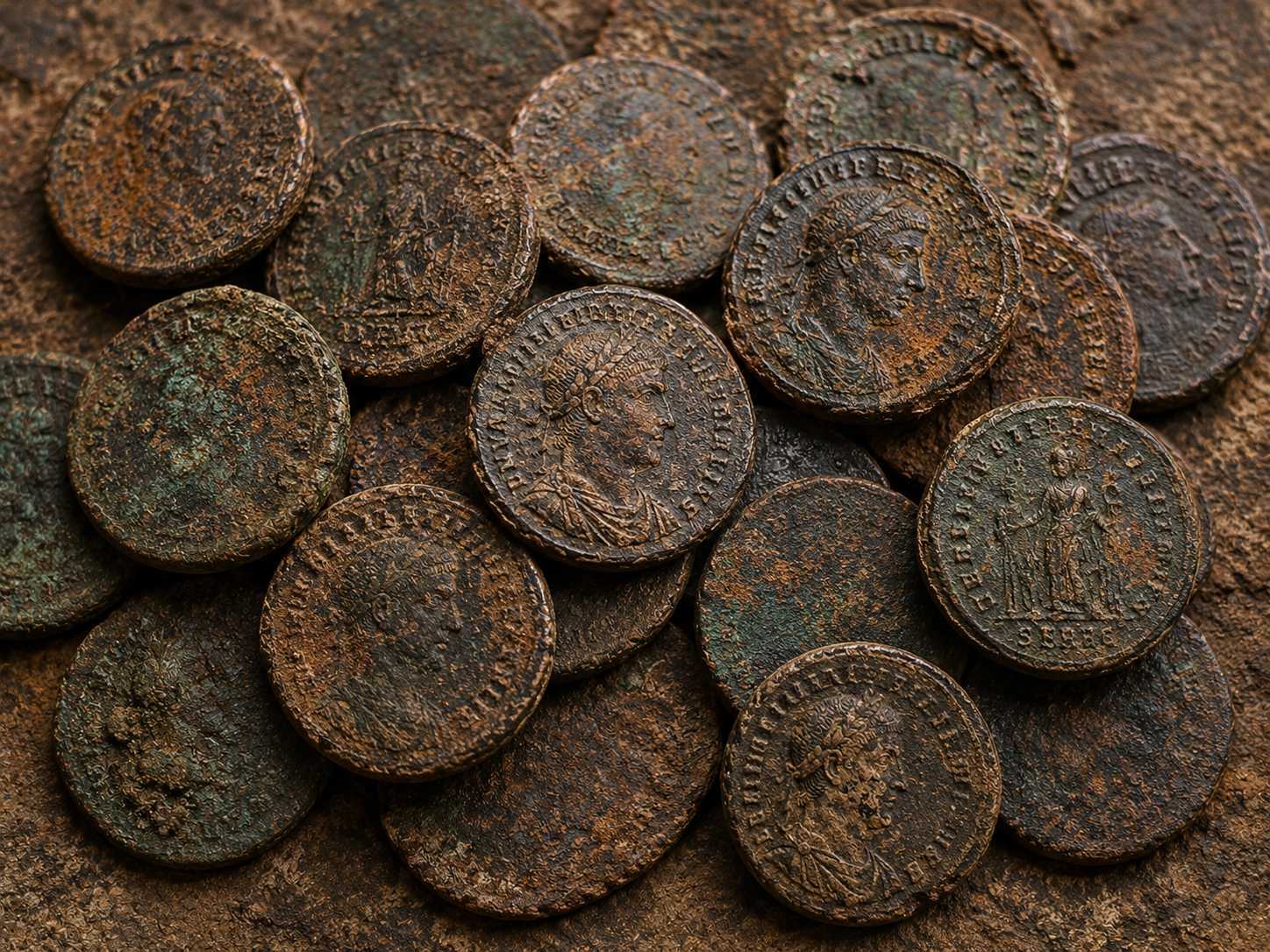
Archaeologists in eastern Croatia have uncovered 302 Roman coins near the village of Mohovo, a discovery researchers believe may preserve the final trace of a small military unit stationed along the Danube frontier during the late Roman Empire.
The coins were found during excavations led by the Institute of Archaeology at the remains of a Roman watchtower in Vukovar-Srijem County. The hoard was concentrated within about one square meter inside a defensive ditch surrounding the site.
Researchers said most of the coins date to the 4th century CE, a period when the Danube Limes formed one of Rome’s most sensitive military borders. The frontier stretched across large parts of Central and Eastern Europe and relied on forts, watchtowers, and patrol routes to monitor movement along the river.
Frontier towers guarded the Danube border
According to Siniša Krznar, assistant director of the Institute of Archaeology, the Mohovo area was controlled by larger Roman camps at Ilok and Sotin. Smaller wooden watchtowers were positioned between them to observe crossings and quickly relay warnings along the frontier.
Excavations at Mohovo uncovered the remains of one such structure. Archaeologists identified traces of a timber watchtower surrounded by semi-circular defensive ditches.
Archaeologists in Croatia uncovered 302 Roman coins near a watchtower along the Danube frontier, a discovery that may preserve the final trace of a small Roman garrison from the 4th century CE. pic.twitter.com/637AauZibf
— Tom Marvolo Riddle (@tom_riddle2025) May 15, 2026
A Croatian broadcaster reported that these towers were built high enough for soldiers to maintain visual contact with nearby outposts, creating a continuous line of surveillance along the Danube.
The coin discovery began when archaeologists noticed a single coin while clearing soil from the ditch. Another appeared moments later. The growing concentration quickly revealed a much larger hoard.
Coins may have belonged to stationed soldiers
Marko Dizdar, director of the Institute of Archaeology, said the money may have belonged to soldiers stationed at the watchtower. Researchers believe the coins could have been hidden during an attack or emergency, with the garrison intending to recover them later.
Preliminary analysis suggests many of the coins were minted during the reign of Valentinian I, who ruled the western Roman Empire from 364 to 375 CE. The emperor was born in Cibalae, the ancient Roman settlement beneath modern-day Vinkovci.
The Mohovo site has also produced Roman-era brooches known as fibulae and a fishing hook linked to everyday life along the river frontier. Researchers said the finds show that soldiers stationed there were not only guarding the border but also living and working beside the Danube.
Discovery sheds light on life along the frontier
After conservation and scientific study, the coins are expected to enter a museum collection. Archaeologists said the hoard may offer a rare glimpse into the uncertain final moments of a Roman frontier outpost more than 1,600 years ago.
See all the latest news from Greece and the world at Greekreporter.com. Contact our newsroom to report an update or send your story, photos and videos. Follow GR on Google News and subscribe here to our daily email!

