



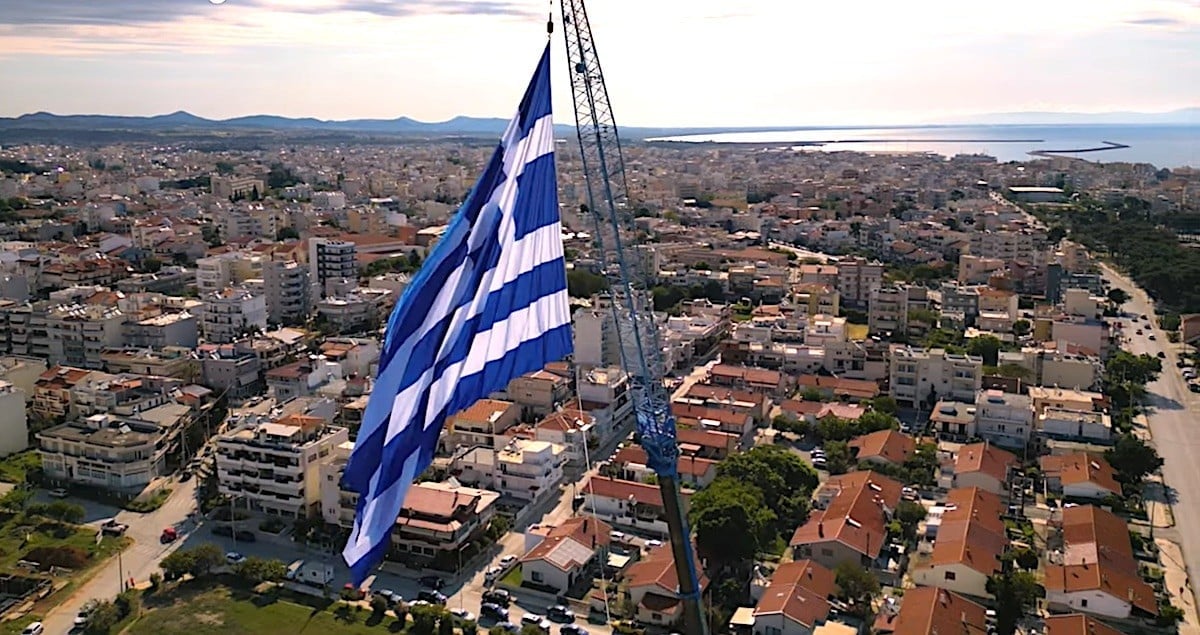
The city of Alexandroupolis in northeast Greece marked on Thursday the 106th anniversary of its union with Greece with a military and student parade attended by government and local officials, as well as representatives of the Orthodox Church.
“Alexandroupolis and Evros serve as Greece’s geopolitical armor, acting today as a vital gateway connecting the country to the Balkans, as well as Central and Eastern Europe,” stated the President of the Republic, Konstantinos Tasoulas. Attending the celebrations on May 14, 2026, he added: “Alexandroupolis honors its freedom by serving both as a shield for the nation and as a pillar of growth and international outreach for Thrace and Greece as a whole.”
The President attended the official Te Deum (Doxology) for the ‘Eleftheria’ of Alexandroupolis at the Metropolitan Church of Saint Nicholas, led by Metropolitan Anthimos. Military guards of honor paid tribute outside the cathedral and at the Domna Visviki Memorial. The event concluded with a parade of military units, students, and local organizations before the President.
The capital of the Evros regional unit is the largest city in Greek Thrace and the region of Eastern Macedonia and Thrace, with a population of over 70,000 and is an important port and commercial center for northeastern Greece.
The turbulent modern history of Alexandroupolis
During the Russo-Turkish War (1877–1878), it was briefly captured by the Russians. Ottoman rule ended with the First Balkan War, when the city was captured by Bulgaria in 1912. In the Second Balkan War, Greece took control of the city. With the Treaty of Bucharest (10 August 1913), the city returned back to Bulgaria.
With the defeat of Bulgaria in World War I, the city came under Greek control for the second time. In 1920, the city was renamed to honor the King of Greece, Alexander. With the Treaty of Lausanne in 1923, Alexandroupolis became an official part of Greece.
A central attraction and symbol of the city is the Lighthouse (recognized as a cultural heritage monument in 2013) located on the city’s promenade (Megalou Alexandrou Street).

It was built in 1850 and started operating in 1880, built on the western side of the city’s harbor to facilitate the coasting of local sailors who traveled to the area of Hellespont.
Greek city becomes US, NATO and energy hub
The port of Alexandroupolis plays a vital role in the military presence of the US and NATO in Greece, especially since the Russian invasion of Ukraine. NATO and US forces use the Greek city as a transit and logistic spot for troops that move to central Europe for training and exercises.
In addition, Alexandroupoli is becoming an energy hub for the Balkans and Eastern Europe. The floating storage regasification unit (FSRU) at Alexandroupolis received the first shipment of liquefied natural gas (LNG) in February.
The FSRU is connected to the 28-kilometer-long high-pressure subsea and onshore gas transmission pipeline, which, once operational, will deliver natural gas to the Greek Transmission System (NNGTS) and onwards to the final consumers in Greece, Bulgaria, Romania, North Macedonia, Serbia and further to Moldova and Ukraine to the East and Hungary and Slovakia to the West.
See all the latest news from Greece and the world at Greekreporter.com. Contact our newsroom to report an update or send your story, photos and videos. Follow GR on Google News and subscribe here to our daily email!

