



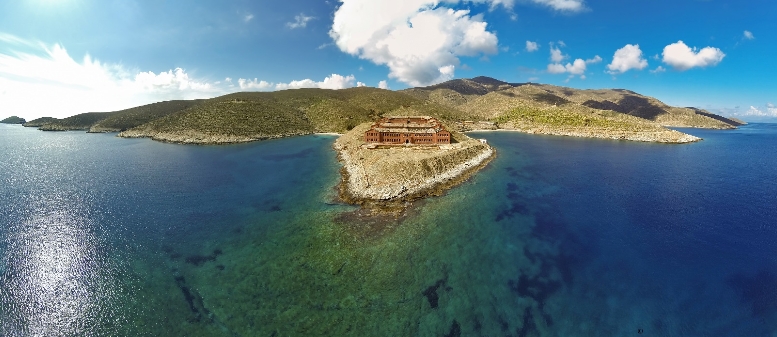
Greece has officially enacted legislation granting permanent status as a Marine Protected Area (MPA) to the uninhabited and biodiverse islet of Gyaros in the Cyclades, the Greek branch of the World Wide Fund for Nature (WWF) announced on Monday.
WWF Greece hailed the signing of the presidential decree, which took place last Thursday, as a “decisive milestone.” The decree formally establishes permanent protection zones, replacing temporary measures, and sets forth a comprehensive framework for management and conservation.
Located northwest of Syros in the central Aegean Sea, Gyaros is a critical habitat for the endangered Mediterranean monk seal, hosting one of its largest remaining populations. “This permanent framework ensures the long-term preservation of the island’s natural wealth, while simultaneously supporting the local communities of the Northern Cyclades,” WWF stated. The decree marks the conclusion of an administrative process that had been pending since 2018.
“Mediterranean monk seals nurse their young on open beaches and seabirds nest in burrows on the inaccessible rocks. Lush Posidonia meadows under the surface of the sea, where the sunlight is lost in the endless blue, and even deeper coral formations, shape underwater seascapes of unique environmental value and unparalleled beauty,” says the World Wide Fund for Nature (WWF) Hellas.
Gyaros: From concentration camp to nature reserve
Following the Civil War (1946-49), the island, which was a place of exile even in Ancient Roman times, continued the grave tradition, with 20,000 people, mostly communists and other dissidents, exiled to Gyaros. Officially, it was a kind of reformatory, where the unruly would be transformed into “real Greeks” through the use of various punishments. It was a place of forced labor and torture. Some characterized it as a concentration camp on Greek soil—the island of the devil.
Since 2013, WWF and a coalition of fifty partner organizations have conducted extensive scientific research on the islet. These efforts have led to a marked recovery of both terrestrial and marine habitats, an increase in fish stocks, and the successful conservation of rare species, including the Mediterranean monk seal and the Yelkouan shearwater seabird.
A model for conservation
A cornerstone of this success was an innovative remote surveillance system installed and operated by WWF from 2015 to 2023. The project was recognized by the European Commission as a “best practice” for marine conservation across the continent. Responsibility for the system has since been transferred to the Natural Environment and Climate Change Agency (NECCA), which manages the protected area in collaboration with the Hellenic Coast Guard.
“Gyaros proves that when we join forces around a common vision, nature protection and sustainable development become reality,” said Dimitris Karavellas, General Director of WWF Greece. The organization emphasized that Gyaros’ success serves as a blueprint for managing other protected areas across Greece, including the two recently established marine parks in the Southern Cyclades and the Ionian Sea.
See all the latest news from Greece and the world at Greekreporter.com. Contact our newsroom to report an update or send your story, photos and videos. Follow GR on Google News and subscribe here to our daily email!

