



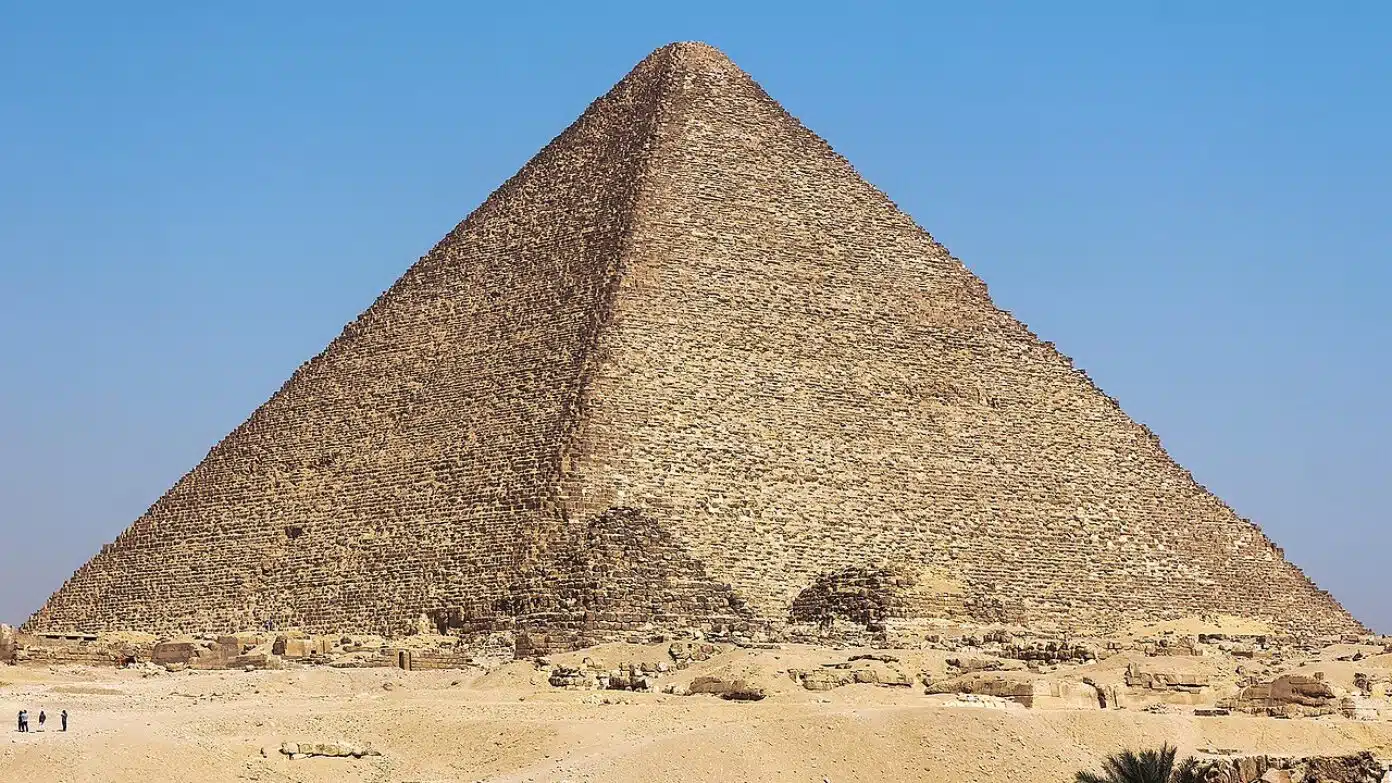
A new Great Pyramid theory is challenging long-standing ideas about how ancient Egyptians built Khufu’s monument at Giza, suggesting that workers may have used a system of temporary edge ramps built into the structure itself rather than relying on a massive external ramp.
The study says this approach could explain how the pyramid was completed within the roughly 27 years of Khufu’s reign. The research, led by Vicente Luis Rosell Roig and published in “npj heritage science,” uses computer modeling, logistics simulations, and structural analysis to test whether this ramp design could support the immense pace required to build the Great Pyramid, which contains about 2.3 million stone blocks.
Long-standing construction challenge
Khufu’s pyramid, built around 2560 BCE, originally stood about 146.6 meters (≈481 feet) tall. Completing a structure of that size within one reign would have required an extraordinary construction pace over many years. That challenge has remained one of the biggest unresolved questions in pyramid research.
The study argues that existing ramp theories each face major limitations. Straight ramps would have required enormous amounts of material and left physical traces that have not been found at Giza.
Zig-zag and side ramps could have blocked access and disrupted alignment work. Spiral ramp models also struggle to match modern scans of the pyramid’s interior.
A ramp built into the pyramid’s edges
The new model introduces what researchers call an “Integrated Edge-Ramp” system. In this concept, builders temporarily left out rows of blocks along the pyramid’s outer edge, creating an open-air, helical path that rose with the structure. Workers could haul blocks upward along this path and later fill the gaps, restoring the smooth outer surface.
Researchers say this method could solve several long-standing problems at once. It would preserve clear sightlines along the edges for accurate surveying. It would remove the need for large external ramps. It would also allow continuous access to higher levels as construction progressed.
A new Great Pyramid theory is rewriting how Khufu’s pyramid may have been built. Researchers suggest workers used hidden edge ramps within the structure itself, not massive external ramps. The model shows this method could complete the pyramid within 27 years. pic.twitter.com/P16KFaTz3g
— Tom Marvolo Riddle (@tom_riddle2025) April 15, 2026
The study tested this theory using a detailed computational framework. It combined geometric modeling, transport logistics and finite element analysis, a method used to evaluate how structures respond to stress and load. The aim was to measure whether the system could function within the limits of Old Kingdom technology.
Simulations suggest a feasible timeline
The results indicate that a single ramp would not have been efficient enough. However, an adaptive multi-ramp system could have met the required pace. In the model, workers used several ramps during the lower stages, where the pyramid base was wide, and gradually reduced the number of active ramps as the structure narrowed.
Under the study’s baseline assumptions, this phased approach could complete on-site construction within a timeframe consistent with Khufu’s reign. The model shows that adjusting ramp use at different stages helped maintain steady progress and avoid bottlenecks.
Structural tests support stability
Researchers also examined whether temporary edge channels would weaken the pyramid. Structural simulations showed that stress levels remained well below the strength limits of limestone under the tested conditions. The findings suggest the structure could remain stable even while these channels were open during construction.
The study also compared its model with modern internal scans of the pyramid. It suggests that some cavities and anomalies detected through muography may align with the proposed ramp paths. Researchers emphasize that this is not direct proof but a testable prediction.
A new direction for pyramid research
The study does not claim to settle the debate on how the Great Pyramid was built. It acknowledges limits, including assumptions about friction, labor coordination and transport conditions. Still, it offers a new explanation grounded in measurable engineering analysis.
By treating pyramid construction as a logistics and design problem, the research provides a fresh framework for testing ideas about one of history’s most famous monuments.
See all the latest news from Greece and the world at Greekreporter.com. Contact our newsroom to report an update or send your story, photos and videos. Follow GR on Google News and subscribe here to our daily email!

