



Crimea was a recurring point of tension between the Byzantine Empire and the early Russian peoples, the Rus’, during the Middle Ages. These interactions involved trade, religious diplomacy, and military conflict. By the end of the 11th century, however, the two powers had established a trade alliance that laid the foundations for Orthodox Christianity.
The Rus’ were a mix of Scandinavian, Finn, and Slavic peoples who emerged along the river routes of Eastern Europe. From the early 9th century, they began launching raids against Byzantium, spreading fear among both ordinary citizens and the empire’s rulers. One frequent target was the strategic Crimean Peninsula, which became a recurring theater of diplomatic and military engagement between the 9th and 11th centuries.
Byzantine control of Chersonesos (modern-day Sevastopol) and the surrounding Black Sea settlements made Crimea both a commercial gateway and a frontier outpost protecting Constantinople’s northern maritime routes. Tensions over trade, imperial influence, and faith often erupted into armed confrontations. Historian George Majeska describes the story of the Rus’ and Byzantium as “a tale of traders, raiders, and converts,” with Crimea at the center of every chapter.
The northern frontier of the Byzantine Empire and Crimea
Byzantium had long recognized the strategic importance of Crimea. The city of Chersonesos (or Cherson), on the southwestern tip of the peninsula, was the empire’s northernmost stronghold on the Black Sea. Majeska describes it as “a transshipment port of grain for the Byzantine capital” and, at the same time, a forward post for monitoring the steppes.
By the early 9th century, the empire had developed Chersonesos into a military province, designed to defend against Viking raids along the coast and to maintain influence over the volatile region surrounding the Dnieper River trade networks. The first recorded appearance of the Rus’ in Byzantine sources, however, was not as neighbors but as marauders. In 860, a Rus’ fleet of perhaps two hundred ships, described by Photius, Patriarch of Constantinople, as “barbarians of Scythian race,” suddenly raided the suburbs of Constantinople while Emperor Michael III was away with the army in the ongoing Arab-Byzantine Wars.
Photius’ sermons, delivered amid the panic of a besieged capital, recount how the invaders “killed many, even women and children,” until a “miracle of the Mother of God” was said to have saved the city. Though legendary in Byzantine memory, the episode revealed the vulnerability of the empire’s Black Sea flank and underscored the critical role of strongholds like Chersonesos in containing future attacks.
The 10th-century wars between the Rus’ and the Byzantine Empire
By the early 10th century, the Rus’ had organized into a structured polity—the Kievan Rus’ (or Kyivan Rus’)—controlling the Dnieper trade routes from Novgorod and Kiev to the Black Sea. Their pursuit of Byzantine markets often blended economic ambition with coercive diplomacy. The Rus’-Byzantine War of 941–944, led by Prince Igor of Kiev, exemplified this pattern. Byzantine historians report that in May 941, Igor launched a naval invasion of Asia Minor, coordinating with Pecheneg allies and taking advantage of a moment when the imperial capital was defenseless.
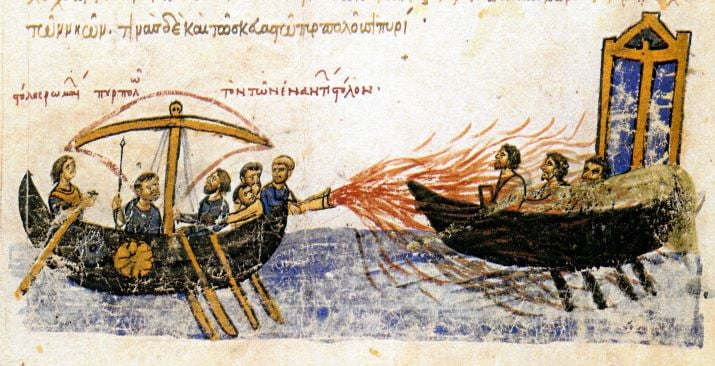
The Byzantines, however, deployed their secret weapon: the Greek fire (or sea fire), famously used in previous Arab-Byzantine Wars. Igor’s fleet was destroyed, with Liudprand of Cremona recounting that “the Rus’, seeing the flames, jumped overboard, preferring water to fire.”
Despite the defeat, diplomacy followed. A treaty in 945 restored trade privileges, demonstrating that military pressure could secure Byzantine concessions when negotiation failed. At the same time, the conflict highlighted the ongoing strategic importance of the Black Sea coast—and Crimea in particular—as a crucial base for both the Rus’ and the Byzantine Empire.
The Rus’ capture of Chersonesos and Crimea from the Byzantines
In 988–989, Prince Vladimir of Kiev captured the Byzantine city of Chersonesos. Historian Werner Seibt describes the strike as “sudden and puzzlingly aggressive…conquering the Byzantine center of Cherson in 989,” despite Vladimir’s existing alliance with Byzantine Emperor Basil II.
The capture was both a demonstration of power and a political maneuver. Byzantine sources suggest that Basil II, embroiled in a civil war against Bardas Phocas, may have accepted Vladimir’s intervention in exchange for military support and the prince’s conversion to Christianity.
Later chronicles, including the Primary Chronicle, transformed the episode into the sacred legend of the Rus’ baptism. Vladimir reportedly agreed to withdraw from Chersonesos and ally with Byzantium after marrying the emperor’s sister, Anna Porphyrogenita, becoming the first Christian ruler of the Rus’.
In this telling, Chersonesos was more than a prize of war. It became the birthplace of Rus’ Christianity. Vladimir’s palace and the Church of St. Basil, built in Chersonesos, symbolized the merging of conquest, conversion, and diplomacy. Crimea thus became the site where the Rus’ evolved from raiding neighbors into Christian partners, although the alliance would not endure indefinitely.
The final Rus’-Byzantium war
In 1043, the Rus’, under Yaroslav the Wise, launched their final recorded campaign against Byzantium. Byzantine chronicler and eyewitness Michael Psellos described it as “an impetuous raid by barbarian ships,” led by Yaroslav’s eldest son, Vladimir of Novgorod. The fleet was destroyed off the Anatolian coast—either by Greek fire, according to Psellos, or by a tempest, as the Slavonic Chronicles suggest.
The conflict, however, did not end at sea. Later accounts, including those compiled by 16th-century chronicler Maciej Stryjkowski, describe a follow-up campaign against the Crimean city of Chersonesos in 1044. “Yaroslav sent his son Vladimir to seize the Crimean emporia of the Greek empire,” Stryjkowski writes, framing the attack as retaliation for Byzantine resistance.
Archaeological and textual evidence supports this account. The Korsun Gate of Novgorod’s Saint Sophia Cathedral, adorned with Chersonesian-style crosses, is believed to have been a trophy of the campaign. Excavations in Chersonesos indicate that the city gate was replaced around 1059—possibly after being taken as spoils.
The peace that followed was diplomatic rather than absolute. Three years later, a treaty cemented reconciliation, marked by the marriage of Yaroslav’s son Vsevolod I to a Byzantine princess, daughter of Emperor Constantine IX Monomachus. Their offspring, the celebrated Vladimir Monomakh, carried his maternal grandfather’s name as a symbol of renewed alliance. Once again, Crimea served as both a crucible of conflict and a bridge of restoration between the two realms.
Rus’-Byzantium relations from the 11th century and on
The recurring battles between the Byzantine Empire and the Rus’ over Crimea highlight the region’s significance beyond mere economic value. For Byzantium, it was the empire’s northernmost bastion and a gateway to the volatile steppe. For the Rus’, Crimea symbolized access to the broader Christian world and a tangible marker of equality with Constantinople.
Historian Werner Seibt interprets the struggle as evidence that “Byzantium had learned to highly esteem the military strength of Scandinavian soldiers active there,” suggesting that imperial diplomacy increasingly relied on Varangian warriors—even those of Rus’ descent—to defend the empire’s borders. This paradox, whereby the same northern peoples both attacked and protected Byzantium, epitomized the ambivalent relationship that shaped Eastern Europe’s medieval identity.
The wars over Crimea also reflected a profound shift in Rus’-Byzantine relations: from a pagan raiding culture to a Christian polity negotiating within the Byzantine diplomatic framework. George Majeska observes that “whatever the reason for their mission, [the Rus’] could not return the way they came.” By the 11th century, that distance had narrowed considerably. Intermarriage, ecclesiastical hierarchy, and shared iconography linked Kiev, Novgorod, and Constantinople in what might be called a Byzantine Commonwealth of the North.
At the same time, these former conflicts, along with the region’s geography, laid the foundations of Eastern Christendom.
See all the latest news from Greece and the world at Greekreporter.com. Contact our newsroom to report an update or send your story, photos and videos. Follow GR on Google News and subscribe here to our daily email!

