



Pablo Picasso (October 25, 1881- April 8, 1973) was one of the most influential artists of the 20th century, whose work was influenced by Greek light, spirit, and spiritual essence.
While he never traveled to Greece, Picasso frequently cited the spirit of the Mediterranean and ancient Greece as foundational to his work. Art critic Frank Elgar has famously described him as being “more Greek than the Greeks” due to the intensity and depth of his engagement with the country’s ancient heritage.
Pablo Picasso spoke about the enduring power of ancient art, including that of Greece, and how he refused to view it as something belonging merely to the “past.”
In a notable interview from 1923 (published in The Arts by Marius de Zayas), Picasso famously said:
“To me there is no past or future in my art. If a work of art cannot live always in the present, it must not be considered at all. The art of the Greeks, of the Egyptians, of the great painters who lived in other times, is not an art of the past; perhaps it is more alive today than it ever was.”
Picasso and Greek mythology
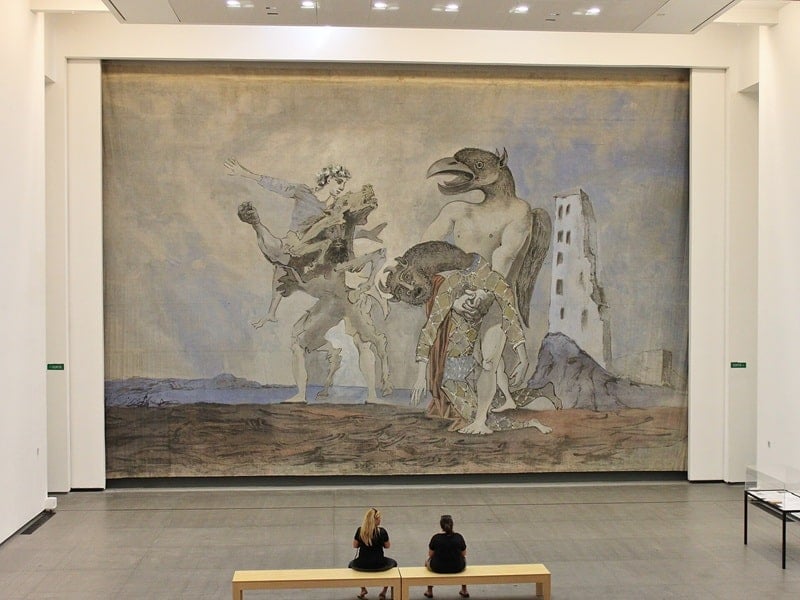
Mythology was a recurring theme in Picasso’s art, acting as a bridge between the past and his modern perspective.
Perhaps his most iconic link to Greek myth, the Minotaur became a central figure in his work, symbolizing the darker, irrational, and primal forces of human nature—particularly during the turbulent years leading up to and during World War II.
Throughout his career, he frequently depicted fauns, satyrs, centaurs, and nymphs. These figures allowed him to explore themes of fertility, joy, and the “joy of life” (la joie de vivre), especially in his later ceramics and sculptures.
“Classical” periods and style
Picasso studied ancient Greek art through plaster casts during his youth and later through his observations in major museums like the Louvre.
In the 1920s, during his “classical period,” his work explicitly drew on the forms of Greek sculpture—featuring statuesque, solid figures that reflected a desire to return to order after the initial radicalism of Cubism.
His line work, particularly in his ceramics and drawings, often echoes the clean, fluid aesthetics of Attic red-figure pottery.
The “El Greco” connection
As a young artist in Spain, Picasso was deeply influenced by the painter El Greco (Doménikos Theotokópoulos), who was born in Crete. The young Picasso frequently signed his early drawings “I, El Greco,” signaling an early, subconscious link to his Greek artistic heritage.
Greek museums have frequently curated exhibitions to highlight this connection, placing Picasso’s work in “dialogue” with actual ancient artifacts. Notable exhibitions have taken place at the Museum of Cycladic Art in Athens and the Museum of Ancient Eleutherna in Crete in 2024.
These exhibitions demonstrated how Picasso’s modern interpretation of shapes and myths aligns remarkably with the ancient Mediterranean aesthetic.
Related: Stolen Picasso and Mondrian Paintings Recovered by Greek Police
See all the latest news from Greece and the world at Greekreporter.com. Contact our newsroom to report an update or send your story, photos and videos. Follow GR on Google News and subscribe here to our daily email!

