



Ancient Greek mercenaries under military leader Xenophon clashed with fierce mountain tribes, known as the Karduchoi, the ancestors of the Kurds, who lived far beyond the reach of Persia’s great kings.
In 401 BC, an army of Ancient Greeks advanced through the heart of rugged mountains north of the Tigris River. These were not gentle hills but steep, forested heights that defied empires and resisted every invader. This encounter reshaped how Greek history portrayed the peoples of the Near East and offered a rare glimpse into one of the region’s oldest indigenous mountain cultures.
The march of the Ten Thousand
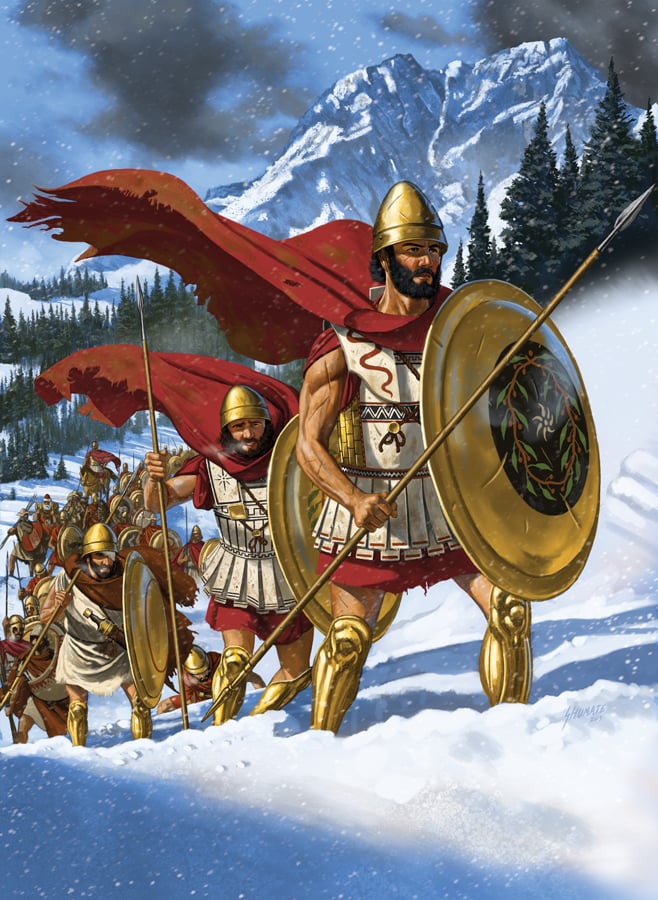
When Cyrus the Younger hired Greek mercenaries to seize the Persian throne, he sent an army of hoplites, peltasts, and light infantry deep into foreign lands. After Cyrus fell at Cunaxa, these troops, later known as the Ten Thousand, were forced to march back to Greece through hostile territory. Their remarkable journey is recorded in Xenophon’s Anabasis, a firsthand account of an extraordinary retreat.
The Ancient Greeks expected battles with Persian garrisons and tribal levies. What they did not anticipate was the sustained resistance of the Karduchoi, the ancestors of the Kurds. Xenophon describes them as a warlike people living in mountains “not subject to the king” of Persia. They avoided large formations that could face Greek hoplites in open combat, instead relying on longbows, slings, and intimate knowledge of the terrain.
For seven days, the Greeks struggled through narrow passes and rocky valleys. Archers hidden on the heights fired relentlessly, while boulders and stones thundered down from cliffs. Even these well-trained mercenaries were repeatedly outmaneuvered by defenders of their homeland. At times, Xenophon admitted that this mountain warfare inflicted more suffering than any previous battle in their campaign.
The courage and skill of these mountain fighters left a profound impression on the Ancient Greeks. Despite lacking heavy armor or formal cavalry, they held their ground against professional soldiers from the Mediterranean world. They were far more than the “barbarians” some Greek writers might have suggested. They were a distinct culture, shaped by rugged terrain, self-sufficient villages, and an unyielding determination to resist domination.
The land of the Karduchoi
Modern scholars such as Dr. Michael M. Gunter place the land of the Karduchoi in the mountains south of Lake Van, north of the Tigris in what is now southeastern Turkey. Ancient sources, including the geographer Strabo, often refer to the region as Gordyene or Corduene, fertile highlands situated between the great empires of the Near East.
Many historians, including George Rawlinson, link these ancient mountain tribes encountered by the Ancient Greeks with the peoples who later became known as Kurds. He equated Corduene and the Karduchoi with proto-Kurdish populations, citing the striking geographic continuity and the evolution of regional names. Terms like “Karduchoi,” “Corduene,” and later medieval forms such as Beth Qardu appear repeatedly across centuries, all referring to peoples inhabiting the same rugged heartland.
Not all scholars, however, accept a direct, unbroken line from the Karduchoi to modern Kurds. The Cambridge History of the Kurds suggests that groups like the Kurtioi and Cyrtii may be closer to the origins of Kurdish identity. Linguistic and ethnographic debates continue, and modern Kurdish identity emerged over millennia through the complex interaction of peoples, languages, and empires.
Still, the geographical overlap between the lands of the Karduchoi and historic Kurdistan is striking. These highlands occupy the same axial zone, stretching from present-day southeastern Turkey through northeastern Iraq and into western Iran, where Kurdish cultures have persisted for thousands of years.
Life in the mountain Highlands
Xenophon’s account provides vivid insight into the everyday life of these hill peoples. He notes that they lived in villages stocked with abundant corn, aged wines, and bronze vessels and utensils—evidence of settled agricultural life rather than nomadic wandering. Their skill with bows and slings was far from primitive, carefully honed to exploit the defensive advantages of their rugged terrain.
In the pages of the Anabasis, Xenophon recounts a gripping, almost cinematic struggle as the Ancient Greeks ascended into the highlands of the Karduchoi. From the outset, the landscape itself became a weapon. As the Greeks strained upward along narrow ridges and broken paths, the Karduchoi hurled boulders and stones from above, shattering formations and forcing the soldiers to advance under relentless danger.
Xenophon emphasizes not only the peril but also the determination of his men. Despite the continuous barrage, they pressed onward, timing their charges to close the distance with their attackers. At critical moments, they surged up the very slopes from which rocks were falling, reaching their opponents while the mountain itself seemed to fight them.
What began as a defensive rain of missiles often transformed into close combat on steep and unforgiving ground. The immediacy of Xenophon’s narrative brings this struggle to life: the exhaustion of climbing under fire, the thunder of tumbling boulders, and the sudden reversals in which attackers became defenders make this episode both harrowing and unforgettable.
Legacy and historical continuity
Through Xenophon, we see that some communities in the Zagros and surrounding highlands existed at the margins of great imperial ambitions. These societies occupied regions that offered both strategic advantage and cultural independence. Whether under Achaemenid, Seleucid, Roman, or later Islamic rule, they maintained a distinct identity, largely thanks to the natural defenses of their rugged homeland.
The story of the Ancient Greeks and the tribes many associate with the Kurds in the Karduchoi mountains is more than a footnote in military history. It illustrates how Greek consciousness came face-to-face with the deep historical roots of highland cultures—societies that would continue to shape the region’s identity for millennia. The Ten Thousand’s arduous march through these mountains stands as an early and vivid encounter between Mediterranean civilization and the resilient, self-governing peoples of the Zagros and its foothills.
Ultimately, the encounter between Xenophon’s Greeks and the Karduchoi provides a lens into how history remembers indigenous mountain peoples. The narrative underscores the continuity of mountain societies in resisting empires and shaping their own destinies.
The Greek retreat through these mountains endures not only as a testament to the tenacity of soldiers far from home but also as a tribute to the enduring spirit of the highland peoples they confronted—the ancestors of the Kurds.
See all the latest news from Greece and the world at Greekreporter.com. Contact our newsroom to report an update or send your story, photos and videos. Follow GR on Google News and subscribe here to our daily email!

