



Captain Corelli’s Mandolin, a famous 1994 novel by Louis de Bernières and a 2001 film adaptation starring Nicolas Cage and Penélope Cruz, brought to international attention the massacre of Italian soldiers on the Greek island of Kefalonia during WWII.
Thousands of Italian soldiers from the Acqui Division were killed by their former German allies in September 1943—a brutal reprisal that claimed close to 9,500 lives in battle, execution, and at sea.
The massacre of the Acqui Division on Kefalonia
The soldiers belonged to the Italian 33rd Infantry Division, which had been garrisoned on the Greek island of Kefalonia since the Axis occupation of Greece. It consisted of about 11,500 soldiers and 525 officers. The armistice signed by Italy with the Allies on September 8, 1943 (Armistice of Cassibile), instantly transformed the former German allies into bitter enemies. The German forces demanded that the Italian troops surrender their weapons.
The commander of the Acqui Division, General Antonio Gandin, found himself in an extremely difficult position, as he was receiving conflicting orders. Ultimately, he put the decision to his troops, who overwhelmingly chose to resist the German demand for disarmament. Fighting began around September 13, 1943. Although the Italians initially mounted a determined resistance, German forces, including the elite Gebirgs Division (1st Mountain Division), supported by decisive air power from the Luftwaffe, gradually gained the upper hand. As the Italian forces ran out of ammunition, their resistance collapsed, and they ultimately surrendered around September 22, 1943
Following the surrender, the German forces, acting on a direct order from the German High Command (and possibly an order from Adolf Hitler himself) to treat any Italians resisting German disarmament as “traitors” and “not prisoners of war,” began mass executions. Estimates of the dead vary, but a commonly cited figure is that 5,155 prisoners of war were executed, in addition to about 1,315 who died during the battle itself. General Gandin was among the executed officers.
Novel and film make the massacre widely known
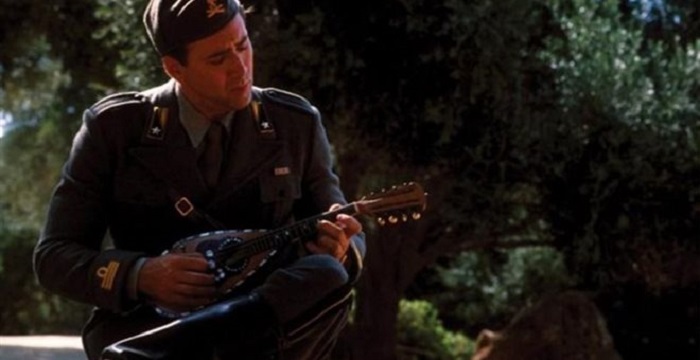
De Bernières, a British author, was captivated by the island’s charm and its complex wartime history. He wove a vibrant tapestry of life, love, and loss, centered around the fiery Greek doctor’s daughter Pelagia, her fisherman fiancé Mandras, and the charismatic Italian Captain Antonio Corelli. Corelli, an opera-loving officer whose mandolin provided a counterpoint to the escalating tensions, embodied the Italian soldiers’ presence on the island—initially seen as occupiers, but often finding common ground and even friendship with the locals.
The novel builds slowly, painting a picture of an almost surreal coexistence under Axis occupation, with Italian soldiers often preferring singing and romance to strict military discipline. This gentle facade, however, was shattered by the stark historical reality of September 1943. When Italy signed an armistice with the Allies, the Germans, incensed by what they saw as betrayal, demanded the disarmament of their former comrades. The Italian Acqui Division, against overwhelming odds, voted to resist.
De Bernières’ depiction of the ensuing battle is swift and devastating. However, it is the aftermath, the brutal, systematic execution of thousands of Italian soldiers by their German counterparts, that serves as the novel’s harrowing heart.
The author spares no detail in describing the scenes of mass murder, bringing to vivid, agonizing life the senseless slaughter of men who, just days prior, had shared trenches and rations with their executioners. The sheer scale and barbarity of the event, during which Italian officers and soldiers were machine-gunned in cold blood, became impossible to ignore for readers worldwide.

Horror on Kefalonia
“It was through the novel that many of us, even in Italy, first truly grasped the horror of what happened here,” remarked Maria Rossi, an Italian historian specializing in WWII. “De Bernières didn’t just tell a story; he shone a spotlight on a hidden wound.”
The book became a global bestseller, earning critical acclaim and a devoted readership. Its success laid the groundwork for the equally influential 2001 film adaptation, starring Nicolas Cage as Captain Corelli and Penélope Cruz as Pelagia.
The film, shot on location on Kefalonia, brought the island’s breathtaking beauty and the tragedy of its past to an even wider audience. While the romance between Corelli and Pelagia captivated audiences, the film did not shy away from the brutality of the massacre. The visual impact of hundreds of Italian soldiers being marched to their deaths and executed on screen was profoundly moving and shocking for many who were completely unaware of the historical event.
The combined power of the novel and the film proved transformative. Before Captain Corelli’s Mandolin, mentions of the Acqui Division massacre were largely confined to academic circles or specific military histories. Afterwards, the event entered the mainstream global consciousness.
See all the latest news from Greece and the world at Greekreporter.com. Contact our newsroom to report an update or send your story, photos and videos. Follow GR on Google News and subscribe here to our daily email!

