



A one-day strike could cost Europe’s economies billions of euros in lost economic output, with Germany facing the largest estimated loss and Greece’s figure reaching €137 million ($154 million), according to a comparison based on 2025 economic data.
The calculation assumes that one in five workers stops working for a day, reducing the amount of goods and services produced across each country.
Germany tops the comparison, with an estimated loss of €2.482 billion ($2.783 billion). France follows at €1.639 billion ($1.838 billion), while Italy could lose €1.241 billion ($1.392 billion). Spain’s estimated loss stands at €926 million ($1.038 billion). Greece ranks 19th among the 38 countries when ranked from the highest estimated loss.
The comparison comes as Spanish workers take part in a 24-hour general strike on Wednesday, Nov. 11. The country’s two largest trade unions, CCOO and UGT, have called the action over rising housing costs, wages and public services. It is their first joint nationwide general strike since 2012.
How a strike could cost Europe’s economies, including Greece
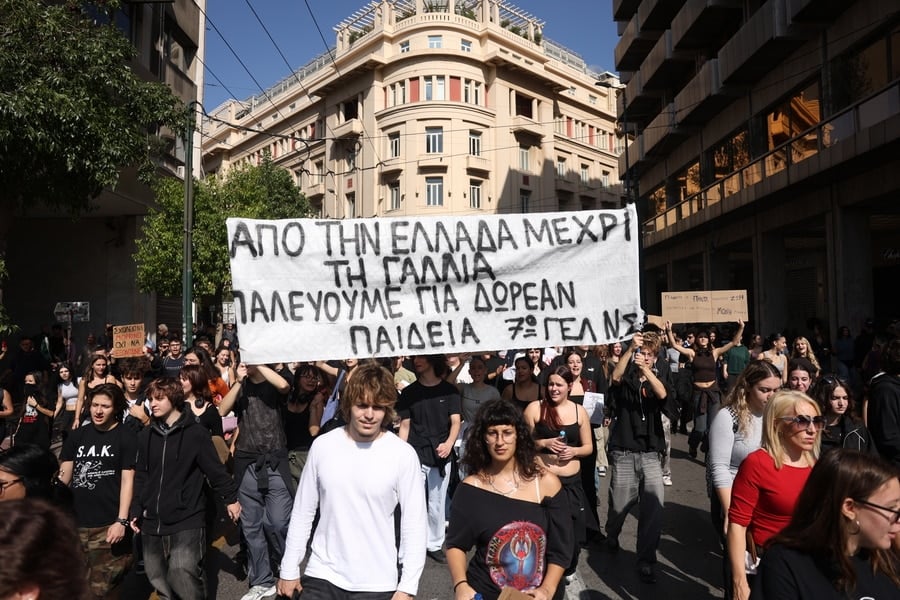
Greece has also seen several strikes and demonstrations over wages, working conditions and the cost of living. On Oct. 21, around 10,000 people, including teachers, school pupils and university students, marched in Athens.
Similar demonstrations took place in other Greek cities, calling for better public education, higher teacher salaries, improved school buildings and more affordable student housing. Teachers held a 24-hour strike, while work stoppages by some doctors also affected schools and hospitals.
The country saw another nationwide transport strike on Nov. 3, when workers at urban and intercity KTEL bus services stopped working for 24 hours. They demanded higher wages, a new collective labour agreement and permanent recruitment. Their federation said workers’ salaries had remained unchanged for 17 years.
Greece is also preparing for further industrial action. The public-sector union ADEDY has called a nationwide 24-hour strike for Nov. 25, seeking higher salaries, more permanent public-sector jobs, the restoration of the 13th and 14th salary payments and measures to address rising living and housing costs.
For further background on Greece’s labour disputes, the European Union agency Eurofound provides an overview of industrial action, strike statistics and the country’s labour relations framework.
Why some strike-related losses can be recovered while others remain
France provides an example of how an economy can recover from industrial action. The Banque de France estimated that pension reform strikes in March and April 2023 reduced economic growth by around 0.1 percentage points in the first quarter. However, activity picked up by a similar amount in the following quarter, suggesting that much of the lost production returned within three months.

The country’s statistics office, INSEE, also estimated that social protests in spring 2018 reduced GDP by around 0.1 percentage points.
Some losses are harder to recover. Workers who participate in a strike can lose a day’s wages, while governments miss tax revenue from economic activity that never takes place. Airlines cannot recover a cancelled flight, and hotels cannot sell rooms that remained empty.
Belgium illustrates another problem: repeated strikes. The country lost 1,354,845 working days to strikes in 2025, equal to 313 days for every 1,000 employees. This exceeded its previous record of 299 days per 1,000 employees, set in 1993.
The Netherlands recorded almost 60,000 working days lost across 23 strikes in 2025. Germany, meanwhile, lost around 645,000 working days, according to estimates from the Institute of Economic and Social Research. These figures show why frequent industrial action can have a more lasting effect than a single day of disruption.
How much each European country could lose in a one-day strike
The estimated cost of a one-day strike varies considerably across Europe’s economies, with Greece facing a smaller financial impact than countries such as Germany, France and Italy.
38. Montenegro: €5 million ($5.6 million)
37. Kosovo: €6 million ($6.7 million)
36. Moldova: €10 million ($11.2 million)
35. North Macedonia: €10 million ($11.2 million)
34. Malta: €14 million ($15.7 million)
33. Albania: €15 million ($16.8 million)
32. Bosnia and Herzegovina: €16 million ($17.9 million)
31. Iceland: €19 million ($21.3 million)
30. Cyprus: €21 million ($23.5 million)
29. Estonia: €23 million ($25.8 million)
28. Latvia: €24 million ($26.9 million)
27. Slovenia: €39 million ($43.7 million)
26. Lithuania: €47 million ($52.7 million)
25. Serbia: €49 million ($54.9 million)
24. Luxembourg: €50 million ($56.1 million)
23. Croatia: €52 million ($58.3 million)
22. Bulgaria: €64 million ($71.8 million)
21. Slovakia: €76 million ($85.2 million)
20. Hungary: €120 million ($134.6 million)
19. Greece: €137 million ($153.6 million)
18. Finland: €154 million ($172.7 million)
17. Portugal: €169 million ($189.5 million)
16. Czechia: €190 million ($213.1 million)
15. Romania: €210 million ($235.5 million)
14. Denmark: €229 million ($256.8 million)
13. Norway: €258 million ($289.3 million)
12. Austria: €284 million ($318.5 million)
11. Sweden: €329 million ($368.9 million)
10. Ireland: €330 million ($370.1 million)
09. Belgium: €351 million ($393.6 million)
08. Poland: €506 million ($567.4 million)
07. Switzerland: €507 million ($568.5 million)
06. Netherlands: €641 million ($718.8 million)
05. Turkey: €773 million ($866.8 million)
04. Spain: €926 million ($1.038 billion)
03. Italy: €1.241 billion ($1.392 billion)
02. France: €1.639 billion ($1.838 billion)
01. Germany: €2.482 billion ($2.783 billion)
See all the latest news from Greece and the world at Greekreporter.com. Contact our newsroom to report an update or send your story, photos and videos. Follow GR on Google News and subscribe here to our daily email!

