



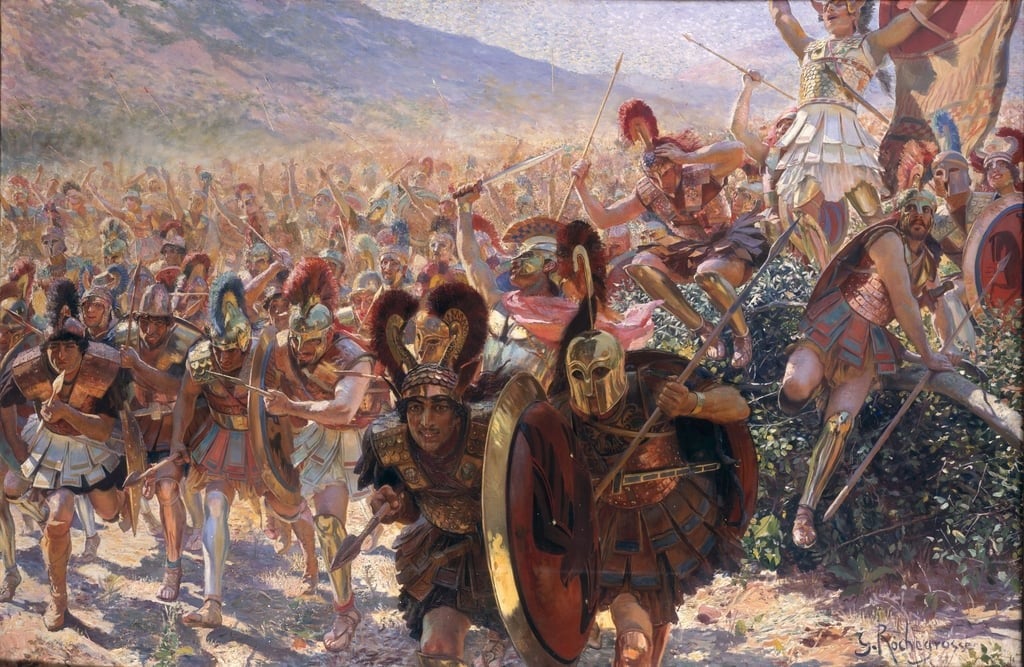
Everyone knows the story—or thinks they do: Athens’ soldiers at Marathon faced down the Persian Empire on a dusty plain by the Aegean Sea. The Greeks won; the world changed.
It’s a story that would go down in history and become a tale of legends, but real life is messier than that. Victory, as Athens learned, doesn’t silence fear. Sometimes it only gives it a louder voice, and this is exactly what happened to Athens after this epic win.
What happened to Athens after the cheers faded at Marathon?
When the survivors of Marathon marched back into Athens, people cheered and wept, relieved to be free from the shadow of total annihilation. The authorities and ordinary Athenians embraced them like gods. Yet beneath all that immense pride ran a quiet current of unease.
The Persians had been defeated, yes, but they were far from gone. Everyone knew they would return. At first, nobody spoke of it openly, but it was nearly common knowledge that the danger had not passed, and while the dead were still being buried, whispers began to spread.
Someone had seen a flash—perhaps a light on Mount Pentelikon, blinking toward the Persian fleet—a signal, a betrayal maybe. Something. Rumors took hold. Was it real? Perhaps not. What mattered was that people believed it could be real. This reveals much about the state of Athens and the traumatized subconscious of its citizens—a city that had just fought for its life and suddenly doubted its own eyes.
That doubt was not unfounded. Athens was proud of its democracy, however young and incomplete, but the old aristocrats still held considerable political and societal influence. Some harbored ties, sympathies, or ambitions. Marathon was a military triumph, but, politically, it cracked something open, marking the start of a new chapter in the Athenian story.
When the soldiers raced back from the battlefield to defend an undefended city, hearts pounding at the sight of potential Persian ships on the horizon, that panic stayed with them forever. The Persians never returned, but the fear never left Athens, shaping the temperament and beliefs of an entire generation.
How this subconscious fear turned into fire
Out of that fear came resolve. The Athenians refused to wait for another invasion. They built ships—hundreds of them. Sleek, fast triremes sliced through the Aegean and beyond into the broader Mediterranean. What began as defense, a response to collective trauma, quickly turned into dominance.
You can almost trace the line: from the fear at Marathon to the glittering confidence of the Parthenon. The city began to see itself not just as Athens but as Athens the protector of Greece, the champion of freedom, and the center of civilization itself. Initial fear became action, and that action became power.
It sounds noble—and for a time, it was, but there is a thin line between pride and power. The Athenians, convinced they were fighting for liberty, began using the same tactics of intimidation to control others. The fear that had once united them now justified an empire, with all the cruelty that entails.
What Athens truly feared, after all, wasn’t Persia, but itself: division, arrogance, forgetting who they were. As the city grew richer and stronger, cracks appeared across every aspect of Athenian life. The democracy that Marathon had seemed to protect was later tested to its breaking point in the Peloponnesian War.
This is why Marathon was a tipping point for Athens—and for Greece as a whole. It shaped what came after. When the cheering stopped and the heroes returned home, the city began to reckon with the true cost of its victory.
Athens defeated Persia, but it also defeated the version of itself that might have surrendered. By keeping that spirit alive and holding onto what made the city worth defending, Athens became the Athens we now know.
See all the latest news from Greece and the world at Greekreporter.com. Contact our newsroom to report an update or send your story, photos and videos. Follow GR on Google News and subscribe here to our daily email!

