



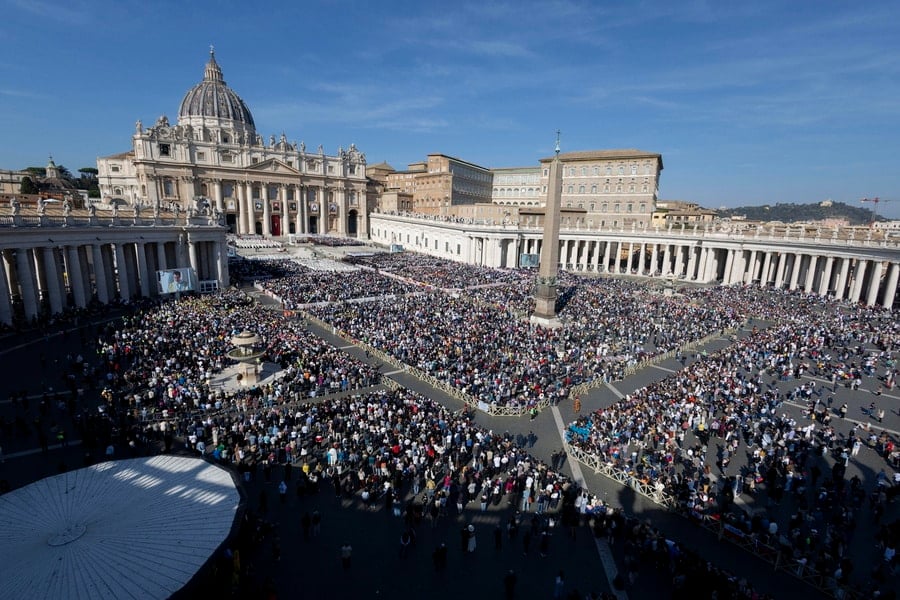
Under clear autumn skies at St. Peter’s Square on October 19, 2025, Pope Leo XIV canonized Saint Ignatius Choukrallah Maloyan, the Armenian bishop executed during the 1915 persecution of Christians in the Ottoman Empire. The ceremony, attended by tens of thousands of pilgrims, fulfilled the decree of canonization previously approved by the late Pope Francis.
Ignatius Maloyan was one of seven new saints proclaimed by the Vatican that day—along with Peter To Rot, Vincenza Maria Poloni, Maria del Monte Carmelo Rendiles Martínez, Maria Troncatti, José Gregorio Hernández Cisneros, and Bartolo Longo—each bearing a story of faith that transcends geography, culture, and time.
Armenian Bishop Ignatius Maloyan: From the Monastery of Bzommar to the Cross of Mardin

Born Shukrallah Melkon in Mardin in 1869, Maloyan entered the Armenian Catholic Monastery of Bzommar in Lebanon at just fourteen years old. There, he immersed himself in theology, philosophy, and languages, mastering Armenian, Arabic, Turkish, French, and Italian. Ordained in 1896 and adopting the name Ignatius, he went on to serve in Egypt and Constantinople before being consecrated Bishop of Mardin in 1911.
His pastoral leadership coincided with the unfolding of the Metz Yeghern, or Great Evil, the systematic persecution and deportation of Armenians and other Christians in the Ottoman Empire during the First World War. Despite the rising threat, Maloyan refused to abandon his people, choosing to remain in Mardin to care for his community.
Tortured, deported, martyred
By the spring of 1915, Maloyan foresaw the disaster approaching his city. He gathered his priests and delivered a spiritual testament, urging them to remain steadfast even if death awaited them. Soon after, agents of the ruling Committee of Union and Progress (CUP) accused the bishop of hiding weapons—a fabricated pretext to eliminate the region’s Christian leadership.
On June 3, 1915, he was arrested, interrogated, and subjected to brutal torture. Survivors later testified he was beaten and mutilated yet refused every offer to renounce his faith. When allowed a final farewell, he asked his mother to bring him shoes two sizes larger—not for comfort but to conceal the wounds on his feet caused by repeated beatings.
A week later, on June 11, 1915, Maloyan and more than four hundred Armenians and Syriacs, including priests and nuns, were forced onto a convoy toward Diyarbakir. Along the way, he continued to pray and console those beside him. That same day, he was executed by an Ottoman officer. He was 46 years old.
The Great Evil and the triumph of virtue
Between 1894 and 1923, as many as two million Armenians, Syriacs, and Greeks perished. Yet their nations endured and rebuilt—many survivors finding refuge in Lebanon, Syria, Iraq, Egypt, and even parts of Arabia, where compassion outweighed politics.
Historians have often described the tragedy as a failure of the great powers—nations that chose expedience over humanity. Maloyan, however, understood that power and justice rarely coexist in the realm of politics. He refused to betray his conscience or the faith of his people. In a world torn by violence, he chose fidelity over fear.
Like countless martyrs before him, Maloyan’s resistance revealed that moral strength can defeat cruelty. The persecutors sought to silence him, yet his silence resounded louder than their threats. His death became a testimony that evil, no matter how forceful, eventually collapses under the weight of truth.

Ignatius Maloyan’s martyrdom and sainthood
Pope John Paul II beatified Ignatius Maloyan in 2001, recognizing his sacrifice as martyrdom “in hatred of the faith.” His canonization by Pope Leo XIV enshrines him among the saints of the universal Church—a shepherd who stood firm as his people faced annihilation and who died proclaiming faith in the face of brutality.
At the Thanksgiving Mass following the canonization at the Vatican, the Armenian Catholic Patriarch described Saint Ignatius as “a light that did not go out, even when the darkness fell upon a nation.” Pilgrims from Armenia, Lebanon, and across the world gathered in prayer, honoring a man whose courage transformed suffering into witness.
Enduring legacy of faith of Ignatius Maloyan, declared a saint by the Vatican
Today, Saint Ignatius Maloyan stands as a symbol of resistance to tyranny and fidelity to faith. His canonization offers not only a moment of pride for Armenians but also a universal call to conscience in an age still scarred by persecution.
As Pope Leo XIV declared during the canonization Mass:
“Where hatred sought to silence love, love endured—and love is eternal.”
Through his unshakable faith and moral courage, Ignatius Maloyan proved that even in the face of unspeakable evil, the human spirit, illuminated by grace, remains unconquerable.
See all the latest news from Greece and the world at Greekreporter.com. Contact our newsroom to report an update or send your story, photos and videos. Follow GR on Google News and subscribe here to our daily email!

