



Several of the most influential Greek philosophers and thinkers are portrayed in Raphael’s masterpiece the School of Athens, which adorns the Apostolic Palace in the Vatican.
Painted between 1509 and 1511, it portrays a congregation of philosophers, mathematicians, and scientists from Ancient Greece, including Plato and Aristotle. But did you know that, in addition to the two philosophers in the center of the painting, there are six more “hiding”?
In his work, Raphael desired to pay his deepest tribute to the greatest philosophers in history, several of whom had tried throughout their lives to discover the prime mover, or cause, in the universe, a branch of thought known as the “knowledge of the first causes.”
It also shows sculptures of the Greek gods Athena, portrayed as the Roman goddess Minerva, representing Wisdom, and Apollo, representing Light and Music, in a direct nod to the greatness of Greek mythology and its contributions to the Western world. In short, Raphael’s painting is the Who’s Who of ancient Greek culture.
Who are the ancient Greek philosophers in Raphael’s painting?
Plato and Aristotle
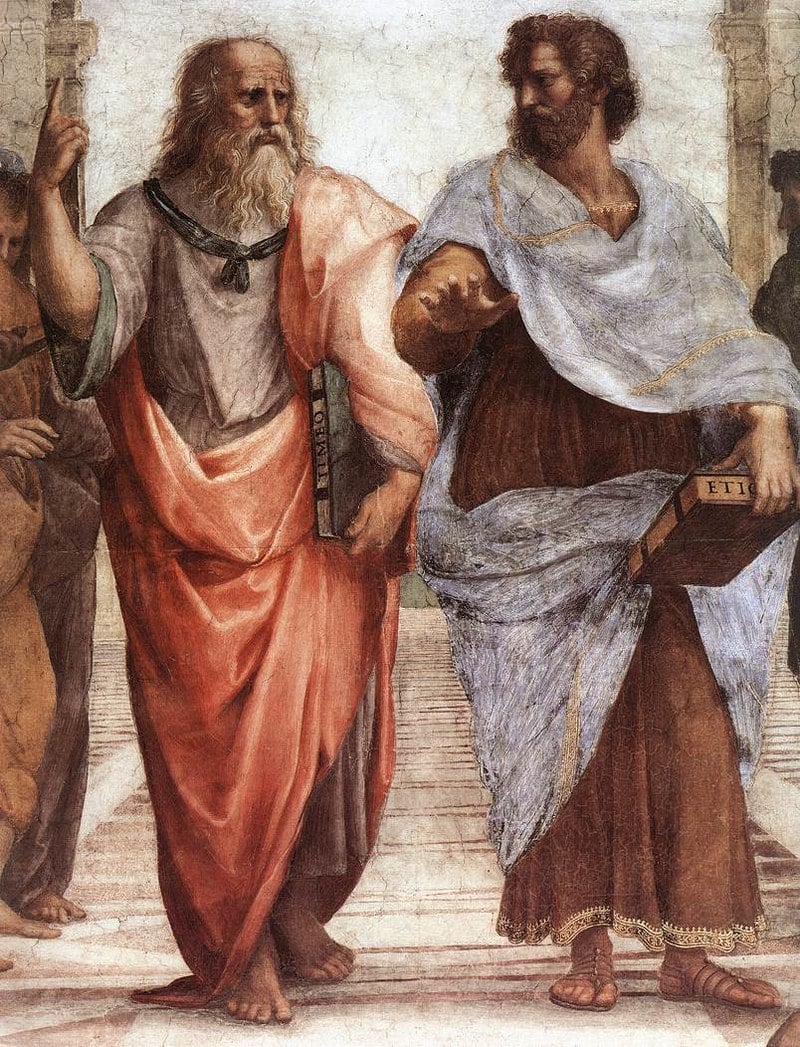
The two main figures in the work are placed directly under the archway and in the fresco’s vanishing point, a compositional trick meant to draw the viewer’s eye to the most important part of the painting. Here, we see two men who effectively represent the different schools of philosophy—Plato and Aristotle.
An elderly Plato stands on the left, pointing his finger to the sky. Beside him is his student, Aristotle. In a display of superb foreshortening, Aristotle reaches his right arm directly out toward the viewer. Each man holds a copy of their books in their left hand—Timaeus for Plato and Nicomachean Ethics for Aristotle.
Socrates, the founder of Western philosophy
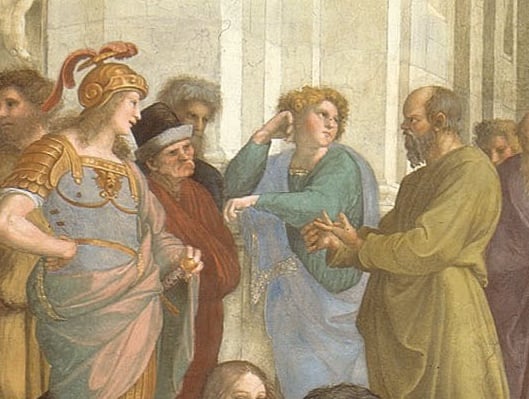
To the left of Plato, Socrates is recognizable thanks to his distinct features. It is said that Raphael was able to use an ancient portrait bust of the philosopher as his guide.
Among the crowd surrounding Socrates are his students, including the general Alcibiades and Aeschines of Sphettus.
Socrates is credited as the founder of Western philosophy and was among the first moral philosophers of the ethical tradition of thought.
Pythagoras, the theorist of metempsychosis
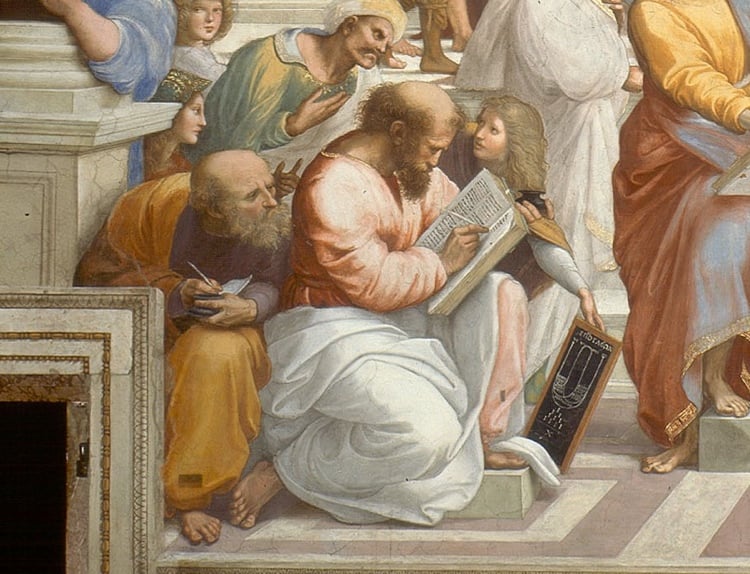
In the foreground, Pythagoras sits with a book and an inkwell, also surrounded by students.
The influence of Pythagoras in mathematics and philosophy remains indisputable to this day. His philosophy influenced both Plato and Aristotle, and through them, his ideas became fundamental to Western philosophy.
The teaching most securely identified with Pythagoras is metempsychosis, or the “transmigration of souls,” which holds that every soul is immortal and, upon death, enters into a new body.
Euclid, the father of geometry
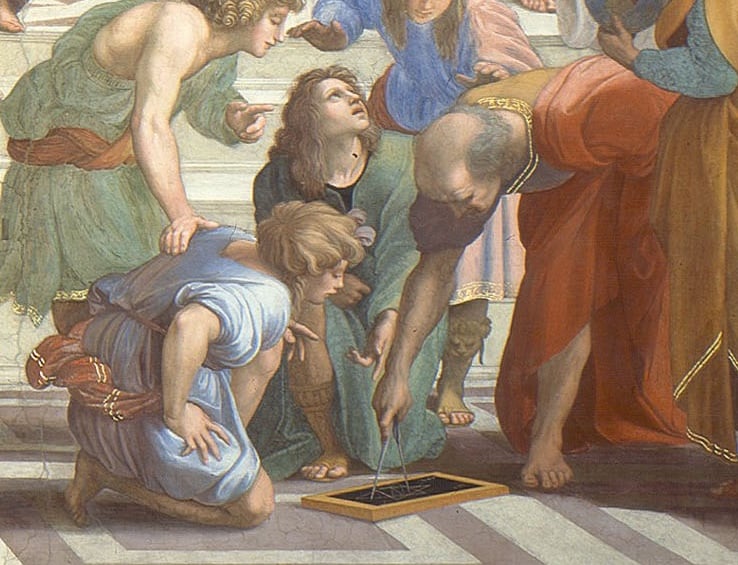
Mirroring Pythagoras’ position on the other side, Euclid, considered the “father of geometry,” is bent over demonstrating something with a compass. His young students eagerly try to grasp the lessons he’s teaching them.
Euclid is chiefly known for the Elements treatise, which established the foundations of geometry that largely dominated the field until the early 19th century.
Ptolemy, the great mathematician and astronomer
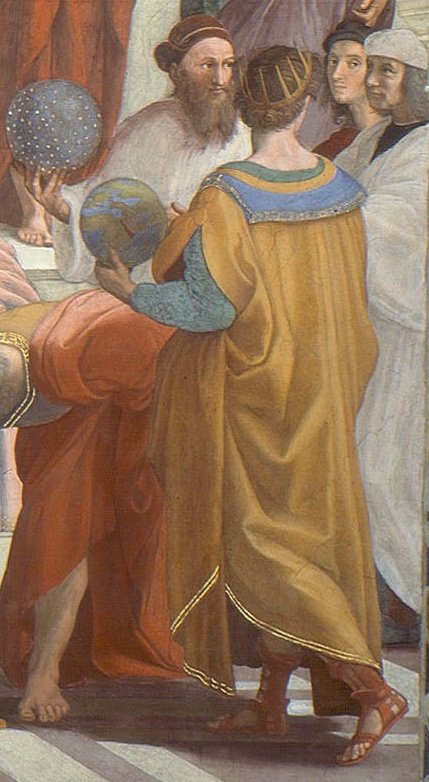
The great mathematician and astronomer Ptolemy is right next to Euclid, with his back to the viewer. Wearing a yellow robe, he holds a terrestrial globe in his hand. It is believed that the bearded man standing in front of him holding a celestial globe is the astronomer Zoroaster.
Ptolemy wrote about a dozen scientific treatises, some of which were of importance to later Byzantine, Islamic, and Western European science.
Diogenes: The ancient Greek philosopher of cynicism
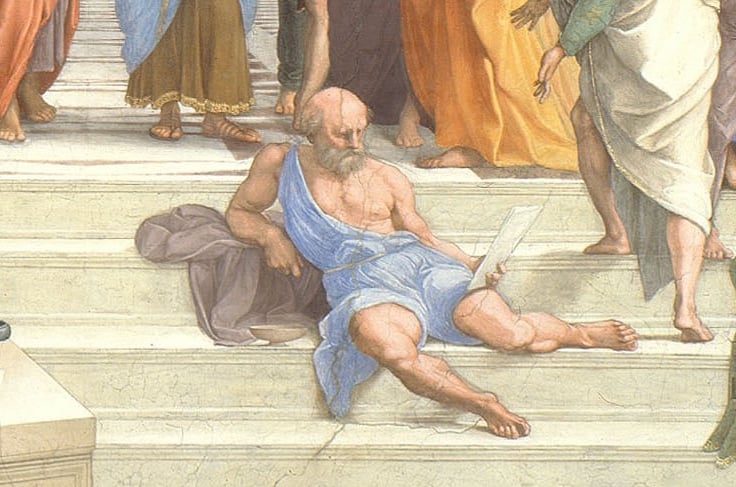
Diogenes was the founder of the philosophy of Cynicism and was a controversial figure in his day, living a simple life and criticizing cultural conventions.
Diogenes the Cynic (also known as Diogenes of Sinope) could have been the first anarchist, absurdist, satirist, or naturalist—depending on the reader’s point of view. By today’s standards, Diogenes was a homeless man by choice, and his life goal was the search for wisdom.
Heraclitus: The Greek philosopher of wisdom
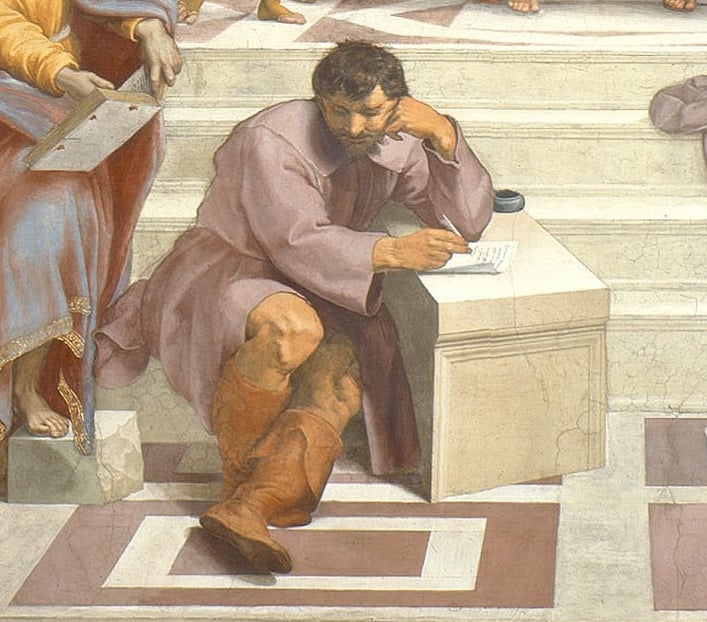
Heraclitus was an ancient Greek pre-Socratic philosopher from the city of Ephesus, then part of the Persian Empire. He saw the world as constantly in flux, changing as it remained the same, and expressed this in saying, “No man ever steps in the same river twice.”
He was a self-taught pioneer of wisdom and a melancholy character who did not enjoy the company of others, making him one of the few isolated characters in the fresco.
See all the latest news from Greece and the world at Greekreporter.com. Contact our newsroom to report an update or send your story, photos and videos. Follow GR on Google News and subscribe here to our daily email!

