



A small ancient vase exhibited at the National Archaeological Museum in Athens offers rare insight on little known cultic rituals of the Greek mythological god Poseidon in classical antiquity.
Best known as the almighty god of the sea, Poseidon was also worshipped as “Hippios” (“of the horses”) at the sacred place of Hippios Kolonos, jointly with Athena Hippia, seen as the patron deities of the Athenian cavalry and of the horses which belonged to the aristocratic class.
Other than the sanctuary of the god at Sounion, overlooking the Aegean sea, and his cult in the Erechtheion, on the Acropolis of Athens, the sacred place of Poseidon at Hippios Kolonos was the location where various historical events took place and cults and myths coexisted.
The black-figure illustrated vase that bears witness to this less-known worship of Poseidon is a tripod construction and was excavated at Tanagra by acclaimed Greek archaeologist Panagiotis Stamatakis in 1881.
Poseidon cult rituals depicted on tripod vase
The tripod vase, classified under the pyxis type of ancient Greek vases, features three different illstrated scenes -one on each leg- which are believed to be associated with the cult of Poseidon at Hippios Kolonos in Athens.
Dated between 550-540 BCE, it is a small container with lid, which was used for keeping ointments and medicines or for storing jewellery and cosmetics. This type of vase first appeared in Corinth and was adopted in Attica during the first quarter of the 6th century BCE before it went out of fashion in the early 5th century BCE.
The first scene of the tripod depicts a bearded Poseidon seated on a stool with a trident in his left hand, two naked youths and two bearded men dressed in himation garments standing on either side of the god.
The second scene shows a hoplites duel, believed to be inspired by the epic fight between Achilles and Memnon over the body of Antilochos, or that of Achilles with Hector over Patroclo’s body, from Homer’s Illiad.
Last, on the third leg, a naked youth with short hair is depicted leading a horse by its reins. On either side of this figure are seated bearded figures wrapped in long himatia garments.
Poseidon’s association to cavalry and chariot races
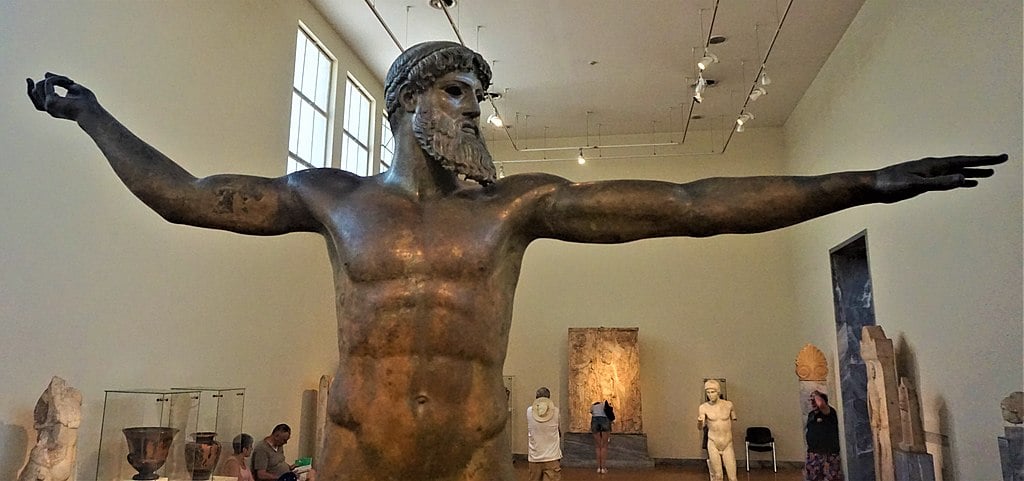
The scenes “must be associated with a particular sanctuary or festival of the god in Attica, even though there are no elements in the depiction that could reveal the exact location of the shrine or the character of the god,” according to a note by Dr Evangelos Vivliodetis.
An important aspect of military life in Athens was connected to the worship of the god at Hippios Kolonos, which fits the illustration theme of the vase.
Sources indicate that chariot races were held in honour of Poseidon in different parts of Greece to celebrate the god as the inventor of cavalry, horse tamer but also guarantor of political order.
Moreover, the Sacred Grove of Poseidon was the location where the suitability test of horses and chariots before a race, in a ritual to gain the favour and the refinement of the god.
The tripod vase can be viewed on the first floor of the National Archaeological Museum in Athens, exhibited among the vast Vases Collection.
See all the latest news from Greece and the world at Greekreporter.com. Contact our newsroom to report an update or send your story, photos and videos. Follow GR on Google News and subscribe here to our daily email!

