



The earthquakes that have been rocking the picturesque Greek island of Santorini have been gradually calming down a month after they began, Greek scientists monitoring the phenomenon said Monday.
The undersea rocks -sometimes only minutes apart- have led thousands of local resident to flee Santorini, one of Greece’s most popular tourist destinations, as well as the nearby islands of Amorgos, Ios and Anafi.
While schools in those islands remain closed for a fourth week and several other restrictions remain in effect, scientists said they are encouraged by the decline of the earthquake swarm.
“Seismic activity continues to show a gradual decline, both in terms of the daily number of recorded earthquakes and maximum magnitudes,” the Interdisciplinary Committee for Risk and Crisis Management at the University of Athens said.
“The activity remains concentrated in the same focal area…with no new micro-seismic surges observed since February 15,” the committee said, which recorded more than 20,000 earthquakes of magnitude 1 or higher between January 26 and February 22.
Meanwhile Santorini Mayor Nikos Zorzos said Monday that several thousand people have returned to the volcanic island since late last week. Zorzos also called on the government to provide further assistance in dealing with risks, including controlling rockfalls and the installation and repair of hillslope fencing.
Greece declared a state of emergency in the municipality of Santorini due to the ongoing earthquakes in the area, which will apply from February 1, 2025, until March 3, 2025. It aims to deal with the emergency needs and manage the repercussions of the seismic activity.
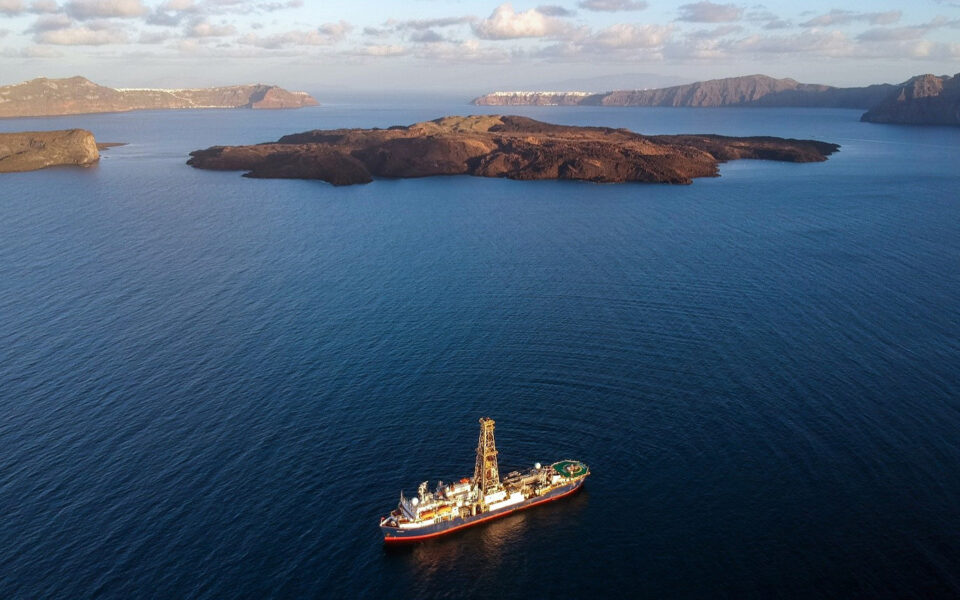
As earthquakes calm down is a new volcano about to be formed under Santorini?
Renowned seismologist Costas Synolakis claimed that the earthquakes rattling Santorini may indicate the expansion of the island’s volcanic complex, potentially leading to the birth of a new volcano.
A total of 6,400 earthquakes were registered in the Santorini and Amorgos islands region between January 26 and February 3, the University of Athens’ Interdisciplinary Committee of Handling Threats and Crises said on Wednesday.
Synolakis, a Professor of Civil Engineering at the University of Southern California and a member of the Academy of Athens, said that rising liquid fluids beneath Santorini suggest deep geological changes. “If confirmed, we may be witnessing, for the first time in recorded history, the formation of a new volcano.”
Speaking to public television ERT he cautioned that this does not necessarily mean an eruption is imminent. Rather, it suggests that the region’s volcanic system could be evolving, possibly forming new craters alongside Santorini.
Greece’s authorities sought to ease concerns about the recent seismic activity at the Santorini volcano. Scientists recently said that the volcanic activity is similar to that of 2011-2012, which lasted approximately 14 months and ended without any volcanic event. According to scientists, based on the data available so far, there is no reason for particular concern.
The volcano has been almost “quiet” for almost 400 years. The last time it erupted, in 1650, it killed more than 70 people and caused a 40-meter-high tsunami. Strong earthquakes and aftershocks were recorded, along with toxic gases and smoke. The most recent eruption took place between January, 10, and February 2, 1950.
See all the latest news from Greece and the world at Greekreporter.com. Contact our newsroom to report an update or send your story, photos and videos. Follow GR on Google News and subscribe here to our daily email!

