


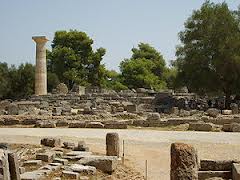
 Olympia was the birthplace of the ancient Olympic Games, which were celebrated every four years by the Greeks. Olympia is situated in a valley in Elis, in western Peloponnisos, through which runs the Alpheus River. It was not a town, but a sanctuary with buildings associated with games and the worship of the gods.
Olympia was a national shrine of the Greeks and contained many treasures of Greek art, such as temples, monuments, altars, theaters, statues, and votive offerings of brass and marble. The Altis, or sacred precinct, enclosed a level space about 200 meters (about 660 feet) long by nearly 177 meters (nearly 580 feet) wide. It held chief centers of religious worship, votive buildings, and structures associated with the administration of the games.
The French began excavations there in 1829. German explorations from 1875-81 threw much light upon the plans of the buildings; they were resumed in 1936, 1952, and 1960-61. Many valuable objects were discovered, the most important of which was a statue of Hermes, the messenger of the gods, by Praxiteles.
Archaeological site
The site of the sanctuary of Olympia in a lush region irrigated by two rivers, the Alpheus and the Cladeus, and led Pindar to call it the kallistos topos (most beautiful place) of Greece. The sacred grove of Zeus, or Altis as the ancients called it, was filled with plane trees and wild olives that were dedicated to Zeus the father of all gods and mortals.
The most celebrated temple in Olympia was the Temple of Zeus, dedicated to the father of the gods. In this temple was a statue of Zeus made of ivory and gold, the masterpiece of the Athenian sculptor Phidias. Next to the Temple of Zeus ranked the Heraeum, dedicated to Hera, the wife of Zeus. In this temple, probably the oldest Doric building known, stood the table on which were placed the garlands prepared for the victors in the games.
The votive buildings included a row of 12 treasure houses and the Philippeum, a circular Ionic building dedicated by Philip II, king of Macedonia, to himself. Outside the Altis, to the east, were the Stadium and the Hippodrome, where the contests took place; on the west were the Palaestra, or wrestling school, and the Gymnasium, where all competitors were obliged to train for at least one month.
Approaching the archeological site before you reach the museum parking area you will cross a bridge over the Cladeus river. The riverbed remains dry for most of the year now but in ancient times it was one of Olympiads vital rivers.
Ancient Olympia Museum
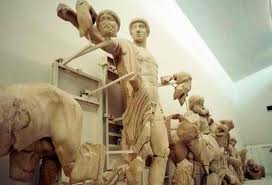 The Archaeological Museum of Olympia, one of the most important museums in Greece, presents the long history of the most celebrated sanctuary of antiquity, the sanctuary of Zeus, father of both gods and men, where the Olympic Games were born.
The museum’s permanent exhibition contains finds from the excavations in the sacred precinct of the Altis dating from prehistoric times to the Early Christian period. Among the many precious exhibits the sculpture collection, for which the museum is most famous, the bronze collection, the richest collection of its type in the world, and the large terracottas collection, are especially noteworthy.
The museum building comprises exhibition rooms, auxiliary spaces and storerooms. The vestibule and 12 exhibition rooms contain objects excavated in the Altis. The auxiliary spaces (lavatories) are located in the museum’s east wing; a separate building between the museum and the archaeological site houses a book and souvenir shop. Finally, part of the east wing and the basement are dedicated to storage and conservation of terracottas, bronze, stone, mosaics and minor objects.
The collections are displayed in a modern way, in chronological order, and easy to understand information panels and subtle lighting, make visiting a museum in Ancient Olympia an enjoyable family event.
Museum of the Ancient Olympic Games
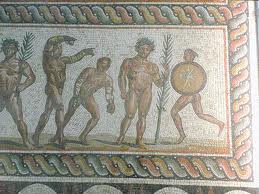 One of the most important archaeological museums in Greece, it hosts in its collection artifacts from the sanctuary of Olympian Zeus, in Olympia, where the ancient Olympic Games were born and hosted. The new museum was constructed in 1975, and opened in 1982, re-exhibiting its treasures. The architect of the museum was Patrocolos Karadinos.
Its collections include terracottas (prehistoric, Archaic and Classical periods), bronzes, sculptures (Archaic up to the Roman period) and from the Ancient Olympic Games.
Folk Museum of Andritsaina
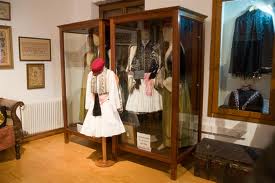 The Folk Museum of Andritsaina was established by the Cultural Asociation of Women of Andritsaina in 1981. Some women from Andritsaina who wanted to show “the soul of their place” were driven by love for the place they live in, their anxiety to save their cultural heritage. They teamed to establish a Folk Museum at their home.
The museum is hosted at the stately home of Georgios Kanellopoulos. It is a renovated stone building from 1847, with peculiar architectural features, which reflects the tradition, the art and the nobility of the people of Andritsaina. The museum’s permanent collections contain carpets and tapestries, costumes and laces, ceramics and brass works, paintings, lithographs and photographs.
Where to Stay: Hotel Europa

Hotel Europa is built on the top of Drouvas Hill in Ancient Olympia, at the foot of which there is the Sacred Alti with brilliant monuments and the stadium of the Ancient Olympic Games. The silent, humble hill whose top our hotel decorates, has been a long-standing witness and a privileged spectator of the events that took place in this divine valley, that spreads out so beautiful and idyllic between two rivers, Alfeios and Kladeos. Visit the hotel’s website here.
See all the latest news from Greece and the world at Greekreporter.com. Contact our newsroom to report an update or send your story, photos and videos. Follow GR on Google News and subscribe here to our daily email!

