



A small bronze woman in the Acropolis Museum once supported an ancient Greek bronze mirror. Dated to 485–480 BC, the figure brings sculpture into the mechanics of an object made for looking at oneself.
The mirror stand belongs to a wider Greek tradition in which a female figure could carry a polished metal disc above her head. Known as caryatid mirrors, these objects combined a reflective surface, a support and detailed imagery within a single useful possession.
The woman beneath the ancient Greek bronze mirror
The Acropolis example, inventory ΕΑΜ Χ6504, stands 20 centimeters high. The museum describes her as a Kore, a young female figure, with her left foot advanced on a small platform supported by galloping horses.
She wears a chiton and an oblique himation, garments belonging to the vocabulary of ancient Greek clothing. Earrings, a patterned headdress and carefully treated dress give the tiny support the attention normally associated with a freestanding statue. She holds a blossom and a pomegranate.
Two projections behind the head and three on the preserved lower part of the mirror may have secured ornaments or helped support the mirror itself, according to the museum.
A polished bronze disc supplied the reflection
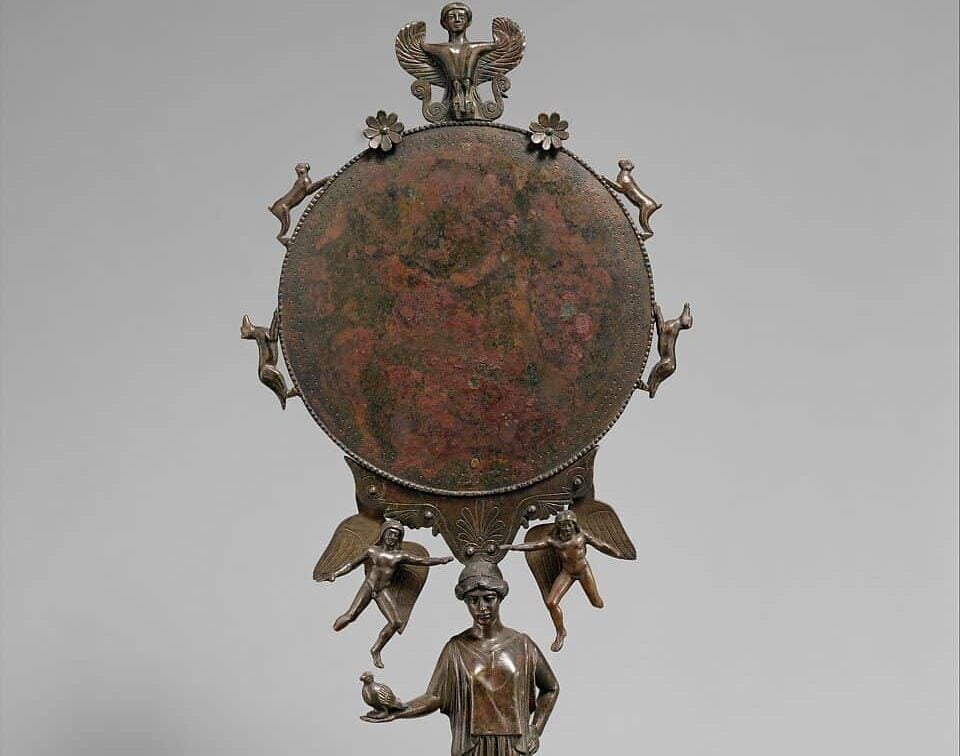
The reflective surface was metal. A comparable, more complete Argive mirror at the Metropolitan Museum of Art, dated to the middle of the fifth century BC, preserves a circular bronze disc above a draped woman. At 40.4 centimeters high, the whole object is substantially larger than the surviving Acropolis stand.
In his book Looking at Greek Art, art historian Mark D. Stansbury-O’Donnell uses the Met example to explain how an object’s condition changes the experience of seeing it. The bronze would originally have been polished smooth enough to reflect. Its present green and uneven surface results from changes in the metal over time. In the published chapter excerpt, he also directs attention to the back, where joins and rivets help reveal assembly.
A user could bring the mirror close while holding it or position it on a flat surface. In a modern display case, that relationship is harder to recover: the visitor looks at the surviving object, while its ancient user also looked into it.
The figures and ornaments were not interchangeable
The Met mirror surrounds the woman with a miniature world. Two Erotes appear beside her head, hounds pursue hares along the disc’s sides, and a siren crowns the top.
A bronze mirror in Cleveland, dated around 470–460 BC and attributed tentatively to Sicyon, provides another comparison. Its female support holds a flower and is flanked by winged figures identified as Nikai, or personifications of victory. The museum leaves open whether the central woman represents a mortal or a deity, perhaps Aphrodite.
Other mirrors had different forms and histories
Standing caryatid mirrors were one solution among several. The Greek Ministry of Culture describes an early fourth-century BC covered bronze mirror from Eretria, whose lid shows Europa riding the bull. Its ornament occupied a cover rather than a female stand beneath the disc.
See all the latest news from Greece and the world at Greekreporter.com. Contact our newsroom to report an update or send your story, photos and videos. Follow GR on Google News and subscribe here to our daily email!

