



On November 18, 1826, Greek revolutionary forces under Georgios Karaiskakis began a decisive battle against Ottoman troops in the mountain town of Arachova, central Greece. The fighting, which lasted until November 24, resulted in one of the most significant Greek victories of the War of Independence, restoring confidence in a revolution that had suffered devastating setbacks.
Two hundred years later, the Battle of Arachova remains a defining moment in Greece’s struggle for independence. It demonstrated the military abilities of Karaiskakis, whose leadership helped revive the revolutionary campaign in central Greece at a time when Ottoman forces appeared to be gaining the upper hand.
The victory came during one of the most difficult periods of the Greek Revolution. Earlier in 1826, the fall of Missolonghi had dealt a severe blow to the independence movement, while Ottoman commander Reşid Mehmed Pasha, widely known to the Greeks as Kioutachis, was tightening his siege of the Acropolis in Athens.
With much of central Greece under Ottoman control, Karaiskakis launched a campaign intended to disrupt enemy communications, regain strategic positions and relieve pressure on the defenders of Athens.
How Karaiskakis trapped the Ottoman army in Arachova
By November 1826, Karaiskakis had established his forces around Distomo, northwest of Athens, preparing to challenge Ottoman control of the routes connecting Boeotia and Phocis.
Arachova, situated on the southern slopes of Mount Parnassus, occupied a strategically important position. Its narrow mountain passages offered opportunities for ambushes, while control of the settlement could restrict Ottoman troop movements across central Greece.
When Karaiskakis learned that an Ottoman force commanded by Mustafa Bey and Kehagia Bey was approaching the area, he moved quickly to exploit the mountainous terrain. According to historical accounts, the Ottoman column numbered approximately 2,000 to 2,500 men, including experienced Albanian troops serving in the Ottoman army. Greek forces were initially smaller, but reinforcements gradually arrived from surrounding areas.
On November 18, Greek fighters took positions inside Arachova and along the surrounding heights, seeking to prevent the Ottoman troops from passing through the village. Karaiskakis coordinated attacks from several directions, gradually surrounding the enemy force and cutting off potential escape routes.
The fighting continued for seven days, with both sides enduring increasingly severe weather conditions. Rain, snow and freezing temperatures complicated military operations, particularly for the Ottoman soldiers, many of whom were exposed on the mountainous slopes.
The Greek forces, familiar with the terrain and supported by local inhabitants, maintained pressure on the trapped troops.
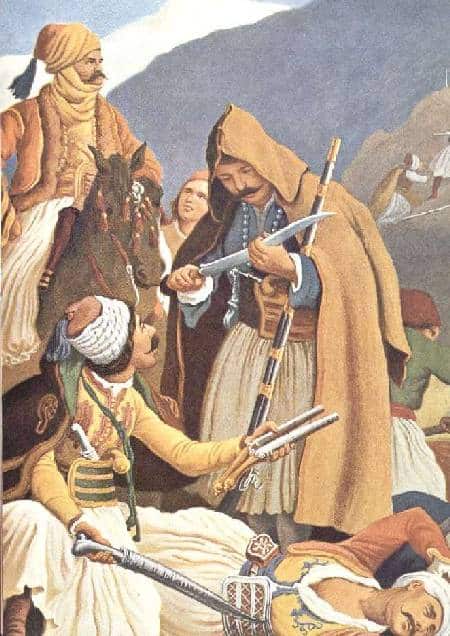

Attempts to send Ottoman reinforcements into the area were unsuccessful. A relief force moving through the Zemenos pass was intercepted by Greek fighters, further isolating Mustafa Bey’s men.As supplies dwindled and casualties increased, the Ottoman commanders attempted to negotiate their withdrawal. According to accounts of the battle, Karaiskakis demanded that the surrounded soldiers surrender their weapons in exchange for safe passage, but the terms were rejected.
On November 24, the remaining Ottoman troops attempted to break through the Greek positions during a snowstorm. The escape turned into a disaster. Greek forces pursued the retreating soldiers through the mountain passes, while exposure and the harsh conditions contributed to heavy losses.
Both Mustafa Bey and Kehagia Bey were killed, and the Ottoman expeditionary force was effectively destroyed. Contemporary Greek accounts reported approximately 1,300 Ottoman soldiers killed, although casualty figures vary between historical sources.
The Greeks captured weapons, ammunition and other military supplies, strengthening their ability to continue operations in central Greece.
Why Arachova became a turning point in the Greek Revolution
The Battle of Arachova was significant not only because of the scale of the Ottoman defeat but also because of the political and military circumstances in which it occurred.
Following the fall of Missolonghi in April 1826, the Greek revolutionary movement faced serious difficulties. Egyptian forces under Ibrahim Pasha were operating in the Peloponnese, while Ottoman troops had regained control of important positions in central Greece. Internal divisions had also weakened the revolution, making coordinated military operations increasingly difficult.
Karaiskakis’ victory demonstrated that the Greeks could still mount successful campaigns against experienced Ottoman forces. It restored morale among revolutionary fighters and strengthened his position as one of the leading military commanders of the independence struggle.
The battle also disrupted Ottoman plans in central Greece, forcing commanders to confront renewed resistance in areas they had hoped to pacify.
Arachova became an example of Karaiskakis’ tactical approach. Rather than confronting larger Ottoman forces in open terrain, he used mountainous geography, intelligence about enemy movements and coordinated attacks to isolate and defeat his opponents. His campaign subsequently continued through central Greece, creating additional difficulties for Ottoman operations around Athens. The victory, however, did not immediately secure Greek independence or end the siege of the Acropolis.
Karaiskakis himself would not survive to see the establishment of the independent Greek state. On April 23, 1827, he died from wounds sustained during military operations near Athens, shortly before the disastrous Greek defeat at the Battle of Phaleron.
The Acropolis garrison surrendered the following month, demonstrating that the revolution continued to face serious military challenges despite its success at Arachova.
Nevertheless, the Greek struggle entered a new diplomatic phase during 1827. Britain, France and Russia increasingly intervened in efforts to resolve the conflict, culminating in the destruction of the Ottoman-Egyptian fleet at the Battle of Navarino in October.
Greek independence was eventually internationally recognized through the London Protocol of 1830.
See all the latest news from Greece and the world at Greekreporter.com. Contact our newsroom to report an update or send your story, photos and videos. Follow GR on Google News and subscribe here to our daily email!

