



In ancient Greek, one short word, mykes, could mean two very different things: a mushroom, or the cap fitted to the tip of a sword’s scabbard. According to the ancient travel writer Pausanias, each meaning produced its own story of how the hero Perseus gave Mycenae its name.
It is a surprisingly small origin for one of the great cities of Bronze Age Greece, the legendary home of King Agamemnon and a place Homer described as “rich in gold.” So how did a mushroom, or a loose piece of a sword, come to name it?
A prophecy fulfilled by accident
The story begins in Argos, the Peloponnesian city ruled by King Acrisius. An oracle had warned him that his grandson would kill him. That grandson was Perseus, the son of Zeus and Acrisius’s daughter Danae, and the hero best known for slaying the Gorgon Medusa.
When Acrisius heard that Perseus was alive and winning fame, he left Argos for Larisa, on the Peneus River in Thessaly. Perseus followed, hoping to meet his grandfather and reconcile with him.
At Larisa, Perseus competed in athletic games. As he threw the discus, Acrisius stepped unseen into its path and was killed. The prophecy had come true despite everything the king had done to escape it.
A hero who could not live with an accident
Perseus had faced down Medusa, but he could not face the talk that followed. Pausanias writes that he returned to Argos ashamed of the gossip about the killing and would not rule there. Instead, he persuaded Megapenthes, son of his great-uncle Proetus, to trade kingdoms with him, and went on to found Mycenae.
Pausanias does not name the kingdom Perseus received. The Library, a handbook of Greek myths traditionally attributed to Apollodorus, is more specific. In its version, Megapenthes took Argos, while Perseus ruled Tiryns and fortified Midea and Mycenae.
Either way, it is an unusually human moment for a Greek hero: a man who had beheaded a monster gave up a throne rather than rule under the shadow of an accident.
Two founding stories, and a third
Pausanias offers two explanations for the name. In the first, the cap fell from Perseus’s scabbard at the site, and he took it as a sign that he should build a city there.
The second is a story Pausanias says he had heard. Perseus was thirsty, and he pulled a mushroom from the ground. Water flowed from the spot, and after drinking his fill he named the place after the mushroom.
A third tradition ties the name not to Perseus but to a woman called Mycene. Homer mentions her in the Odyssey, and an early epic poem known as the Great Eoeae made her the daughter of Inachus, the river god of Argos.
Legend, doubt and archaeology
Pausanias, who traveled through Greece in the second century AD, did not accept every version he found. He dismissed one more account, which traced the name to a man called Myceneus, because it rested on a family tree that not even the Spartans accepted.
Mycenae’s true origins are unknown. Many scholars think the name itself is not Greek at all but one of many place names inherited from people who lived in Greece before Greek speakers. If so, both mykes stories were later attempts to explain a name whose meaning had already been lost.
Archaeology tells a different story. The Mycenaean civilization, named after the citadel, flourished in the late Bronze Age, and most of the monuments visible today were built between about 1350 and 1200 BC.
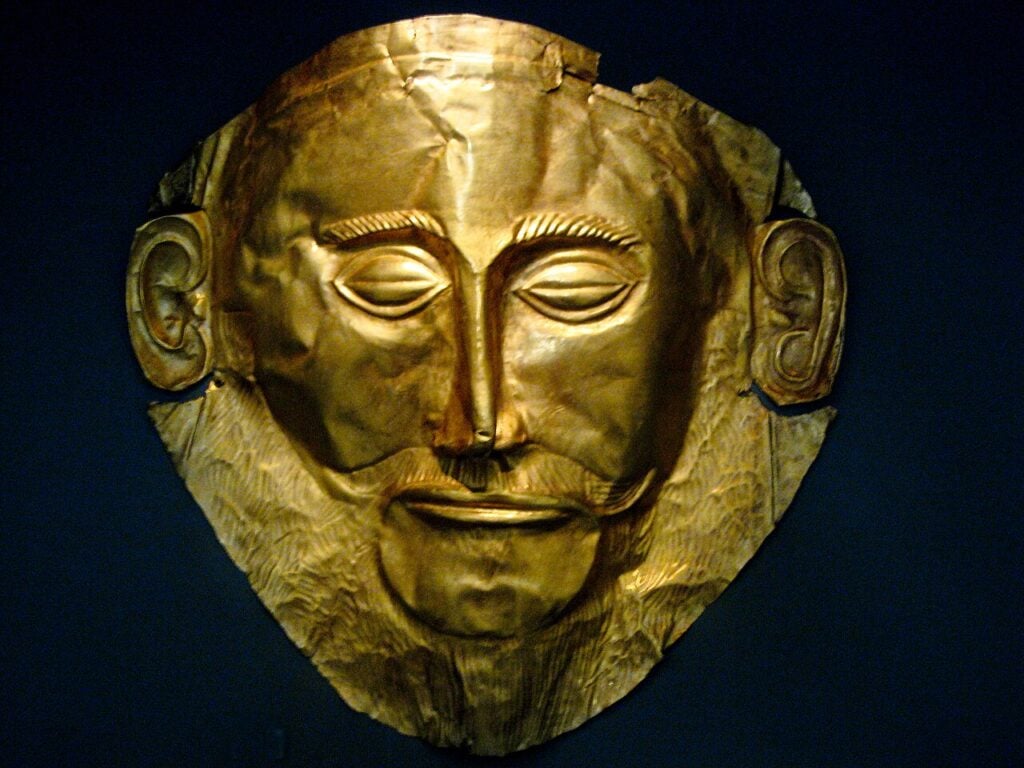
By Pausanias’s time, the city was already in ruins. Argos destroyed it in 468 BC, an act Pausanias blamed on jealousy after Mycenae sent 80 men to fight at Thermopylae while Argos stayed out of the war against Persia. Modern interest returned in 1876, when Heinrich Schliemann excavated the shaft graves and their gold, including the famous mask he linked to Agamemnon.
The Lion Gate, built around 1250 BC as the citadel’s main entrance, still stands. Pausanias saw it too and noted the lions carved above it. Pausanias also recorded a fountain among the ruins called Persea, named after the city’s legendary founder. Today, Mycenae and nearby Tiryns are a UNESCO World Heritage Site.
Sword cap or mushroom, the ancient Greeks never settled the question, and the name has outlived every answer.
See all the latest news from Greece and the world at Greekreporter.com. Contact our newsroom to report an update or send your story, photos and videos. Follow GR on Google News and subscribe here to our daily email!

