



At the Minoan palace on Crete, conservation, archaeological evidence, and Arthur Evans’s imagination are preserved side by side.
The Knossos reconstruction on the Greek island of Crete makes it difficult to tell where Bronze Age remains end and modern interpretation begins. Arthur Evans and his team did more than excavate the complex: they rebuilt parts of it, giving physical form to theories that archaeologists still dispute.
The criticism has sometimes taken a sharper form among academics. In a 2022 essay, former archaeologist and narrative designer Florence Smith Nicholls used the phrase “Disneyland Knossos,” arguing that Evans’ reconstruction imposed a particular vision of the past on the surviving evidence.
Yet dismissing Knossos as a fabricated attraction would also be misleading. The more revealing question is where necessary preservation ended and where Evans’s imagination began.
Knossos before Evans
Evans was not the first person to excavate the site. In 1878, Cretan businessman Minos Kalokairinos uncovered ancient architectural remains that attracted the attention of foreign archaeologists. When Evans visited in 1894, Kalokairinos showed him the excavations. Evans was already inclined to connect the complex passages with the Labyrinth of Greek mythology, a subject that remains central to accounts of the Minotaur and the Labyrinth at Knossos.
Large-scale excavation under Evans began in 1900. Working with his assistant Duncan Mackenzie, he investigated a complex archaeological sequence, with Bronze Age buildings above much older occupation layers. Their work helped establish the Early, Middle, and Late Minoan chronological framework that archaeologists continue to use, with later revisions.
The palace was not a building frozen at a single moment about 3,500 years ago. Its architecture reflected successive periods of construction, destruction, and rebuilding. Any attempt to recreate an “original palace” therefore required choices about which phase to represent. That complexity also shapes modern understanding of the wider Minoan civilization on Crete.

When protection became modern reconstruction
Excavation created urgent conservation problems. A shelter erected over the Throne Room deteriorated as its timber rotted, while winter rains contributed to the partial collapse of the Grand Staircase. Leaving the exposed remains untouched was not necessarily a way to preserve them.
Architect Christian Doll used steel beams and brick vaulting to strengthen ancient structures. Concrete columns replaced vanished wooden ones whose impressions had survived. Architect Piet de Jong later worked with Evans, using reinforced concrete to give substantial form to their reconstruction of the palace.
Those interventions were not all equivalent. Supporting a vulnerable staircase addressed a physical threat. Completing an uncertain architectural arrangement made a claim about the past.
That distinction is central to the controversy: a reconstruction can look far more certain than the evidence behind it.

The Bull at the North Entrance
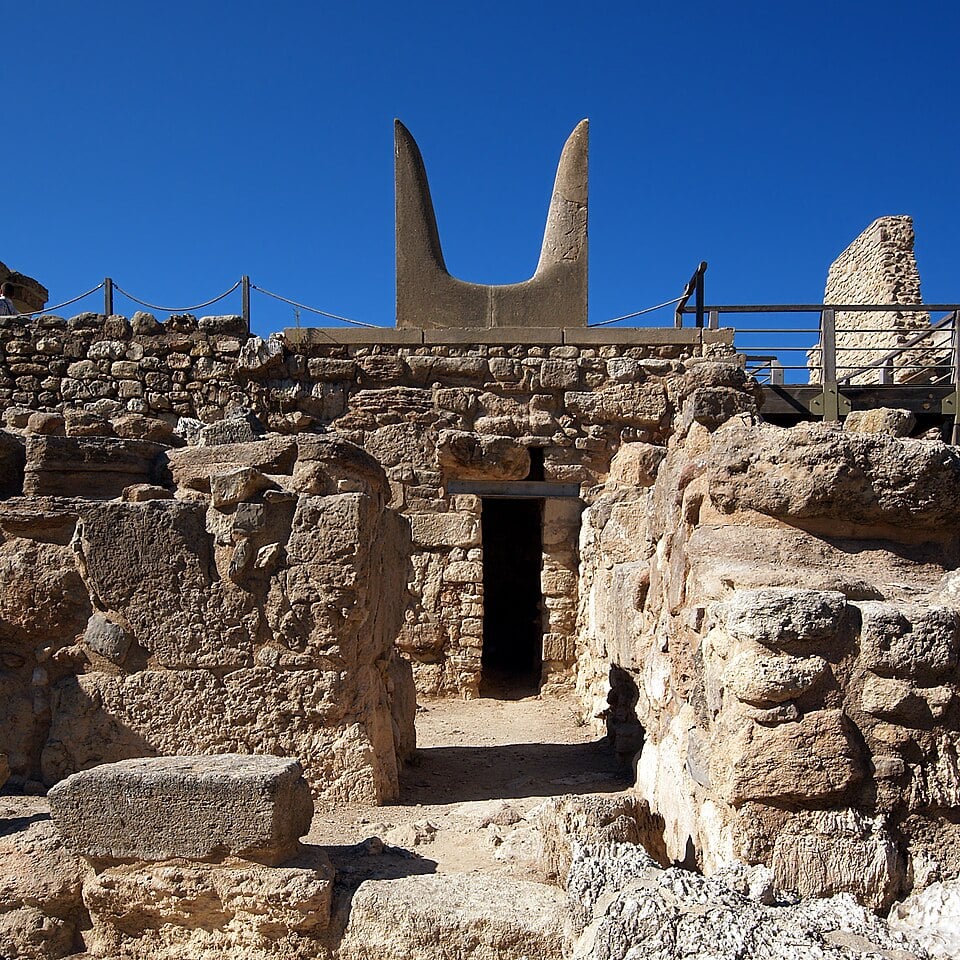
The north entrance provides a particularly clear example. Andrew Shapland, the Ashmolean Museum’s curator of Bronze Age and Classical Greece, has identified its reconstructed bastion and charging-bull fresco as a composition supported by limited evidence. Genuine fragments nevertheless establish that large bull imagery existed in the area.
The bull also served Evans’s interpretation of Greek mythology. He proposed that such imagery survived after the palace’s destruction and helped inspire the story of the Minotaur and its Labyrinth. The reconstructed entrance therefore presented more than an architectural possibility: it gave visible form to his explanation of a myth.
In some places, Evans even sought to recreate how the palace might have appeared as a ruin in the later Classical period rather than during its Bronze Age occupation.
Visitors should not read the reconstructed entrance as independent proof of Evans’s theory. The theory helped determine what they see.
A “Prince” built from fragments
The controversy extends beyond architecture to the images through which the Minoans became familiar.
The celebrated Prince of the Lilies fresco illustrates the problem. According to the Heraklion Archaeological Museum, the reconstructed figure incorporates three fragments that do not join. Evans interpreted it as a ruler of Knossos, or a priest-king who combined religious and secular authority.
Prince of Lilies,
Minoan fresco from 1550 BC.
Knossos Palace, Crete Island – Greece.#archaeohistories pic.twitter.com/JsDRoSAVah— Archaeo – Histories (@archeohistories) June 12, 2021
Other scholars have proposed different arrangements and identities. Parts of the figure have been interpreted as belonging to an athlete, boxer, or commanding ruler, while the elaborate headdress may have belonged to a priestess or a sphinx. The surviving relief is too poorly preserved to establish the figure’s gender securely through the conventional skin colors used in Minoan painting.
The ancient fragments are genuine. What remains uncertain is whether the familiar completed figure combines elements that originally belonged to the same person. Similar problems of interpretation surround other evidence from Minoan Crete, including the still-undeciphered Linear A writing system.
That is a more precise criticism than calling the fresco fake. It also raises a more consequential question: how much of the apparent evidence for a priest-king was supplied by the reconstruction itself?

What the “Disneyland” criticism gets right—and misses
Smith Nicholls’ comparison focuses on the power of an immersive environment to tell a story. The argument is that Evans’ Knossos presents an idealized palace shaped by the assumptions of its modern interpreter.
The metaphor captures a genuine danger. Visitors encounter a completed scene, not the uncertainty, competing explanations, and missing evidence behind it. A persuasive reconstruction can make a hypothesis feel like an observation.
Yet “Disneyland” is a critical metaphor, not an adequate description of the archaeological site as a whole. Knossos preserves authentic material of considerable historical importance, and some modern interventions were necessary to support fragile ancient structures. Evans’ legacy cannot be reduced either to rescuing a palace or inventing one. Excavation, protection, and interpretation became inseparable.
UNESCO’s verdict on authenticity
In 2025, Knossos joined five other Cretan archaeological sites on UNESCO’s World Heritage List as the Minoan Palatial Centres. The inscription did not erase the reconstruction controversy. UNESCO’s assessment of the Minoan Palatial Centres recognizes that extensive early 20th-century interventions compromised aspects of Knossos’ form and design.
At the same time, the assessment states that large portions remain authentic and that the surviving materials contribute to the site’s value. It also calls for further development of methods that clearly distinguish ancient remains from later reconstruction.
That distinction offers a more useful way to approach Knossos than either unquestioning admiration or wholesale dismissal. Ancient masonry, protective support, and speculative additions should not carry the same evidentiary weight.
The question is not whether visitors should use their imagination. It is whether they receive enough information to recognize where the archaeology ends and the reconstruction begins.
See all the latest news from Greece and the world at Greekreporter.com. Contact our newsroom to report an update or send your story, photos and videos. Follow GR on Google News and subscribe here to our daily email!

