



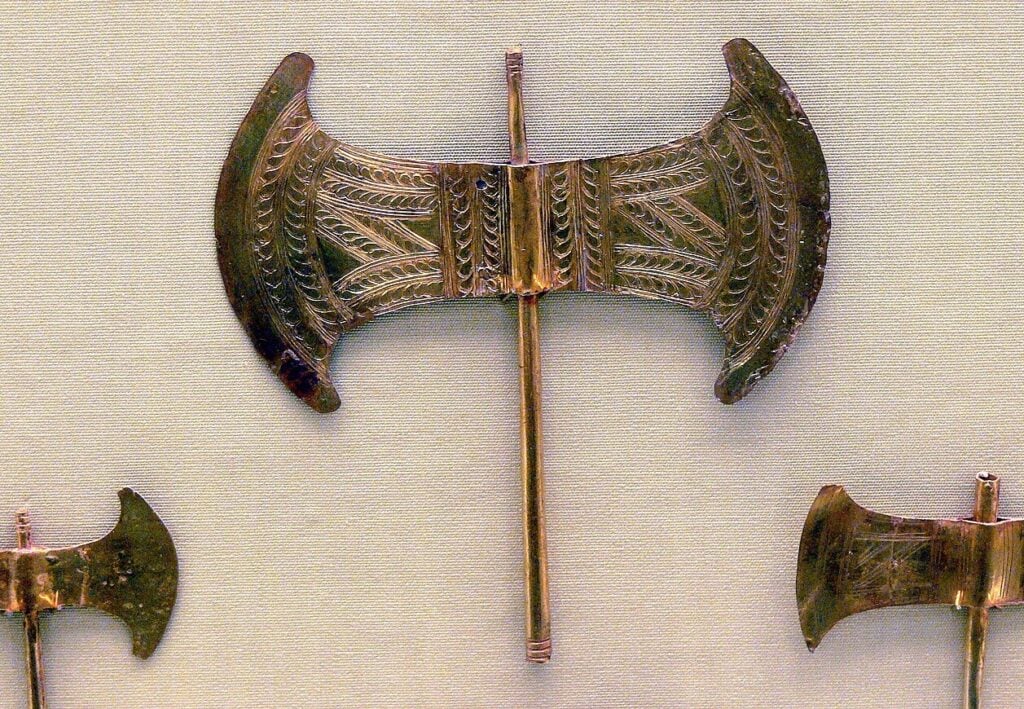
The double-axe, called the labrys (λάβρυς), is one of the most recognizable symbols associated with the Minoan civilization of Bronze Age Crete. It appears on architectural blocks at Knossos, in seals and sealings, in frescoes, on pottery, in ritual contexts, in miniature votive forms, on stone and metal objects, and in funerary imagery.
As a powerful symbol, the labrys appears at the intersection of religion, political authority, ritual performance, warfare, and the relationship between Crete and the wider eastern Mediterranean.
The interpretation of its symbolism, however, has never been straightforward. Early scholars tended to understand it primarily as a religious emblem, sometimes associating it with a great Minoan goddess or with the later Greek Zeus. More recent scholarship has emphasized that symbols can change their meaning according to context. Researcher Matthew Haysom, in his influential study of the Neopalatial period, argues that the double-axe was “a symbol primarily associated with a social group” exercising economic, military and religious power, rather than simply being a symbol of a particular deity.
The double-axe at the center of Minoan religious symbolism
The archaeological evidence demonstrates that the double-axe had a prominent place in Minoan ritual culture. At Knossos, numerous double-axe signs were carved into architectural blocks, particularly in the area traditionally associated with the Palace Sanctuary and Pillar Crypts. Arthur Evans, the pioneer of the excavations at Knossos, regarded these signs as having a religious significance. In his later work he described the labrys as one of the “distinctive symbols” associated with the Minoan divinity.
Evans’ interpretation was part of a broader reconstruction of Minoan religion in which the double-axe was connected with a powerful female deity. In The Palace of Minos, he described a goddess who could appear in several forms and who was repeatedly associated with particular sacred attributes. He specifically identified the double-axe as one of her recurring symbols.
This interpretation gained strength from representations in which women appear with double-axes. A particularly important example comes from the archaeological record of Minoan Crete, where female figures are associated with the labrys in ritual contexts. Such representations encouraged scholars to connect the object with female divinity, priesthood, or the ceremonial authority of women. Yet it is important not to turn this evidence into an overly simple statement that “the double-axe was the symbol of the Minoan Mother Goddess.”

A sacred object connected to ritual sacrifice?
One interpretation of the double-axe is that it was connected with sacrifice. This is understandable because the axe is, after all, a tool capable of killing an animal. Minoan iconography also places the labrys in scenes involving ritual activity and animal sacrifice.
The famous Hagia Triada sarcophagus, for example, contains highly elaborate ritual imagery involving sacrifice, libations, sacred trees or vegetation, and double-axes. The axes are integrated into a broader visual vocabulary of religious ceremony rather than appearing as ordinary agricultural tools.
Martin Nilsson, one of the most influential historians of ancient religion, was more cautious than Evans. His work questioned some of the elaborate interpretations that had been built around Minoan symbolism. In discussing the duplicated blades of certain axes, Nilsson concluded that he could see “nothing but a purely ornamental device” in some examples.
Nilsson’s skepticism is significant because it reminds us that the presence of a double-axe does not automatically demonstrate that the object was being worshipped. An archaeological symbol can become decorative, conventionalized, or disconnected from its original meaning.
Nevertheless, other examples are much harder to dismiss as purely decorative. At Hagia Triada, for instance, the archaeological record includes ceremonial representations in which axes are clearly integrated into ritual processions. The Heraklion Archaeological Museum describes a Neopalatial sealing from Hagia Triada showing a woman and a man carrying double-axes in procession and connects the imagery with ceremonial activity.
The evidence suggests that at least some double-axes functioned as sacred emblems used in ritual performance, even if not every representation necessarily carried the same meaning.
Symbol of political power
One of the most important developments in modern scholarship is the attempt to move beyond the question “Which god or goddess did the axe represent?” and instead ask who used the symbol and in what social circumstances? This is particularly important for the Neopalatial period, approximately 1700–1450 BC, when Minoan palatial society reached a high level of economic and political organization.
Matthew Haysom’s 2010 study represents a major shift in interpretation. Rather than treating the double-axe simply as a religious symbol, Haysom examines its association with architecture, iconography, ritual objects, and social power. His conclusion is that during the Neopalatial period the labrys was associated with a social group that exercised authority in economic, military and religious spheres. Only later, he argues, did its meaning become more exclusively religious.
This interpretation is particularly valuable because it places religion within the political structure of Minoan society. A sacred symbol does not necessarily have to represent a god. It can represent the authority of the people, institutions, or social group responsible for controlling religious ceremonies and important economic resources.
In this sense, the Minoan double-axe may have functioned somewhat like an emblem of institutional authority. Its repeated appearance on buildings and ritual objects could communicate that a particular place, ceremony, or individual belonged to a recognized system of power.
The importance of the double-axe therefore extends beyond religion narrowly understood. It may have been part of the visual language through which Minoan elites communicated their legitimacy.
The labrys and the Labyrinth
Perhaps the most famous association of the labrys symbol is with the Labyrinth of Knossos. The Greek word labyrinthos (λαβύρινθος)was traditionally connected by some scholars with labrys, a word associated with the double-axe. From this proposed relationship came the attractive interpretation of the Labyrinth as the “House of the Double-Axe.”
This theory became particularly influential because Knossos itself contained numerous representations of double-axes. Arthur Evans consequently regarded the connection as meaningful.
However, the etymological argument has been contested from the beginning. W. H. D. Rouse, writing in 1901, criticized several of the conclusions being drawn from the archaeological evidence. He warned against accepting attractive interpretations too quickly, observing that “a great part of the evidence has been overlooked.”
The debate illustrates an important methodological issue in archaeology: similarity between words and archaeological symbols does not automatically establish historical connection. The relationship between labrys, labyrinthos, and the palace at Knossos therefore remains an important scholarly hypothesis rather than an unquestionable fact.
The Minoan double-axe goddess and her astral realm
Researcher J. Alexander MacGillivray rather than interpreting the double-axe simply as a ritual weapon or an emblem of sacrifice, he proposes that its origins and meaning may be connected with astronomy, calendrical cycles, fertility, death, and regeneration. His central argument is that the Minoan double-axe may ultimately have developed from an ancient astral symbol associated with the Egyptian constellation centered on Sirius and subsequently became an important attribute of a powerful female divinity.
MacGillivray cautiously identifies this goddess with a possible Minoan form of a Great Mother, perhaps represented by the name A-sa-sa-ra and possibly related to the wider ancient Near Eastern goddess tradition.
He begins by emphasizing the extraordinary importance of the double-axe in Minoan religion. Martin Nilsson had described it as the most conspicuous religious symbol of Minoan civilization, comparable in visibility to the cross in Christianity or the crescent in Islam. The archaeological evidence demonstrates that the double-axe had a long history in Crete. During the Early Minoan period, representations of the axe occur in tombs, caves, sanctuaries and mountain locations. These contexts are significant because they associate the symbol simultaneously with death, the underworld, sacred mountains and possibly the heavens.
From the Protopalatial and Neopalatial periods onward, the labrys became increasingly widespread and was combined with other religious symbols, including the bull or cow head, mountains, vegetation, stars, birds and the so-called “Sacral Knot.”
Not an abstract symbol
MacGillivray revisits an older interpretation proposed by Sir Arthur Evans who initially associated the double-axe with bull sacrifice and later with a male Minoan deity, partly because of the later association of the axe with Zeus Labraundos. MacGillivray points out, however, that this interpretation encounters difficulties. Minoan artistic evidence does not clearly show male gods holding the double axe, whereas the symbol is frequently associated with female figures and divine imagery. Moreover, sacrificial scenes indicate that daggers, rather than axes, were normally used to kill sacrificial victims. Evans therefore eventually interpreted the axe as an emblem of the Minoan “Great Mother.” MacGillivray accepts the importance of this female association but seeks to explain more fully why an axe should have become a symbol of such a goddess.
A particularly important part of MacGillivray’s argument concerns the Early Minoan funerary evidence. Non-functional double-axes made of copper, lead and stone appear in Cretan tombs from approximately 2800–2600 BC. Some were small enough to function as pendants or amulets, while others were apparently votive objects or large ceremonial displays. Their presence in funerary environments suggests that the symbol was connected with ideas concerning death and the afterlife. The researcher therefore sees an early relationship between the labrys and Minoan eschatology. He also notes the possibility that the “butterfly” motifs appearing on Early Minoan pottery represent stylized versions of the double-axe. The symbol subsequently enters the earliest Cretan writing systems, suggesting that it may have acquired not merely pictorial but also linguistic and religious significance.
During the Protopalatial period, the double-axe became particularly prominent. It was frequently carved or painted on buildings, seals, pottery and other objects, and it occurs in Minoan Hieroglyphic and Linear A contexts. MacGillivray gives special attention to the Linear A libation formula, in which the double-axe sign appears alongside signs that are commonly read as A-SA-SA-RA. He suggests that the axe sign may have represented the beginning of the name or title of a female deity, perhaps “Ashera.” This interpretation is necessarily speculative, since Linear A remains undeciphered, but it allows MacGillivray to connect the archaeological symbol with a specific goddess rather than treating it as an isolated abstract sign.

The Egyptian connection
MacGillivray observes similarities between the Minoan symbol and an Egyptian astronomical motif known as the Egyptian “X.” This figure consisted of five stars, with Sirius, or Sothis, at its center. In early Egyptian iconography, this stellar configuration could appear in association with a bovine head and the horizon sign. The author argues that this imagery was connected with Hathor, the Egyptian cow goddess, and with the Egyptian conception of cyclical time. Sirius was particularly important because its heliacal rising marked the beginning of the Egyptian year. Thus, the astronomical configuration could symbolize renewal, the turning of the year and the repetition of life.
This Egyptian evidence is significant because MacGillivray argues that the Minoan double axe may have inherited or transformed an earlier eastern Mediterranean astronomical tradition. He also examines Mesopotamian evidence, where double-axe forms occur much earlier than in Crete. Archaeological discoveries from the Halaf period demonstrate symbolic associations between double axes, goddesses, bovine imagery and birds. The physical double axe itself appears to have an eastern origin, while later written examples occur in Mesopotamian traditions. MacGillivray therefore envisages the Minoan symbol as the product of a complex process of cultural transmission and transformation rather than an entirely independent Cretan invention.
Egyptian influence becomes especially visible in the later Minoan evidence where the double-axe is combined with the so-called Sacral Knot, bovine imagery, the horizon symbol and birds. MacGillivray compares the Sacral Knot with the Egyptian tiet, or “Isis Knot,” while the bovine imagery recalls Hathor. In Egyptian religion, Hathor could appear as a cosmic cow and as a goddess associated with the dead and their passage into the afterlife. Minoan representations of the labrys may therefore have incorporated several related concepts: fertility, motherhood, death, regeneration and celestial renewal.
Beyond Crete
The significance of the double-axe becomes even more interesting when we look beyond Crete. The symbol is strongly associated with Caria in southwestern Anatolia, particularly with the sanctuary of Zeus at Labranda. Ancient sources describe Zeus at Labranda as carrying a double-axe. The connection between the Carian deity and the axe became an important part of the comparative study of Minoan and Anatolian religion. W. H. D. Rouse noted that ancient evidence described the statue of Zeus at Labranda as holding a double axe and that the Carian name for the axe was connected with the word labrys.
The resemblance between the Cretan and Carian traditions is striking, but its historical interpretation is complicated. It does not necessarily prove that the Minoan symbol was directly transferred to Caria or that the two traditions had an uninterrupted common origin.
Arthur Bernard Cook, in his extensive study of Zeus, argued for a connection between the double-axe and the divine power of Zeus in Anatolia and Crete. He emphasized the association of the Carian Zeus Labrandeus with the double axe and discussed the possibility that the axe represented a form of heavenly or lightning power.
Later archaeological research continues to document the importance of the labrys in Anatolia. A 2025 study of the Zeus Lepsynos temple at Euromos notes representations of the labrys in several ancient cultural contexts and emphasizes its recurring association with heavenly power and Zeus. This broader evidence suggests that the double-axe cannot be understood exclusively as a “Minoan” invention isolated from the rest of the eastern Mediterranean.
From Minoan goddess to Zeus
The apparent movement of the double-axe from female-associated contexts in Bronze Age Crete to male divine contexts in later Anatolian and Greek religious traditions is particularly significant. Early scholars sometimes interpreted this development as evidence of a transformation from a female Minoan deity to a male Indo-European or Greek god. Such explanations must be treated cautiously because the religious systems of Bronze Age Crete are not sufficiently documented for us to reconstruct their theology with certainty.
Nevertheless, the archaeological contrast is real: some Cretan representations associate the double-axe with female figures, whereas the later Carian Zeus Labrandeus is represented carrying the weapon. This may demonstrate not the survival of one unchanged religion, but the reinterpretation of an old sacred symbol within new religious systems. The double-axe therefore provides an excellent example of how symbols can survive while their meanings change.
MacGillivray, however, insists on the identity of the goddess and the labrys’ significance in Greece and the Near East. He suggests that the Minoan deity may have been comparable to Egyptian Hathor and Isis, Phrygian Cybele, Greek Rhea and Demeter, and the Near Eastern goddess Ashera. He connects the possible name A-SA-SA-RA from script fragments, while acknowledging that these linguistic relationships remain conjectural. What unites these figures in his interpretation is their association with fertility, motherhood, vegetation, death and regeneration. The goddess is therefore not merely an earth deity but a cosmic figure whose power encompasses the entire cycle of existence.
See all the latest news from Greece and the world at Greekreporter.com. Contact our newsroom to report an update or send your story, photos and videos. Follow GR on Google News and subscribe here to our daily email!

