



Every September 17, Orthodox Christians commemorate Saint Sophia and her three daughters, Faith, Hope and Love. Yet despite the familiar name, the feast has no connection to Istanbul’s famous Hagia Sophia.
The coincidence of names, however, opens a fascinating window into two very different traditions—one centered on a Christian martyr and her daughters, and the other on the Byzantine understanding of Divine Wisdom.
Who Is Saint Sophia Celebrated on September 17?
The Orthodox Church commemorates the Holy Martyr Sophia and her daughters, Faith, Hope and Love, on September 17. The 2026 liturgical calendar of the Greek Orthodox Archdiocese of America explicitly lists September 17 as the commemoration of Sophia and her three daughters.
According to the traditional account, Sophia was a Christian woman from Italy who lived during the reign of the Roman Emperor Hadrian. Her three daughters were named after the Christian virtues Faith, Hope and Love—Pistis, Elpis and Agape in Greek.
The traditional story says that the three girls were tortured and executed because of their Christian faith. Sophia survived them and remained at their grave in prayer before also dying. Because of her endurance and faith, she too is honored as a martyr.
The story has endured in Orthodox Christian tradition for centuries, giving September 17 its place in the ecclesiastical calendar.
The Hagia Sophia of Constantinople Is a Different Story
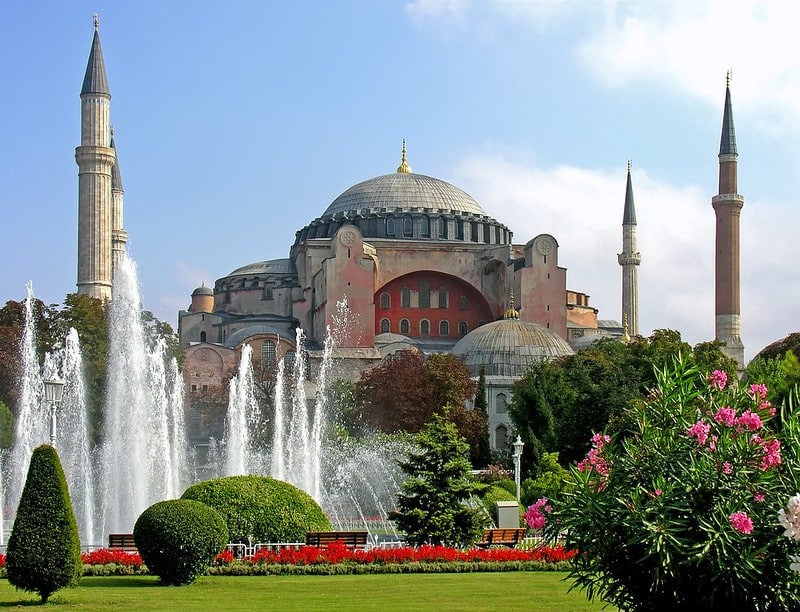
The famous Hagia Sophia of Constantinople was not named after Saint Sophia, the mother of Faith, Hope and Love.
Its name, Hagia Sophia, means Holy Wisdom. Byzantine sources and modern scholarship have understood the dedication of the Constantinopolitan cathedral in relation to Divine Wisdom, which was commonly identified with Christ, the Incarnate Word.
This distinction is important because the name “Sophia” can easily suggest that the monumental church was dedicated to a woman named Sophia. In the Byzantine context, however, the name referred to a theological concept: Divine Wisdom.
The distinction can also be seen in the church’s liturgical and artistic tradition. Scholarly research into Byzantine sources has found that Hagia Sophia was understood in a distinctly Christological sense, rather than as a church dedicated to the fourth-century or Roman martyr Sophia commemorated on September 17.
The Date Connected With the Great Church
The Constantinopolitan Hagia Sophia was associated with a different date in the Byzantine liturgical calendar.
The church’s commemoration was observed around December 23–24, close to Christmas. The surviving Byzantine evidence connects this celebration with the consecration and later rededication of the Great Church. The present Justinianic building was originally completed in 537 and was rededicated after reconstruction in 562.
The Orthodox calendar continues to commemorate the founding and consecration of Hagia Sophia in Constantinople on December 23.
That date should not be understood as a “name day” in the same sense as September 17 for Saint Sophia. Rather, it belongs to the liturgical memory of the church itself and its dedication.
One Name, Two Traditions
September 17 therefore belongs to Saint Sophia and her daughters Faith, Hope and Love.
Hagia Sophia of Constantinople belongs to the Byzantine tradition of Holy or Divine Wisdom, understood in relation to Christ as the Word of God.
The two are connected by a name, but not by the same feast or dedication. One commemorates a martyr and her three daughters; the other preserves the memory of one of the greatest churches of the Byzantine world and its dedication to Divine Wisdom.
That distinction makes September 17 an especially interesting date for remembering that behind the familiar name “Sophia” lie two very different chapters of Christian history.
See all the latest news from Greece and the world at Greekreporter.com. Contact our newsroom to report an update or send your story, photos and videos. Follow GR on Google News and subscribe here to our daily email!

