


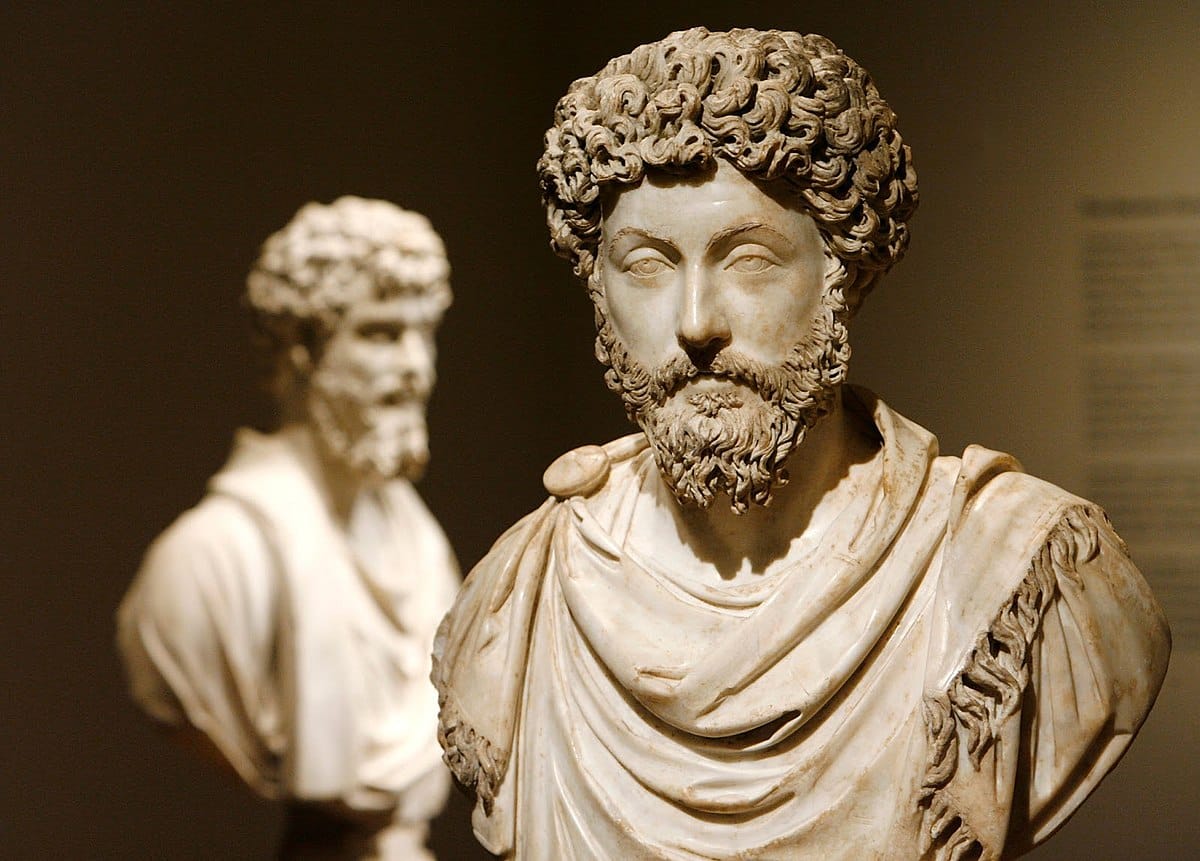
The Roman emperor Marcus Aurelius’ Meditations is one of the most remarkable works of the philosophy of Stoicism, yet it was never intended for publication at all. Written largely as a private exercise in self-discipline, the work records the reflections of a Roman emperor who was inspired by the Greek Stoic philosophers, attempting to live according to Stoic principles amid war, political responsibility, illness, loss, and the ordinary problems of human life.
Nearly two thousand years later, its continuing popularity suggests that the fundamental problems Marcus Aurelius addressed have not disappeared. His questions—How should we respond to adversity? What is within our control? How should we treat other people? How can we live meaningfully in a world we cannot fully control?—remain central to modern life as well.
Stoicism as a way of life
Marcus Aurelius was born in 121 AD and became emperor of the Roman Empire in 161. His reign was far from peaceful. He faced military conflicts, political pressures, disease, and personal bereavements. His philosophical reflections therefore developed not in an abstract academic environment but under conditions of enormous responsibility.
As the modern classicist Pierre Hadot argues, ancient philosophy should be understood not merely as a collection of theories but as a “way of life.” Hadot’s interpretation is particularly important for understanding Marcus. Meditations is not primarily a book about Stoicism; it is evidence of someone attempting to practice Stoicism every day.
Modern scholarship has frequently emphasized this practical dimension. Donald Robertson, a contemporary writer on Stoicism and Marcus Aurelius, describes Stoic philosophy as a form of “psychological training.” This interpretation helps explain why Meditations has attracted attention far beyond classical studies and remains relevant today.
‘Power over your mind-not outside events’
One of Marcus Aurelius’ central ideas is the distinction between what depends upon us and what does not. Although this principle is more explicitly formulated in Epictetus’ Encheiridion, Marcus Aurelis repeatedly applies it to his own circumstances. He writes: “You have power over your mind—not outside events. Realize this, and you will find strength.” The statement captures one of the most enduring aspects of Stoic thought. We cannot determine everything that happens to us, but we can attempt to govern our judgments, responses, and actions.
This idea has obvious relevance to contemporary society. Modern individuals live amid circumstances that can produce constant anxiety: economic uncertainty, political conflict, technological change, social-media pressures, and an overwhelming flow of information. Much of this lies beyond individual control. Marcus Aurelius’ philosophy does not suggest that people should become passive or indifferent. Rather, it encourages them to distinguish between action and futile anxiety. We should act where action is possible and accept what cannot be changed.
Its exercises resemble techniques used in modern cognitive approaches to emotional regulation: examining one’s judgments, questioning automatic reactions, and deliberately choosing more constructive responses. This is what Robertson describes as “psychological training”.
Success and happiness
Another important theme in the Meditations is Marcus Aurelius’ insistence that external success cannot guarantee happiness. Wealth, status, physical attractiveness, political power, and reputation are unstable. The Roman emperor himself possessed almost unimaginable political power, yet he repeatedly reminds himself that power and fame are temporary. He writes: “Think of yourself as dead. You have lived your life. Now take what’s left and live it properly.” The statement is not simply pessimistic. It is an invitation to recognize the limited nature of human existence and therefore to use the present moment responsibly.
This concern with mortality is particularly striking today. Contemporary culture often attempts to conceal death through entertainment, consumerism, technological optimism, and the pursuit of youth. Marcus Aurelius instead treats mortality as a philosophical fact that can clarify priorities. The awareness that life is temporary should not necessarily make life meaningless; for him, it makes our choices more significant. If time is limited, then attention becomes precious.
The modern scholar John Sellars notes that Stoicism can be understood as a philosophy concerned with “how to live.” This is precisely what makes the Meditations different from purely theoretical philosophical writing. Marcus is constantly asking himself what kind of person he should be. He reminds himself to be patient, rational, courageous, just, and compassionate. Philosophy is valuable only insofar as it changes conduct.
Importance of character
This emphasis on character also provides an important corrective to contemporary ideas of success. Modern societies frequently measure achievement through income, professional status, visibility, or social recognition. Marcus offers another standard: the quality of one’s character. A person may possess power and wealth and still live badly if he is governed by anger, vanity, greed, or fear. Conversely, a person with little external success may live well if he acts with integrity.
Marcus Aurelius’ reflections on relationships with other people are equally relevant. As emperor, he was surrounded by individuals who could flatter him, disappoint him, or oppose him. Yet he repeatedly warns himself against hatred and resentment. In one memorable passage he writes: “The best revenge is not to be like your enemy.” The principle is remarkably contemporary. In an age characterized by political polarization, online arguments, and public hostility, Marcus reminds us that responding to hostility with further hostility can reproduce precisely the behavior we condemn.
He also stresses humanity’s interconnectedness. Human beings are social creatures, and our purpose cannot be separated from our responsibilities toward others. The Roman emperor writes: “What is not good for the hive is not good for the bee.” The image expresses a fundamental Stoic conviction: individual flourishing and social responsibility are connected. A good life is not simply a private pursuit of pleasure; it involves contributing to the community.
Pierre Hadot’s interpretation is again valuable here. His scholarship emphasizes that Stoic exercises were designed to transform an individual’s entire perspective. Marcus Aurelius’ reflections therefore should not be reduced to inspirational quotations. His philosophy demands continuous practice. It is easy to say that one should remain calm in adversity; it is much harder to remain calm when confronted with betrayal, illness, financial difficulty, or grief.
Modern day limitations
Nevertheless, Marcus Aurelius’ philosophy of Stoicism also has limitations when viewed from a modern perspective. Stoicism can sometimes be misunderstood as an argument for emotional suppression. “Control your emotions” is not an entirely accurate representation of his position. The Stoics did not simply advocate becoming emotionless. Rather, they sought to examine the judgments underlying destructive passions and cultivate appropriate emotional responses. Modern psychology likewise distinguishes between suppressing emotions and regulating them. This distinction is essential if Stoicism is to be applied responsibly today.
Furthermore, Marcus Aurelius’ emphasis on accepting circumstances should not become an excuse for political or social passivity. Some problems require collective action rather than private acceptance. Injustice, discrimination, poverty, and environmental destruction cannot simply be dismissed as events outside our control. A modern interpretation of Stoicism should therefore combine acceptance with responsibility: accept what cannot be changed, but work actively to change what can.
The enduring value of Meditations ultimately lies in its honesty. Marcus Aurelius was not writing as someone who had achieved perfect tranquility. He was writing reminders to himself because he repeatedly needed them. He had to remind himself not to become angry, not to become obsessed with reputation, not to fear death, and not to neglect his responsibilities. In this sense, the book is surprisingly modern. It presents philosophy not as a declaration of perfection but as a lifelong practice of self-correction.
A meaningful life in a world of uncertainty
Modern scholar Massimo Pigliucci has argued that Stoicism offers a “philosophy of life” capable of helping people confront the difficulties of existence without promising that suffering can simply be eliminated. This may explain much of the contemporary revival of interest in Marcus Aurelius. Modern people do not necessarily need another promise of constant happiness. They may instead need a framework for living meaningfully despite uncertainty.
The Meditations therefore remains relevant because the external world has changed less than we might imagine at the level of human experience. We still desire recognition, fear loss, experience anger, worry about the future, struggle with other people, and eventually confront mortality. Marcus Aurelius reminds us that although we cannot control the entire world, we can take responsibility for our judgments and conduct within it.
Marcus Aurelius’ philosophy can be summarized in a simple but demanding principle: live deliberately, accept reality without surrendering responsibility, treat others justly, and remember that time is limited. The emperor’s world disappeared long ago, but the human problems recorded in his private reflections remain recognizable. That is why Meditations continues to speak to the present. It does not offer an escape from life’s difficulties. Instead, it asks a more challenging question: given the circumstances we have been given, what kind of person will we choose to become?
See all the latest news from Greece and the world at Greekreporter.com. Contact our newsroom to report an update or send your story, photos and videos. Follow GR on Google News and subscribe here to our daily email!

