



On Santorini, one of Greece’s most famous foods has a history that reaches back more than 3,500 years—to a time when the island was home to a Bronze Age civilization and a volcano was about to transform it forever.
The food is fava Santorinis, the creamy golden dish served today in tavernas across Greece. But despite its name, Santorini fava is not made from the broad bean that many people associate with the word “fava.” It comes from the seeds of a different plant, Lathyrus clymenum L., a legume that has an extraordinary connection to the island’s ancient past.
The seeds buried beneath Santorini
Around the 16th century BC, Santorini experienced one of the largest volcanic eruptions in recorded human history.
The eruption devastated the island and forced its inhabitants to abandon settlements, including Akrotiri, the remarkable Minoan town on the southern part of Santorini.
Ash and volcanic material eventually buried much of Akrotiri. That catastrophe, however, also helped preserve an extraordinary archaeological snapshot of Bronze Age life.
When archaeologists excavated the settlement thousands of years later, they found stored plant remains among the ruins. Some of the seeds were identified as Lathyrus clymenum—the same species used today to make Santorini fava. Archaeological evidence indicates that the plant was being cultivated and its seeds processed for food.
In other words, the connection between Santorini and this particular food is not simply a modern tradition claiming an ancient origin. There are physical archaeological remains showing that the plant was part of the island’s Bronze Age food system.
What survived the volcano?
The fava dish itself did not somehow remain edible for 3,500 years beneath the volcanic ash. What survived in the archaeological record were ancient seeds, preserved by the conditions created when Akrotiri was buried.
The more remarkable story is what happened afterward.
The European Union’s documentation for Fava Santorinis says the plant was exceptionally well adapted to Santorini’s difficult environment. It could cope with drought, strong winds and poor soil, while its ability to fix atmospheric nitrogen helped it survive where other crops struggled. The documentation identifies its survival and adaptation to the island as an important part of the product’s distinctive character.
Generations of farmers continued cultivating the crop, helping turn an ancient Aegean legume into one of Santorini’s best-known foods.
The European Commission now recognizes Fava Santorinis as a Protected Designation of Origin (PDO) product. The designation requires the production, processing and preparation of the product to take place within the defined geographical area using the specified traditional methods.
It isn’t the fava bean many people expect
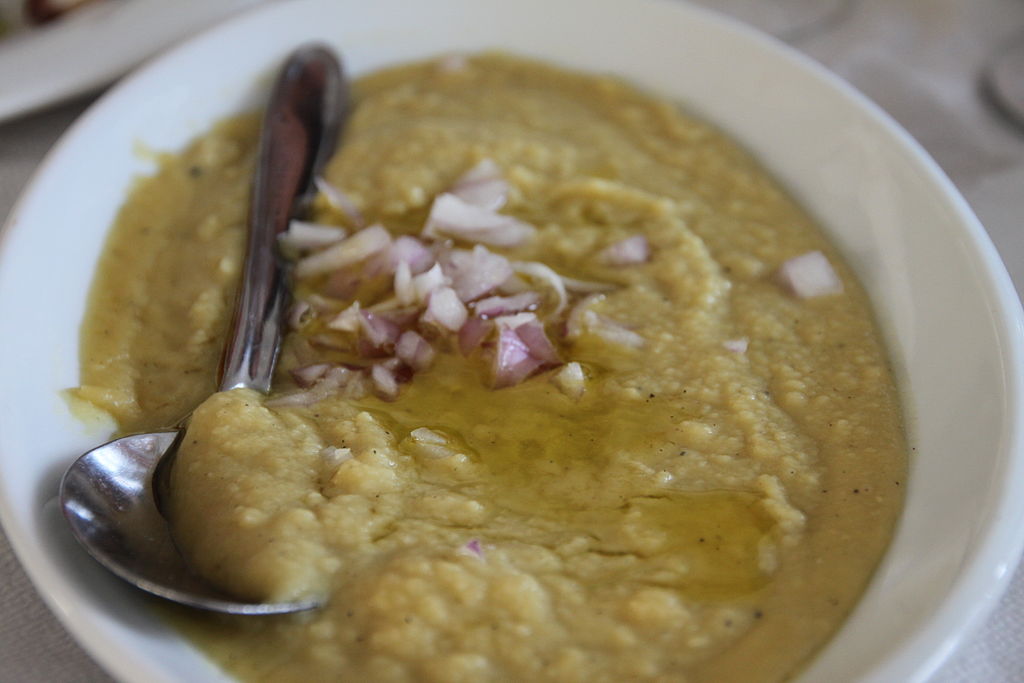
The name can be confusing. Santorini fava is made from Lathyrus clymenum, sometimes known locally as arakas or associated with the Greek term lathouri. It belongs to the grass-pea group of legumes rather than being the common broad bean, Vicia faba.
Once dried, the small yellow seeds are peeled and split or ground. When cooked, they produce the smooth, creamy purée familiar on Greek tables.
The result is deceptively simple: golden fava, usually finished with olive oil and lemon and often accompanied by onions, capers or other local ingredients.
But beneath that simple dish is a much older agricultural story.
A crop shaped by a volcanic island
Santorini is not an easy place to farm. Its volcanic landscape, limited rainfall and strong winds have forced generations of farmers to work with conditions that are very different from those found in fertile mainland agricultural regions.
That helps explain why the survival of Lathyrus clymenum is so significant.
Rather than being an ordinary crop that happened to become famous, the plant became closely associated with a very particular environment. The EU’s historical documentation notes that its cultivation in the Santorini area can be traced archaeologically to the 16th century BC and describes a continuity of cultivation extending for more than 3,500 years.
Researchers studying the crop also describe Lathyrus clymenum as an ancient Aegean domestic plant whose archaeological record extends into the Bronze Age.
That makes Santorini fava an unusual kind of food heritage: not simply an old recipe, but a living crop connected to an ancient agricultural landscape.
From Bronze Age food to Greek meze
The word “fava” itself has a complicated history. The EU’s historical documentation notes that the term appears in fragments of a lost tragedy by Aeschylus, dating to the 6th–5th century BC. Later ancient writers used related terminology for legumes and preparations that do not always correspond neatly to the modern dish.
That means it would be misleading to say that an ancient Greek writer described exactly the same dish served in a Santorini taverna today.
What the evidence allows us to say is more interesting: the plant behind Santorini’s fava was already being cultivated and consumed in the Bronze Age, while the modern food tradition developed through a much longer history of Greek agriculture and cuisine.
Today, the dish is one of the foods most strongly associated with Santorini.
A visitor may encounter it as an inexpensive meze beside seafood, tomatoes, capers and other island specialties. Yet the little bowl of golden purée represents an agricultural tradition that predates Classical Greece by roughly a millennium.
Related: Foodies Alert: 5 Best Traditional Santorini Dishes to Try
See all the latest news from Greece and the world at Greekreporter.com. Contact our newsroom to report an update or send your story, photos and videos. Follow GR on Google News and subscribe here to our daily email!

