



Every August 23, the harbor of Naousa in the Cyclades becomes the stage for one of the region’s most distinctive summer traditions. The day marks the Nine Days of the Virgin Mary—the closing day of the Dormition feast—which, on the Greek island of Paros, is followed by the dramatic Pirate Night (Koursariki Vradhia).
The event is a reenactment of the arrival of corsairs in Naousa and is officially presented by the Municipality of Paros as a tradition connected with the 1537 campaign of Ottoman admiral Hayreddin Barbarossa. The modern celebration features boats, fireworks, music, dancing, and performers dressed as pirates in a procession through the harbor and narrow streets of the town.
Pirate Night is a striking example of how a community on a Greek island such as Paros has combined religious celebration with the preservation of historical memory.
The history behind Pirate Night on Paros
The historical backdrop is the turbulent period when Paros was caught between Venetian and Ottoman power in the Aegean. The Ephorate of Antiquities of Cyclades records that Paros remained under the rule of the Duchy of the Aegean and later the Venetian Sommaripa and Venier families before the island was conquered in 1537 by the Ottoman admiral Barbarossa and his fleet.
The island had already endured repeated attacks by Turks and pirates. According to the official archaeological guide to Paros, Naousa itself had become a pirate hideout by the early 15th century. The medieval and early modern history of Naousa can still be seen in its harbor. The settlement’s fortifications date to the Venetian period, including the circular tower at the entrance to the harbor, which was built in the early 16th century. That landscape is an important part of the story. Pirate Night does not take place in an abstract setting; the celebration unfolds around a harbor that still preserves physical traces of the era pertaining to the tradition.

What happened in 1537?
The Ottoman conquest of Paros in 1537 is a documented historical event. Barbarossa’s campaign brought the island under Ottoman control, ending the period of Venetian rule. The more dramatic story associated with the modern celebration, however, differs. According to the Municipality of Paros, Barbarossa’s men raided Naousa, abducted women from the village, and fought with local men who attempted to rescue them. It should be noted, however, that this is an account based on local tradition rather than a historically confirmed fact.
Official archaeological sources do, nevertheless, clearly document Barbarossa’s conquest of Paros in 1537 although they do not formally support every detail incorporated into today’s reenactment. This distinction is worth noting, but it does not make the tradition any less interesting.
When the pirates return to Naousa
The modern Koursariki Vradhia takes place every August 23 as part of the Nine Days celebration. Based on the Municipality of Paros, the reenactment begins with pirates arriving from the sea with flares before proceeding to the harbor and narrow streets of Naousa. Performers recreate the traditional narrative as spectators watch on from the waterfront. The evening continues with fireworks, live music, and performances by local dance groups. Traditional food and drinks, including souma, a traditional alcoholic beverage from the Cyclades, and seafood, are also part of the celebration.
According to locals, the custom allows residents to symbolically “exorcise” the memory of the pirates who ravaged the island for many years. The result is not a historical reenactment in the strict academic sense. Instead, it is a living piece of local folklore and cultural memory, performed annually by the community.
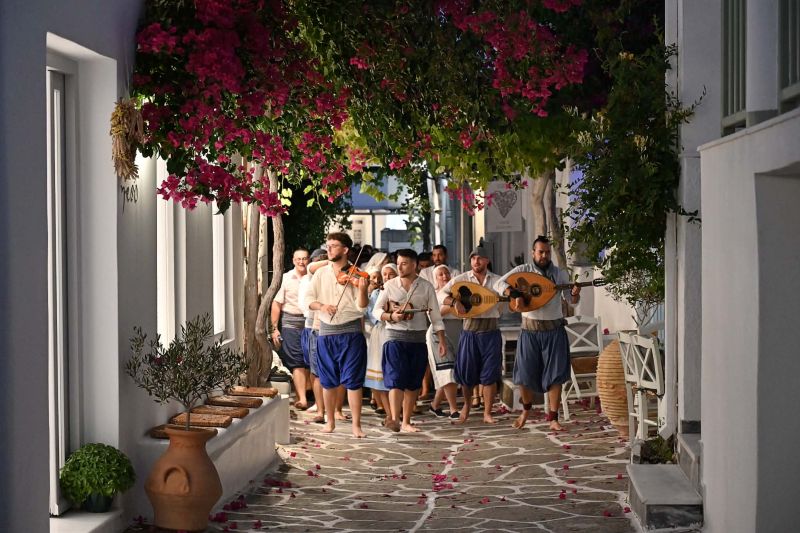
Why is Pirate Night on the Greek island of Paros celebrated on August 23?
The timing of Pirate Night is directly connected to the Orthodox calendar. The celebration takes place on August 23, the Nine Days of the Virgin Mary, marking the completion of the Feast of the Dormition. The Municipality of Paros explicitly describes Pirate Night as part of the August 23 celebration.
The connection has been part of Paros’ organized cultural calendar for decades. A municipal cultural program from 2013, for example, lists August 23 in Naousa as the celebration of the Nine Days of the Virgin Mary, accompanied by Pirate Night, fireworks, and traditional dance performances. The event is therefore not a separate tourist attraction that happens to occur in August. Instead, it is woven into the community’s annual celebration of August 23.
A tradition with a long modern history
Pirate Night itself has become an established part of Naousa’s cultural identity. A municipal press release marking its fiftieth anniversary described the celebration as an annual event in which corsairs enter the harbor at sunset with lights and cries, recreating the pirate raid. That detail is significant. The modern event is not a centuries-old reenactment handed down unchanged from the 16th century. Instead, it is a modern cultural tradition inspired by historical memory.
This distinction allows the celebration to be appreciated for what it actually is: a community-organized performance that keeps an important chapter of Paros‘ past visible.

Naousa on the Greek island of Paros turns history into a spectacle through its Pirate Night
Today, Naousa is one of Paros’ most renowned destinations with its whitewashed streets, fishing harbor, and Venetian remains attracting visitors from around the world. On August 23, however, the harbor transforms. The lights go out, boats become pirate vessels, performers arrive from the sea, and fireworks illuminate the waterfront as residents and tourists come together to experience the spectacle of Pirate Night.
The tradition also demonstrates how Greek communities preserve history in ways that go beyond monuments and museums. The fortifications remain in the harbor, while the story associated with them is revived annually through music, theater, and ritual. For Naousa, the Nine Days of the Virgin Mary therefore draws on religious memory of the Dormition as well as local memory pertaining to an Aegean world shaped by Venetian rule, Ottoman conquest, and piracy. The result is one of the most unusual August 23 traditions in Greece—a religious feast that, by nightfall, transforms into a pirate story on the waters of the Greek island of Paros.
See all the latest news from Greece and the world at Greekreporter.com. Contact our newsroom to report an update or send your story, photos and videos. Follow GR on Google News and subscribe here to our daily email!

