



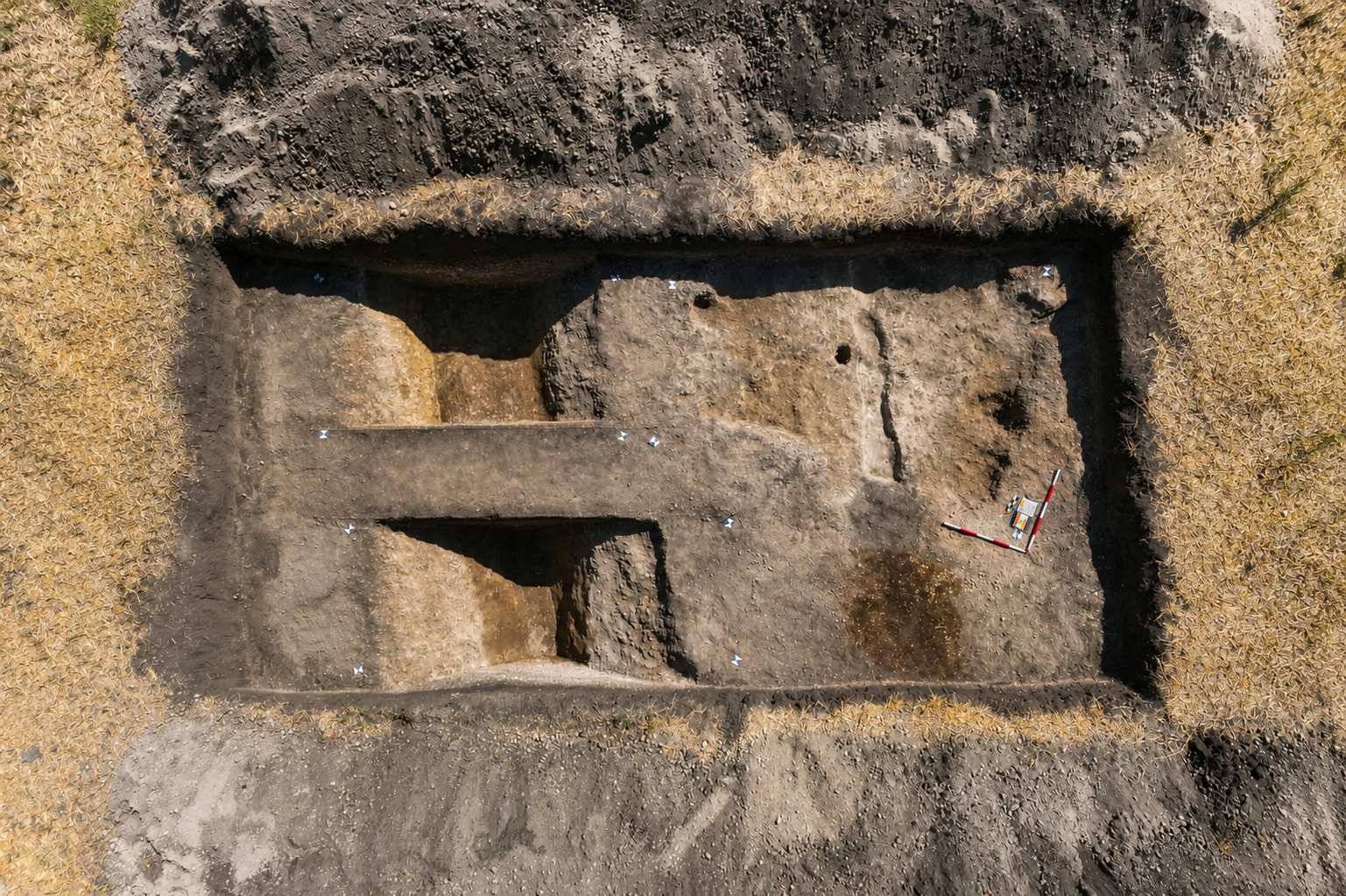
Archaeologists in Czech Republic are uncovering new evidence that a 6,500-year-old prehistoric sanctuary may have been designed around the movements of the Sun and Moon, more than 1,000 years before the earliest earthworks at Stonehenge.
The nearly circular enclosure lies near Chleby in Central Bohemia’s Nymburk region. It measured about 230 meters, or 755 feet, across and was surrounded by a ditch more than 2.5 meters deep. Twelve entrances opened into the monument.
Researchers led by the University of West Bohemia in Pilsen say the entrances do not appear to have been positioned randomly. Their arrangement may instead have helped prehistoric communities observe important points in solar and lunar cycles.
Two alignments are particularly significant. One appears to mark the Moon’s most extreme rising and setting positions during its roughly 18.6-year cycle, known as a major lunar standstill. Another links sunrise at the summer solstice with sunset at the winter solstice, adding Chleby to a wider group of ancient monuments with astronomical alignments.
Solar and lunar alignments shape the monument
Stonehenge also has a main axis associated with the summer and winter solstices. Archaeologists recently identified a 5,000-year-old solstice site near Stonehenge, highlighting how solar observation shaped the wider prehistoric landscape. Chleby, however, is far older.
Organic material from the site dates the enclosure to roughly 4,500 B.C., during the early Eneolithic period. Stonehenge’s first major earthwork phase dates to around 3000 B.C.
A 6,500-year-old prehistoric sanctuary in Czechia may have been built to track the Sun and Moon.
Its carefully positioned entrances align with the solstices and an 18.6-year lunar cycle — more than 1,000 years before the earliest Stonehenge earthworks. pic.twitter.com/8fM3GEeXi7
— Tom Marvolo Riddle (@tom_riddle2025) August 21, 2026
Petr Krištuf of the University of West Bohemia, who leads the research, believes the solar alignment may have carried symbolic meaning. The summer solstice may have represented renewal, while the winter solstice could have marked an ending in the seasonal cycle.
Evidence from the ditch also supports an interpretation of Chleby as a ritual center rather than simply a defensive enclosure. Archaeologists found bull skulls and horns near some entrances, raising the possibility that cattle remains once decorated gateways into the monument.
Bull remains point to ritual activity
Other discoveries in Europe, including a 10,500-year-old wild cattle skull placed on a stake, have also pointed to the ritual importance of cattle in prehistoric communities.
Jan Turek of Charles University notes that bulls held symbolic importance among early farming societies in prehistoric Europe. The enormous ditch also points to organized communal labor well beyond a single household.
Chleby remained important after its original use ended. During the Early Bronze Age, people associated with the Únětice culture reused part of the site for burial. A grave discovered in 2016 contained 15 to 18 people deposited over time.
Ancient DNA showed they did not all belong to one biological family, echoing broader research showing that prehistoric communal burials did not always reflect biological kinship. By the Iron Age, the enclosure appears to have lost its earlier significance. The ditch was gradually filled and a settlement developed across the former ritual landscape.
Soil chemistry may reveal daily activity
Researchers are now studying soil chemistry to identify activities that left few visible remains. Jan Fišer of the University of Hradec Králové is examining chemical signatures that could reveal where people gathered, handled animals or prepared food.
The research could provide a clearer picture of how Chleby functioned. The site preserves an unusual record of a landscape that shifted from a monumental gathering place tied to celestial cycles to a burial ground and, eventually, an everyday settlement.
See all the latest news from Greece and the world at Greekreporter.com. Contact our newsroom to report an update or send your story, photos and videos. Follow GR on Google News and subscribe here to our daily email!

