



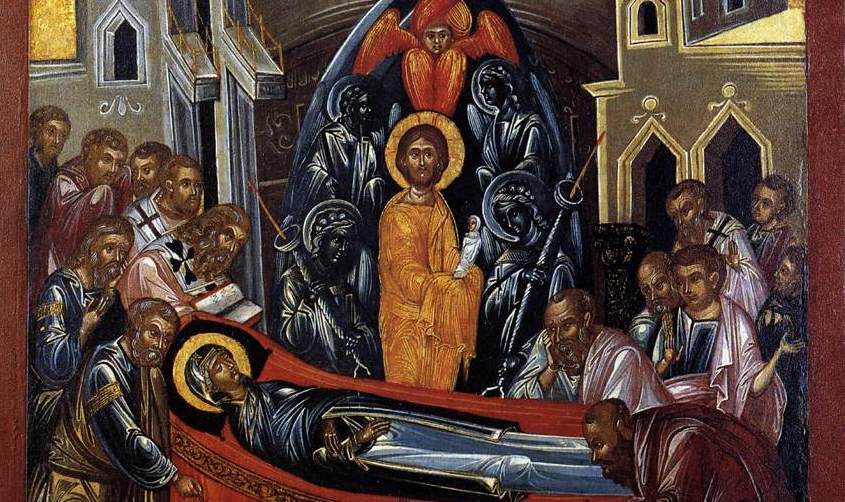
As Orthodox Christians prepare to celebrate the Dormition of the Theotokos on August 15, the question of what happened to Mary, the mother of Jesus, at the end of her life remains surprisingly difficult to answer based on the earliest Christian sources.
The Orthodox tradition preserves a detailed account. Mary is said to have learned that the end of her earthly life was approaching. The Apostles miraculously gathered in Jerusalem, where she died peacefully, and Christ received her soul. Her body was then carried to a tomb near Gethsemane. Three days later, according to tradition, the tomb was found without her body.
But the New Testament does not tell this story. The detailed account of the Dormition appears in Christian writings centuries later, and the earliest surviving accounts do not agree on every detail.
The Bible’s silence on Mary’s death
Mary is a central figure in the Gospels, particularly in the accounts of the birth and early life of Jesus. She is also present at the Crucifixion in the Gospel of John.
After the Ascension, however, the New Testament says very little about her. Acts 1:14 places Mary among the disciples in Jerusalem, where they devoted themselves to prayer. After that, the canonical New Testament does not record when she died, where she was buried, or what happened to her body.
This silence is noteworthy because the detailed story familiar to Orthodox Christians today does not appear in the New Testament itself. Instead, it comes from a later Christian tradition.
An uncertain fourth-century Christian writer
One of the most revealing early references comes from Epiphanius of Salamis, a fourth-century Christian bishop and theologian. In his Panarion, Epiphanius considers what may have happened to Mary at the end of her life. Rather than presenting a settled account, he acknowledges that Scripture does not make the matter clear and considers several possibilities.
Mary may have died and been buried, he suggests. Alternatively, she may have suffered martyrdom, or she may have even remained alive. Epiphanius does not claim to actually know, and that uncertainty is significant. By the late fourth century, a Christian writer of considerable authority was discussing the end of Mary’s life without having a definitive account to present.
Modern historian Stephen J. Shoemaker, in his study Ancient Traditions of the Virgin Mary’s Dormition and Assumption, likewise points to the first four Christian centuries as a period in which evidence for the end of Mary’s life is remarkably sparse.
When did the Dormition tradition emerge?
The picture changes during late antiquity. According to Shoemaker’s research, the earliest surviving Dormition narratives appear clearly in the late fifth and early sixth centuries. They emerged in different Christian communities, particularly in Syria, Palestine, and Egypt. There was no single account. Instead, differing narratives began circulating, each offering its own version of Mary’s final days and departure from earthly life.
Shoemaker identifies more than sixty Dormition and Assumption stories surviving from before the tenth century in nine ancient languages. These share certain basic themes but differ considerably in the details, making the history of the Dormition more complicated—and more interesting—than the idea of one uninterrupted narrative handed down unchanged from the Apostles.
At the same time, Shoemaker argues that some of these traditions may preserve much older material. A few narratives, he suggests, may have been composed as early as the third century or even earlier, although the surviving evidence becomes much clearer only centuries later.
The story of the Apostles gathering around Mary
One of the central elements of the tradition is the gathering of the Apostles around Mary at the end of her life. According to later Dormition narratives, the Apostles had been preaching in various parts of the world when they were brought together in Jerusalem as Mary’s death approached. She then passed away peacefully, and Christ received her soul. Her body was placed in a tomb, where the Apostles buried her.
These details appear in several ancient Dormition traditions, but they should not be presented as events recorded in the New Testament. They belong to the later literature through which Christians came to understand Mary’s final days.
The ancient story of the empty tomb
The tradition becomes even more familiar with what happens after Mary’s burial. In several Dormition accounts, the Apostles discover that Mary’s body is no longer in the tomb. A particularly important version is preserved in a homily associated with John, Archbishop of Thessalonica, who lived in the seventh century. The text describes the Apostles gathering for Mary’s death and burial and relates the discovery that her body was no longer in the tomb. The story is an important witness to the development of the Dormition tradition, but the date of the text is crucial, as it belongs to the early Byzantine period rather than the first Christian generation.
The Apostle Thomas also becomes part of some versions of the story. In the tradition that developed around the Dormition, Thomas arrives later on and inquires about Mary’s body, requesting to see it—only for the tomb to be found empty. This is one of the elements that eventually became deeply embedded in the Orthodox understanding of the event.
Gethsemane, the Virgin Mary, and the Dormition of the Theotokos
The tradition places Mary’s tomb in Gethsemane at the foot of the Mount of Olives in Jerusalem. By the Byzantine period, the association between Mary and the site had become well established.
The eighth-century Christian theologian John of Damascus delivered homilies on the Dormition at a church near Gethsemane traditionally associated with Mary’s tomb. His sermons describe the Apostles gathering around Mary, her death, the reception of her soul by Christ, and the burial of her body. They also reflect the developed tradition that Mary’s body was subsequently removed from the tomb.
The existence of this tradition by the eighth century is historically significant. It shows how firmly the association between Mary and Gethsemane had become established in Byzantine Christianity. It does not, however, prove archaeologically that the woman buried there was Mary, the mother of Jesus. The distinction between an ancient tradition and historical proof is essential.
Ancient accounts about Mary and the Dormition of the Theotokos differ
One of the most important findings of modern scholarship is the sheer variety of the Dormition narratives. The surviving texts originate from various regions and Christian communities and were written or preserved in several languages. Some emphasize Mary’s bodily translation into heaven, while others present differing accounts of what happened to her body.
According to Shoemaker, there is no convincing evidence that all of these stories simply developed in a single, orderly sequence from one original account. Instead, the evidence points to several traditions emerging and developing alongside one another.
That diversity does not mean that the Dormition tradition is late or insignificant. It means that historians must distinguish between the ancient belief in Mary’s departure from earthly life and the individual details in particular versions of the story.
How the tradition evolved into the feast of August 15, the Dormition of the Theotokos
Over time, the Dormition became firmly established in the liturgical life of the Christian East. The Orthodox Church today celebrates August 15 as the Dormition of the Theotokos, understanding Mary’s “falling asleep” as her departure from earthly life and her entrance into heavenly glory.
The Greek Orthodox tradition preserves the account of the Apostles gathering around Mary, Christ receiving her soul, her burial near Gethsemane, and the later discovery of the empty tomb. For Orthodox Christians, these events are not merely a historical puzzle. They form part of the Church’s theological understanding of the Mother of God and her place in salvation history.
Historically, however, the sources must be treated according to what they actually are. The New Testament provides only a brief final glimpse of Mary, fourth-century writers such as Epiphanius acknowledge uncertainty, and detailed Dormition narratives emerge and multiply in later centuries.
What we actually know
The surviving evidence on Mary and the Dormition of the Theotokos allows some conclusions to be made with confidence. Mary was alive and part of the early Christian community in Jerusalem after the Ascension of Jesus. The New Testament does tell us that much, but it does not reveal when or how she died.
By the fourth century, Epiphanius did not have a definitive account of her final days. By the late fifth and sixth centuries, detailed traditions related to Mary’s death and departure from the world were in circulation in several Christian communities. By the seventh and eighth centuries, accounts involving the Apostles, Mary’s burial, and the disappearance of her body had become established features of influential Christian literature.
What historians cannot establish from the surviving evidence is the exact year of Mary’s death, the precise circumstances of her final days, whether the Apostles actually gathered around her, and whether the tomb at Gethsemane can be identified with certainty as her historical burial place. Such questions belong to the boundary between historical evidence and religious tradition.
The mystery behind the Dormition
The story of the Dormition is therefore also a story about Christian memory. The New Testament leaves the final chapter of Mary’s earthly life undisclosed. Centuries later, Christian writers began preserving accounts of her death, burial, and departure from the world. Those accounts on Mary differed in significant ways, but they gradually formed the traditions that became central to the celebration of the Dormition of the Theotokos.
For Orthodox Christians, August 15 remains one of the greatest feasts of the year. For historians, however, the ancient Dormition narratives offer a different kind of insight and show how early Christian communities sought to answer the question of what happened to the Mother of Jesus after the story of the Gospels concluded—a question the earliest biblical sources had left unanswered.
See all the latest news from Greece and the world at Greekreporter.com. Contact our newsroom to report an update or send your story, photos and videos. Follow GR on Google News and subscribe here to our daily email!

