



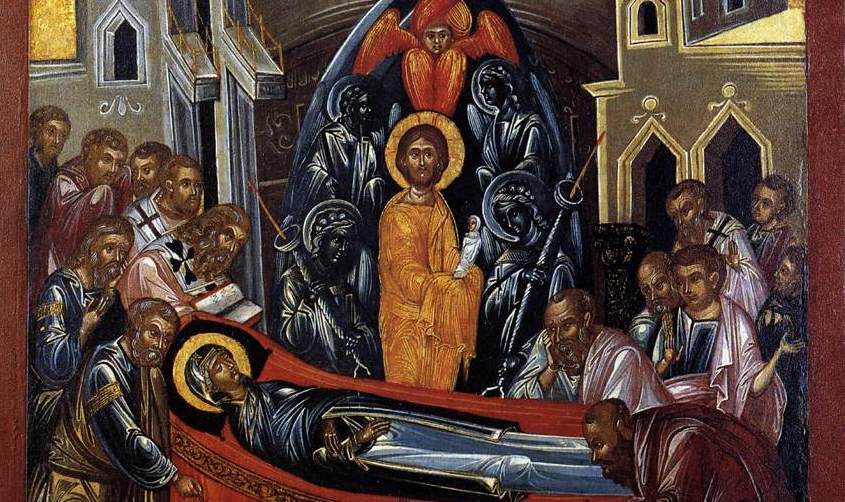
In Orthodox tradition, August 12 is linked to the final days of the Virgin Mary before her Dormition, celebrated a few days later on August 15. Three days prior to her death, the Archangel Gabriel appeared to Mary and announced she would soon depart from her earthly life and be reunited with her Son.
This is part of the sacred tradition surrounding the Dormition of the Theotokos and should be understood as a religious tradition rather than a historically documented event.
The Archangel Gabriel’s announcement
According to the traditional account, the Virgin Mary was praying on the Mount of Olives when the Archangel Gabriel appeared to her. He announced that her earthly life was nearing its end and that, in three days, she would be taken to her Son. Gabriel is said to have given Mary a palm branch, which she received as a sign of the approaching event. She then returned to Jerusalem and prepared herself for her Dormition through prayer.
The connection with August 12 comes from the traditional three-day period preceding the Feast of the Dormition, celebrated just days later.
What is the Dormition of the Virgin Mary?
The Dormition of the Theotokos, celebrated on August 15, is one of the most important feasts of the Orthodox Church. The word itself means “falling asleep” and refers to the death of the Virgin Mary as well as her passage from earthly life to the presence of God.
Orthodox tradition holds that the Apostles were miraculously gathered in Jerusalem for Mary’s final days and were present at her Dormition and burial. The Apostle Thomas, however, arrived after the burial. Tradition has it that when the tomb was opened so he could venerate Mary’s body, it was empty. The Church interprets this as part of the mystery of Mary’s glorification and her passage into heavenly life.
Why the Dormition of the Virgin Mary on August 15th is so important
The Feast of the Dormition is celebrated throughout the Orthodox world, but it is especially important in Greek religious and cultural life. August 15 is often referred to as the “Easter of summer,” and churches and monasteries dedicated to the Virgin Mary attract thousands of pilgrims, while major celebrations take place across the country.
Among the most well-known Marian pilgrimage sites is the island of Tinos. There, a celebrated icon of the Virgin Mary can be found at the Church of Panagia Evangelistria. Numerous monasteries and churches throughout mainland Greece and other islands also house icons of the Virgin Mary, before which services of supplication, including the Paraklesis, are held on the days leading up to her Dormition as Orthodox Christians prepare spiritually for the feast.
Not a documented historical event but a tradition
The story of Gabriel’s announcement is especially significant in Orthodox Christianity, but it is vital to distinguish religious tradition from independently established history. The New Testament does not describe the death of the Virgin Mary or the circumstances surrounding her Dormition. The details of the story come from the Church’s later sacred tradition and liturgical life.
For this reason, the account of Gabriel appearing to Mary on August 12 should be presented as an Orthodox tradition rather than as a historically verified event. The tradition is a vital part of the spiritual narrative leading toward August 15.
For Orthodox Christians, the period from August 12 to the Dormition represents the final stage of preparation for one of the Church’s greatest celebrations—a feast centered not simply on death but on the Christian understanding of Mary’s passage from earthly life to eternal life with her Son.
See all the latest news from Greece and the world at Greekreporter.com. Contact our newsroom to report an update or send your story, photos and videos. Follow GR on Google News and subscribe here to our daily email!

