



In the dusty shadows of ancient Greek history, where warriors and kings take precedence, a lone voice rises from Sparta—that of Tyrtaeus, the poet who armed the legendary city-state not with blades but with words.
Today, his name rings faintly in the ears of history enthusiasts. He stands nearly forgotten, a minor footnote in the grand tale of Greek warfare and literature. Yet, in the 7th century BC, Tyrtaeus was the heart of Sparta’s spirit. His verses stirred the souls of warriors, and his words gave form to a uniquely Spartan idea of honor, sacrifice, and unity.
Tyrtaeus: A poet in a warrior’s world
Sparta was not a city known for art or poetry. Unlike Athens, it did not glorify the stage, the brush, or the stylus. On the contrary, Spartan life revolved around discipline, order, and war. Boys trained as soldiers from the age of seven. Spartan citizens lived simply, spoke little, and fought hard. In such a world, a poet seems out of place.
Yet Tyrtaeus existed and even thrived. His poetry played a crucial role in shaping the Spartan identity. He lived during the Second Messenian War, around the mid-7th century BC. Sparta was locked in a brutal struggle against the helots, the enslaved people of Messenia. It was a time of ongoing war when morale dropped and fear began to crack the Spartan ranks. The Spartans needed more than weapons—they needed belief, and Tyrtaeus gave them just that.
Through elegiac verses, he reminded them of duty, pride, and ancestral honor. His poetry became part of their training, recited in camps and echoed on battlefields. Moreover, it reminded them of what it meant to die for Sparta—and why that death mattered.
From Athens to Sparta: The myth of the poet Tyrtaeus
Legend cloaks the origins of Tyrtaeus in mystery and mockery. According to Pausanias, Sparta once consulted the Oracle at Delphi during a time of desperation. The Oracle advised them to bring in an Athenian leader. Expecting a wise general or skilled strategist, Sparta instead received Tyrtaeus.
He was, they said, lame and unimpressive—a mere teacher, perhaps even a joke sent by the Athenians. However, Tyrtaeus turned their scorn into awe. His verses rallied the Spartan troops. He did not need a sword to lead; he led with song.
Whether this tale holds truth is unknown. Most scholars like H. J. Rose suspect Tyrtaeus was Spartan-born. The story of his Athenian origin likely reflects a case of later propaganda in an aim to discredit the idea that Sparta produced a poet. Still, the myth captures a deeper truth: Tyrtaeus defied expectations, carving a space for art within the harshest society of ancient Greece.
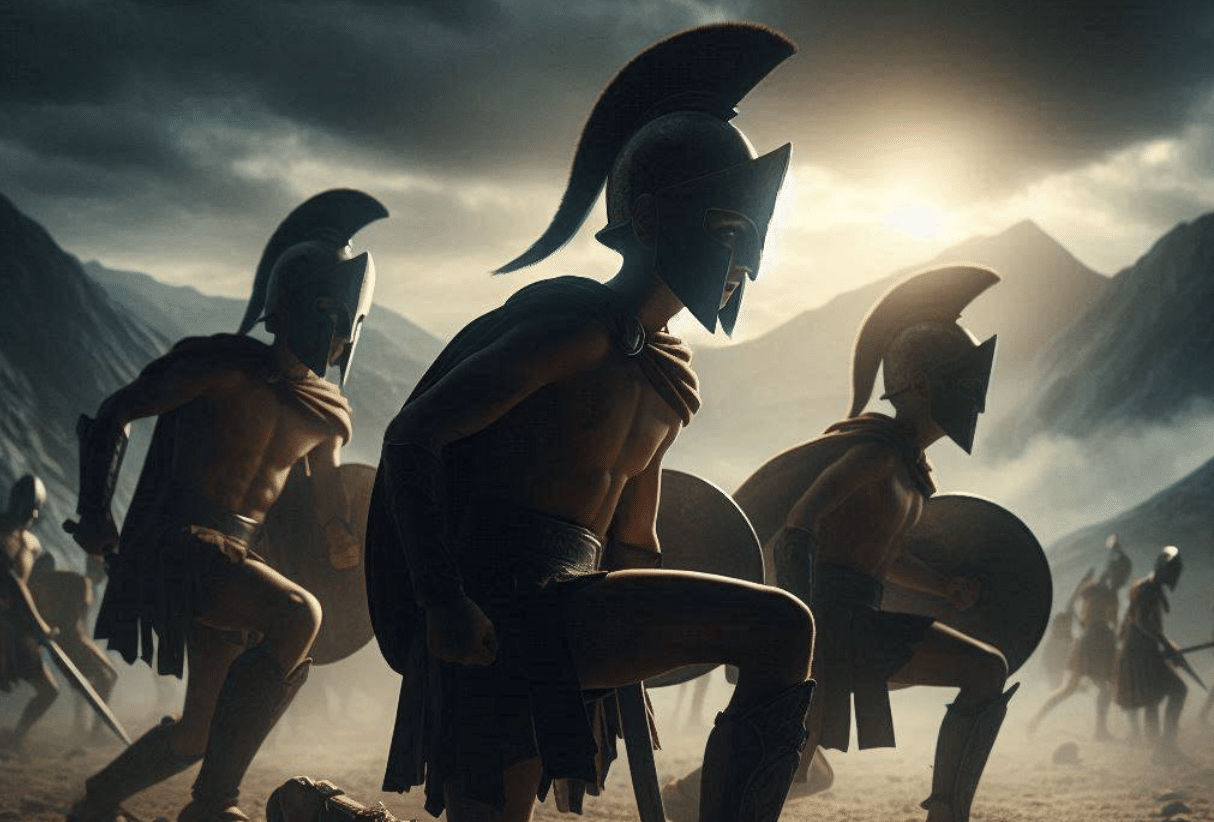
The message of the poet
Tyrtaeus did not write for entertainment. His poetry was a weapon with a clear aim: to mold Spartan men into fearless warriors.
He wrote in elegiac couplets, a form used often for funeral songs. The style matched the content. Death and honor walked hand in hand in his work. He told Spartans that dying in battle was the highest good. To die for the city was not a loss but a triumph. In one of his most famous fragments, he wrote:
“Let each man hold his shield straight and advance,
And be quick to reach the front, close to the enemy.”
He praises the man who dies young in battle, and he scorns the old man who flees and dies in disgrace. Tyrtaeus made it clear: glory came only through courage and loyalty. His verses did not glorify individual heroes. Unlike Homer, who sang of Achilles and Odysseus, Tyrtaeus focused on the group. The phalanx mattered more than the man. This was Sparta’s creed, and Tyrtaeus gave it voice.
Some may balk at the idea of poetry as military propaganda. However, in Tyrtaeus’ time, it was the main medium of mass communication. Additionally, there were no newspapers or broadcasts. Words had to be spoken, heard, and remembered. Tyrtaeus understood this well.
His verses reached the hearts of Spartan boys, and they absorbed them alongside sword drills and endurance training. By the time they became hoplites, his words had become a part of them. They carried not only shields but songs. In this way, Tyrtaeus helped build the Spartan war machine. In other words, he gave it its very soul.
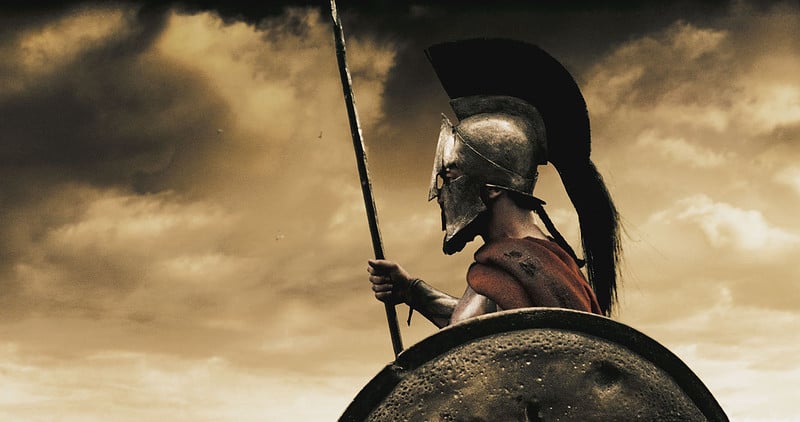
Rediscovering Tyrtaeus, the poet of warriors
Tyrtaeus’ eclipse in modern memory is not surprising. He left behind only fragments—scattered verses, quoted by later writers. He did not write epics like Homer or philosophical dialogues like Plato. His work served a specific purpose and time.
Later generations viewed Sparta with both admiration and suspicion. Philosophers such as Aristotle saw its rigid system as unnatural, while others romanticized its military discipline. Nonetheless, few valued its culture, and since Tyrtaeus unabashedly spoke of Spartan ideals, his fame withered as did that of the Spartans in general.
Furthermore, as Athens became the cradle of Western civilization, its poets, thinkers, and artists filled the libraries of Europe. Tyrtaeus was thus left behind. Yet he matters not just as a poet but as a lens that shows us how a society like Sparta viewed war, sacrifice, and identity. Moreover, his words reveal what they feared—and what they desired.
Tyrtaeus challenges our assumptions. In a city that claimed to disdain the arts, a poet eventually shaped its soul. In a world ruled by force, words still found a way to lead.

de Benutzer Ticinese Wikimedia Commons, CC BY-
SA 3.0
The legacy that lingers
Tyrtaeus’ verses echo in unexpected ways, for instance in the patriotic poems of Rome, in the war songs of medieval Europe, and even in modern nationalist rhetoric. The idea that dying for one’s homeland is noble finds one of its earliest expressions in his work.
His poems raise questions that continue to be debated to this day. Is dying for one’s country the highest virtue? Can words inspire courage—or manipulate it? What is the role of art in times of war? These are not ancient questions. They are in fact timeless ones.
Tyrtaeus, the poet of Sparta, deserves more than a passing mention in a dusty textbook. He should be remembered as a poet among warriors rather than a mere curiosity. He was, after all, Sparta’s conscience, written in verse. His lines did not adorn temples or win prizes, but they did arm hearts and stir feet to march and hands to grip spears.
In a city built for silence, Tyrtaeus dared to sing.
See all the latest news from Greece and the world at Greekreporter.com. Contact our newsroom to report an update or send your story, photos and videos. Follow GR on Google News and subscribe here to our daily email!

