



The Ancient Greek world is remembered for its wonders, heroes, and stories that shaped Western culture, yet it was equally haunted by mysteries that defy explanation to this very day. Some of these events appear in historical texts, while others endure in local memory, but all challenge the limits of rational understanding.
From the runner who encountered a god on the road to Sparta to the farmer-warrior who vanished after saving Athens, the Ancient Greek world preserves many mysteries, and each of these continues to fascinate and push the boundaries of our imagination.
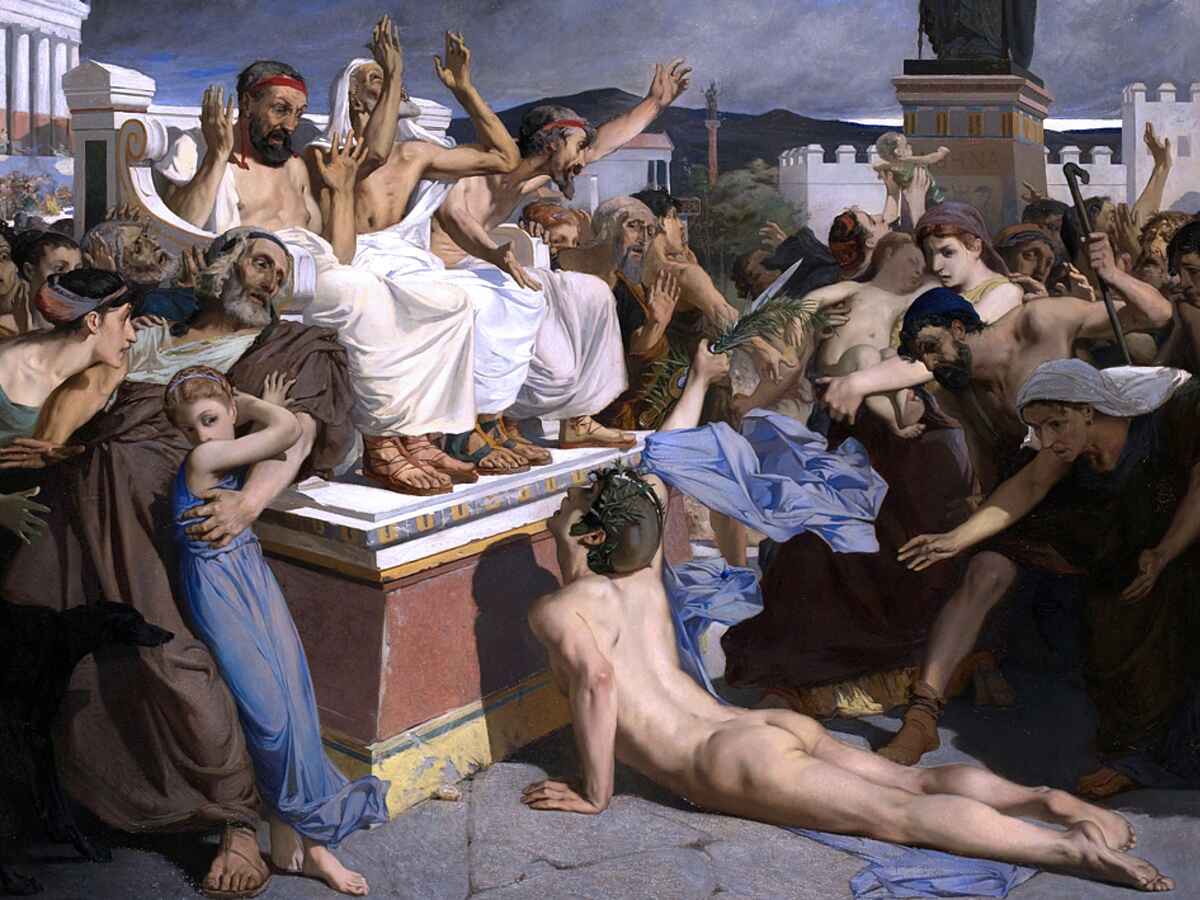
Possibly the most perplexing of Ancient Greek mysteries: Phidippides and the God Pan on the way to Arcadia
The story of Phidippides and Pan, the god of the wild, stands as the most baffling episode of the Ancient Greek world—one of those mysteries that defy clear explanation. Ancient Athenians never questioned it. They trusted the messenger who ran through the wilderness toward Sparta and returned with a message from a god.
Phidippides reached Athens and reported the encounter immediately. He spoke before the victory rather than after it. According to Herodotus in Histories, Pan stopped him near Mount Parthenium. The god asked why the Athenians ignored him and promised support in the coming battle. Phidippides delivered the message the moment he arrived. The Athenians listened, and then they prepared for war.
After their triumph at Marathon, the Athenians remembered the promise. They built Pan a sanctuary at the foot of the Acropolis and offered sacrifices and torch races. They honored the god who, according to their messenger, had spoken in the wilderness. The paradox remains. Phidippides had no reason to invent a divine encounter. He stood exhausted, hungry, and bruised from the run and spoke with urgency. Moreover, the Athenians believed him long before Marathon became a symbol of glory.
Was he driven into a hallucinatory state by extreme physical strain? Did he stumble upon a mountain hermit who, in the dim light, looked like a horned god, or did he witness something we still have no name for? Whatever the case, the event reshaped Athenian religion and introduced new rites. It also set the stage for a victory that transformed Western history. Finally, it is clear that Ancient Greek culture often moved in a space where the supernatural and historical overlapped, leading to mysterious events that still challenge explanation.
Echetlus: The phantom farmer who saved Athens
The Battle of Marathon led to legends that endured for centuries. One of these concerns Echetlus, the “man with the plow.” The historian Pausanias describes a strange figure who fought beside the Athenians. He carried no shield, wore no armor, and held a simple plow as a weapon.
Witnesses claimed he appeared suddenly from the rear of the army. He smashed Persian soldiers with furious strength and fought in silence. When the battle ended, he walked into a cloud of dust and vanished. The Athenians searched for him. No citizen admitted to playing the role. None knew his name. He simply arrived and disappeared.
Later oracles declared that the figure came from the realm of heroes. The Athenians honored him with offerings, placing his image on pottery and frescoes. In time, he became part of civic memory. The identity of Echetlus remains a riddle. He may represent an agricultural hero from an old myth or reflect the spirit of the Athenian farmer-soldier. Yet the reports share consistent details. Soldiers swore they saw a real man. They also insisted he struck down Persians with the use of godly power.
Marathon produced deep trauma and deep pride. Within this emotional landscape, something unusual settled over the memory of that battlefield. In this context, the story of Echetlus stands out. His sudden appearance, silent strength, and mysterious disappearance left the Ancient Athenians with an unexplainable tale, and, to this day, the figure of Echetlus remains one of the most haunting features of the Marathon tradition.
The Ancient Greek mystery of Alexander the Great and the whisper at the oracle of Siwa
Alexander crossed deserts, conquered empires, and changed history. Yet among all the Ancient Greek mysteries associated with his life, one stands apart for its enduring enigma. During his campaign in Egypt, he traveled to the Oracle of Amun at Siwa, a sanctuary deep in the Libyan Desert. Priests guarded it with secrecy, and few outsiders ever made it to the temple.
Alexander entered the inner chamber. Only he and the priests witnessed the ceremony, and when he returned, he refused to reveal what he had been told by the oracle. His expression had changed so noticeably that his generals sensed a transformation. He grew more determined and more confident. Some believed he emerged convinced of divine descent, while others claimed he had been delivered a prophecy pertaining to his future.
Two details deepen the mystery and give the episode even more weight. First, the chief priest greeted Alexander with a title reserved exclusively for gods, calling him “son of Amun.” Then, as the ceremony unfolded, the atmosphere shifted. Alexander accepted the title without hesitation, as though he had anticipated it. Second, he later insisted that no historian record the oracle’s message. Not even Ptolemy, his closest companion, dared to break the silence.
He preserved the secrecy for the entirety of his life. Naturally, this silence raises questions. Why did Alexander conceal the message? Why did the priests treat him as divine the moment he arrived? And how did an isolated desert oracle speak with such apparent precision about his destiny? These questions remain unanswered and keep the story alive for every generation that studies his extraordinary life. No one knows what the oracle said. The desert kept its secret, and Alexander carried it with him to his grave.

The miracle of Delphi in 279 BC: Gods and heroes against the Gauls
In 279 BC, the sanctuary of Delphi faced a massive threat when a huge army of Gauls marched into Greece seeking loot, gold, and the treasures of Apollo. As the priests evacuated the sacred site and the defenders prepared for battle, the tension in the valley grew, and a violent storm suddenly struck as the Gauls advanced.
Thunder shook the mountains, and rocks broke loose from Mount Parnassus, crashing down onto the invaders. At the same moment, witnesses reported ghostly figures appearing beside the defenders—identified as the mythical heroes Hyperochus, Laodocus, and Pyrrhus of the Molossians—whose presence sent fear rippling through the Gaulish ranks. The attackers panicked and fled into the night, only to be trapped by heavy snowfall that left many dead in the ensuing chaos. Greek historians such as Pausanias later described the episode as a direct intervention from Apollo, arguing that divine forces had fought alongside the Greeks.
A modern reader might point to weather, terrain, and battlefield confusion, yet the ancient testimonies insist on something more. They describe figures who fought in human form, and multiple witnesses claimed to have seen these heroes with their own eyes. Because of these accounts, the mystery shaped Delphi’s reputation among the Ancient Greeks as a sacred fortress protected not only by its defenders, but—according to the stories—by the gods themselves. The miracle remains one of the most dramatic and puzzling episodes in Ancient Greek history.

The ghost of Aetolia: Phlegon of Tralles’ terrifying tale
Phlegon of Tralles, a freedman of Emperor Hadrian, recorded many marvels, and one of his strangest stories came from Aetolia. A young woman named Philinnion died and reportedly returned from the grave six months later, visiting the guest who was staying in her parents’ home and speaking with him before lying down to sleep at his side.
Rumors soon reached her parents, who entered the room and found their daughter alive. Philinnion scolded them for interrupting her visit and then collapsed, dying a second time on the spot. When the authorities opened her tomb, they found it empty, only to later discover her body laid out again in a nearby chamber.
Phlegon listed names, locations, and witnesses, treating the story as a factual report rather than offering any moral interpretation. He presented it almost as a case study. The tale contains too many concrete details for easy dismissal. It fits neither myth nor simple superstition, and it remains one of the most unsettling accounts from antiquity.

A world still full of shadows
These five events show the ancient world in its most mysterious form, revealing moments when reality seemed to blur with myth. They preserve testimonies from soldiers, kings, priests, and citizens—accounts that carry historical weight, yet consistently break beyond the normal boundaries of human experience.
The Ancient Greeks lived close to the sacred. They saw the divine in mountains, valleys, storms, and strangers, and they accepted without hesitation that heroes might walk beside them in battle or that the gods could speak, warn, or even fight. In the end, we continue searching for explanations, but the mysteries endure.
See all the latest news from Greece and the world at Greekreporter.com. Contact our newsroom to report an update or send your story, photos and videos. Follow GR on Google News and subscribe here to our daily email!

