



Katerina Harvati, one of the world’s leading paleoanthropologists, will receive this year’s Albert Einstein World Award of Science from the World Cultural Council in recognition of her groundbreaking contributions to the study of human origins and evolution.
The award, one of the most prestigious international honors in science, recognizes researchers whose work has significantly advanced scientific knowledge while benefiting humanity. Named after Albert Einstein, it has previously been awarded to distinguished scientists whose discoveries have transformed their fields.
Prestigious international award honors human origins research
Harvati, professor of Paleoanthropology and director of the Senckenberg Centre for Human Evolution and Palaeoenvironment at the University of Tübingen in Germany, has spent more than two decades reshaping scientists’ understanding of the human evolutionary story.
Internationally recognized for pioneering the use of virtual anthropology and three-dimensional geometric morphometrics, she has developed innovative techniques that allow researchers to digitally reconstruct fossil remains and compare subtle anatomical differences with unprecedented precision. These techniques have revolutionized the study of ancient human fossils, enabling scientists to answer longstanding questions about the relationships between extinct human species.
Her research has provided compelling evidence that Neanderthals were a distinct human species rather than simply a regional variation of modern humans. She has also strengthened the case for the African origin of Homo sapiens and helped reconstruct ancient migration routes that brought early humans into Europe and Asia.
Oldest skull in Europe found on the Peloponnese
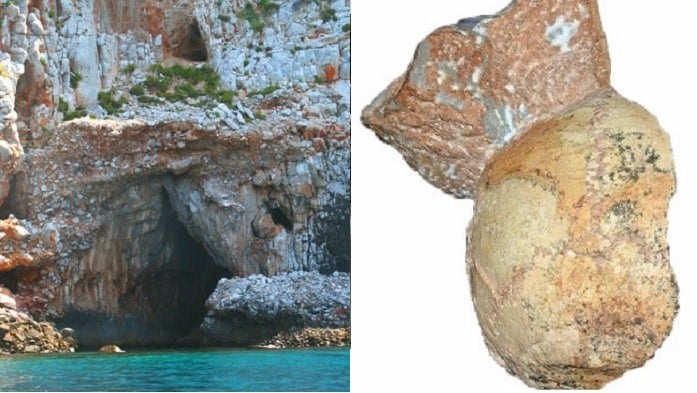
Harvati’s work has been especially significant for Greece, where several of her discoveries have rewritten key chapters of European prehistory.
Perhaps her best-known contribution came through the study of the Apidima 1 skull from the Mani Peninsula in the Peloponnese. Using modern imaging and dating techniques, Harvati and her colleagues concluded that the fossil belongs to Homo sapiens and is approximately 210,000 years old, making it the oldest known evidence of modern humans outside Africa. The finding pushed back the arrival of Homo sapiens in Europe by roughly 150,000 years, suggesting that early populations reached southeastern Europe far earlier—and in multiple waves—than previously believed.
Her research throughout Greece and the Balkans has also revealed that southeastern Europe played a far more important role in human evolution than once assumed. During the Pleistocene Ice Ages, the region served as both a climatic refuge and a migration corridor for humans and wildlife moving between Africa, Asia, and Europe. Excavations directed by Harvati and her collaborators have uncovered some of Europe’s oldest archaeological sites in Greece, extending evidence of human occupation in the region to around 700,000 years ago.
Harvati’s team and the Marathousa discoveries

More recently, Harvati’s team made another landmark discovery at the open-air archaeological site of Marathousa 1 near Megalopoli in the central Peloponnese. Researchers identified the world’s oldest known wooden hand tools, dating to approximately 430,000 years ago. Preserved in waterlogged sediments alongside the remains of butchered elephants and stone tools, the artifacts provide rare evidence that early humans possessed sophisticated woodworking skills and relied on organic technologies that rarely survive in the archaeological record.
Beyond her own discoveries, Harvati has become one of Europe’s most influential leaders in paleoanthropology. She has directed numerous international research projects, mentored a new generation of scientists, and promoted interdisciplinary approaches combining archaeology, anthropology, genetics, geology, and advanced digital imaging to better understand humanity’s deep past.
The Albert Einstein World Award of Science recognizes not only Harvati’s scientific achievements but also the lasting impact of her research in transforming how scholars understand the origins, evolution, and migrations of our species. Her work has firmly established Greece as one of the most important regions for investigating the earliest chapters of human history.
See all the latest news from Greece and the world at Greekreporter.com. Contact our newsroom to report an update or send your story, photos and videos. Follow GR on Google News and subscribe here to our daily email!

