



The Third Sacred War (356–346 BC) began when Phocis, a region of Ancient Greece, seized the treasures of Delphi to fund a mercenary army following a legal dispute. A decade of fighting exhausted the Greek city-states, allowing Philip II of Macedon to intervene and cement his dominance over Greece.
Yet despite its far-reaching consequences, the Third Sacred War is often overlooked in discussions of Ancient Greece. That is a mistake, as it marked the moment the traditional Greek city-state system began to unravel.
A seemingly mundane legal dispute over the cultivation of a plot of sacred land near Delphi ultimately paved the way for a northern king from Macedonia to conquer the Greek world and dismantle Athenian democracy. What followed was a decade of bloodshed, as deep religious fervor collided with political ambition and military pragmatism.
How a fine sparked a fire that burned all over Greece
A question worth exploring is how events spiraled out of control so quickly. It all began when the Amphictyonic League, an influential religious council that was heavily influenced by Thebes at the time, imposed a staggering fine on the Phocians. Their alleged crime was plowing land that belonged to the god Apollo. The Phocians lacked the funds to pay and, according to historians, probably would not have done so even if they had been able to.
Facing total ruin, their leader, Philomelus, made a desperate move. He seized the Sanctuary of Delphi, claiming the Phocians had an ancient right to protect it. By assuming control of the famed Oracle, the Phocians effectively held the spiritual heart of Greece hostage. Suddenly, every city-state was forced to choose between honoring its religious obligations and supporting its political allies.
Following Philomelus’s death, his successor, Onomarchus, took the step that truly shocked the Greek world. To finance the war, the Phocians systematically looted the Delphic treasury, melting down centuries of priceless gold and silver offerings to purchase swords as well as obtain soldiers and vast mercenary armies.
In doing so, they fundamentally changed the nature of Greek warfare. Instead of relying primarily on citizen-soldiers and farmers, the Third Sacred War was fought by large armies of professional mercenaries financed with stolen temple wealth.
The influx of mercenary gold also brought a level of brutality and destruction the Greek world had rarely experienced before. It marked a major turning point, as the traditional ideals of the polis gave way to ruthless military efficiency, a model that would become increasingly common in the centuries that followed. Thebes bled itself dry in a grinding war of attrition against the Phocians, while Athens exhausted its resources resisting Philip’s expansion in the north, demonstrating how quickly traditional power structures can crumble when survival is at stake.
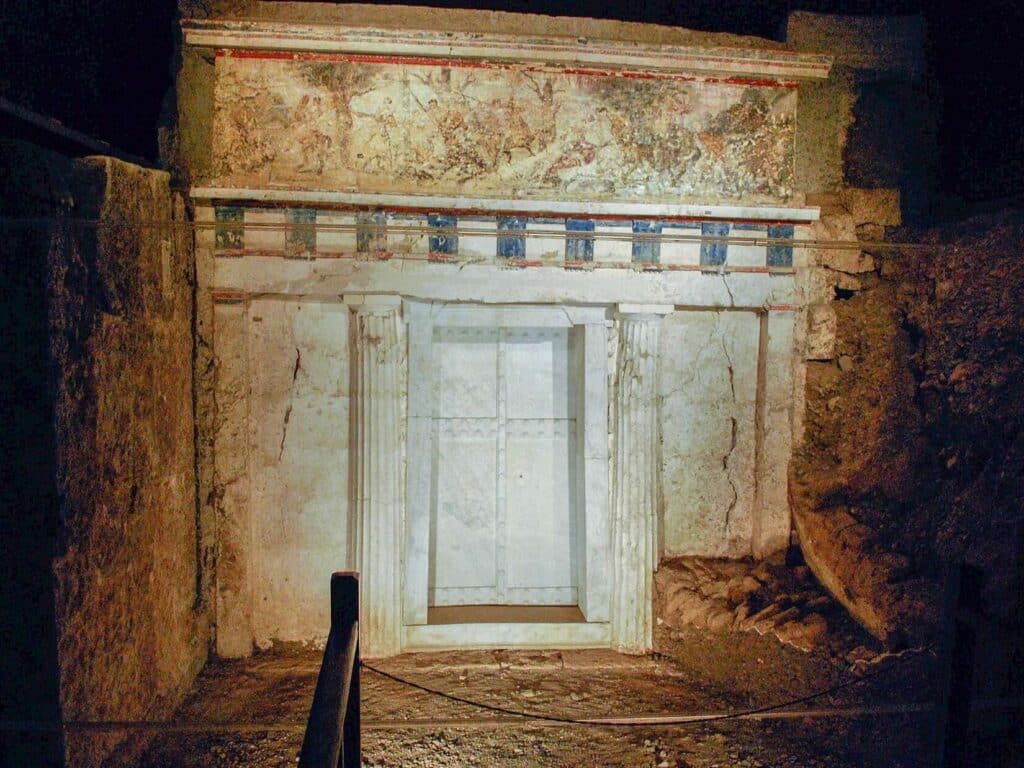
The Third Sacred War of Ancient Greece and the rise of Macedon
While the southern Greek states were busy fighting one another, Philip II of Macedon was watching and waiting. Geopolitically, Macedon emerged as the war’s greatest beneficiary, skillfully positioning itself as Apollo’s righteous defender. By intervening on behalf of the Amphictyonic League, Philip found the perfect pretext to march Macedonian troops into central Greece, cloaked in a sense of religious legitimacy that earlier kings could only have dreamed of.
Philip crushed the Phocians at the Battle of Crocus Field and executed more than three thousand captured Phocian mercenaries by drowning them. Brutal as it was, drowning was the traditional Greek punishment for temple robbers, allowing Philip to send a chilling message to his rivals while presenting himself as the enforcer of Apollo’s laws. When the dust settled in 346 BC, he had fundamentally shifted the geopolitical center of gravity away from Sparta and Athens and toward the north. Macedon claimed the Phocians’ vacant seats on the Amphictyonic Council, effectively bringing the era of the fiercely independent Greek city-state to an end.
Looking back, the conflict illustrates how quickly local disputes can unravel an entire political system and trigger devastating wars with far-reaching, unpredictable consequences. Does any of this sound familiar? Perhaps it is no surprise that the story of the Phocian rebellion and the rise of Macedon continues to resonate today.
See all the latest news from Greece and the world at Greekreporter.com. Contact our newsroom to report an update or send your story, photos and videos. Follow GR on Google News and subscribe here to our daily email!

