



Christopher Nolan’s adaptation of Homer’s The Odyssey is bringing renewed international attention to Messinia, a spectacular region in Greece’s southwestern Peloponnese where ancient myths, archaeological treasures, medieval landmarks, and dramatic coastal landscapes come together.
Much of the film’s production took place in Messinia, including locations around Pylos, Voidokilia Beach, Nestor’s Cave, and Methoni Castle. While these sites span different periods of Greek history—from the Bronze Age to the Byzantine and Venetian eras—they share the rugged beauty and maritime landscapes that have long inspired stories of heroes, kingdoms, and journeys.
For travelers following in the footsteps of Nolan’s production, Messinia offers far more than cinematic scenery. The region preserves some of Greece’s most important archaeological sites and cultural landmarks, including the remains of the Mycenaean world associated with Homer’s legendary King Nestor.
Pylos: The Land of Homer’s King Nestor

The coastal town of Pylos holds a special place in Greek mythology and history.
In Homer’s Odyssey, Telemachus, the son of Odysseus, travels to Pylos searching for information about his missing father after the Trojan War. There he meets King Nestor, the elderly ruler of Pylos and one of the most respected Greek leaders in Homer’s epics.
The historical connection between Pylos and the Mycenaean world is equally remarkable. About 15 kilometers (9 miles) north of the modern town lies the Palace of Nestor, one of the best-preserved Mycenaean palaces ever discovered.

Dating to approximately 1300 BC, the palace complex reveals the sophistication of Bronze Age Greece, with royal apartments, storage rooms, workshops, and hundreds of Linear B tablets—the earliest known written records of the Greek language.
Modern Pylos combines this ancient heritage with Mediterranean charm. Visitors can explore its picturesque harbor, the central square shaded by old plane trees, waterfront cafés, and Niokastro, the fortress overlooking Navarino Bay.
Voidokilia Beach: A Landscape of Myth and Natural Beauty

Among the most recognizable Messinia locations associated with The Odyssey is Voidokilia Beach, famous for its distinctive curved shoreline, turquoise waters, and untouched natural surroundings.
Often described as one of Greece’s most beautiful beaches, Voidokilia forms a nearly perfect omega-shaped bay and is protected within the Natura 2000 environmental network.
Behind the beach lies the Gialova Lagoon, an important wetland ecosystem that provides shelter for numerous migratory bird species.
Local traditions connect the area with episodes from Homer’s epic, although these associations belong primarily to regional folklore rather than confirmed historical evidence. What is certain is that the landscape’s dramatic combination of sea, cliffs, and ancient pathways has helped preserve its mythological appeal.
Nestor’s Cave: Where Archaeology Meets Legend

Above Voidokilia Beach sits Nestor’s Cave, a natural cavern overlooking the Ionian Sea.
According to local tradition, the cave was linked with King Nestor and later interpretations of Homeric stories. Archaeological evidence, however, indicates prehistoric human activity at the site, making it significant both as a natural landmark and as a place connected to the long history of human settlement in Messinia.
The short hike to the cave rewards visitors with panoramic views of Voidokilia Beach, the lagoon, and the surrounding coastline.
Methoni Castle: A Medieval Landmark by the Sea
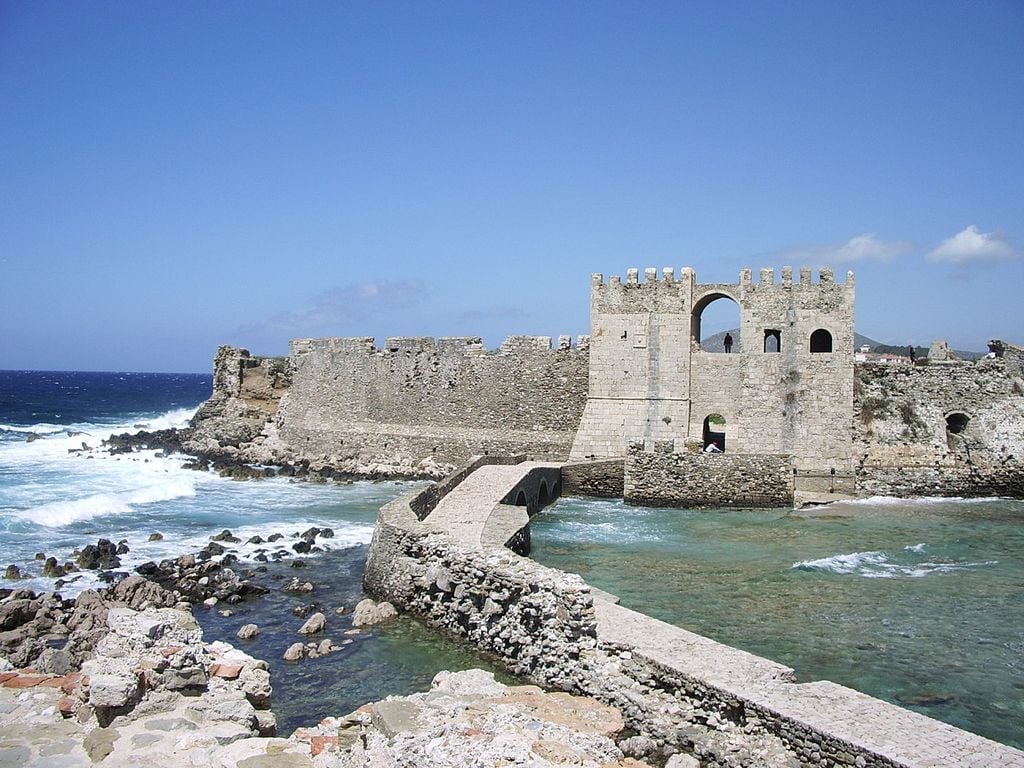
Not all of Messinia’s attractions connected with Nolan’s production come from the age of Homer.
Methoni Castle, located on the southwestern coast of the Peloponnese, represents a much later chapter of Greek history. Built and expanded by the Venetians during the Middle Ages, the fortress became one of the most important maritime strongholds in the eastern Mediterranean.
The castle’s massive walls extend into the sea, while its famous Bourtzi tower—a small octagonal fortress connected by a narrow stone passage—remains one of Greece’s most photographed medieval monuments.
A Destination Where Myth, History, and Cinema Meet
The attention surrounding Nolan’s The Odyssey is expected to introduce new travelers to a region that has long been one of Greece’s richest cultural destinations.
Beyond the filming locations, Messinia offers ancient wonders such as Ancient Messene, one of Greece’s best-preserved ancient cities, as well as the Venetian castle town of Koroni, the fishing village of Gialova, and the luxury coastal destination of Costa Navarino.
Together, these sites make southwestern Peloponnese a rare destination where visitors can experience archaeological treasures, legendary landscapes, pristine beaches, hiking routes, and living Greek culture in one journey.
Nearly 3,000 years after Homer’s Odyssey first captured the imagination of the ancient world, Messinia continues to offer landscapes where history and legend remain inseparable.
Related: The Griffin Warrior: A Staggering Discovery from Ancient Greece
See all the latest news from Greece and the world at Greekreporter.com. Contact our newsroom to report an update or send your story, photos and videos. Follow GR on Google News and subscribe here to our daily email!

