


For more than two centuries, Karagiozis has endured wars, occupations, political upheavals, television, video games, smartphones, and social media. Yet every summer in Greece, as evening falls and the lights come on behind the white screen, children still gather in village squares waiting for the familiar silhouette of the barefoot trickster to appear.
Many expected Greece’s beloved shadow puppet theater to disappear long ago.
Instead, Karagiozis survived.
During the summer months, village squares, parks, and open-air theaters across Greece continue to come alive as the familiar figure appears behind the berntes, transporting audiences into a world of humor, imagination, and timeless messages.
The ragged but resourceful antihero, forever poor but endlessly inventive, continues to attract audiences across Greece, proving that some forms of storytelling remain timeless regardless of technology.
A Hero of Ordinary People
Karagiozis emerged in Greece during the Ottoman period and quickly became one of the country’s most recognizable folk characters.
Living in a ramshackle hut with his wife and children opposite the grand palace of the local pasha, Karagiozis embodied the struggles of ordinary people. Hungry, unemployed, and constantly searching for work, he relied on wit, improvisation, and humor to outsmart authority figures and survive difficult circumstances.
Generations of Greeks recognized themselves in him. He was flawed, opportunistic, and mischievous, yet he remained deeply human—a character who confronted hardship not with power or wealth but with cleverness and resilience.
The Art Form That Refused to Disappear
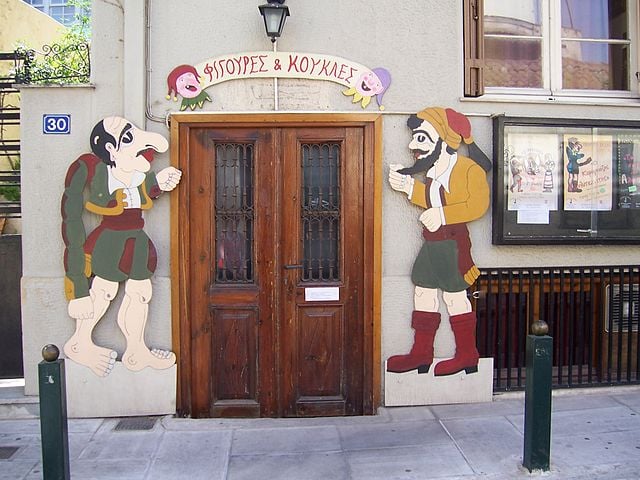
Like many traditional performing arts, Karagiozis appeared vulnerable during the rise of cinema and television in the twentieth century. Then came computers, streaming platforms, smartphones, and social media. Yet shadow theater never entirely vanished.
Instead, performances gradually shifted away from urban theaters and found new life in cultural festivals, municipal events, schools, museums, and summer celebrations in towns and villages throughout Greece.
On warm evenings, families still gather in open squares to watch stories unfold behind the illuminated screen exactly as previous generations did decades earlier.
The technology surrounding audiences may have changed dramatically. The experience itself has not.
Why Children Still Love Karagiozis

Part of Karagiozis’ endurance lies in the universal appeal of the character. Children laugh at the exaggerated movements, the absurd misunderstandings, and the endless schemes that inevitably go wrong. Adults appreciate the satire, social commentary, and references hidden beneath the humor.
The stories move quickly. The jokes are direct. The villains are obvious. The hero wins not through strength but through imagination. These are storytelling ingredients that remain effective regardless of era.
Menia Spathari, daughter of legendary shadow-theater master Eugenios Spatharis, rejects the idea that younger generations are abandoning the art form.
“The younger generation embraces Karagiozis more every year because it is a magical spectacle,” she told AMNA. “Children have become saturated with frightening and violent cartoons.”
She pointed to the growing number of young people interested not only in watching performances but in learning the craft itself. During annual museum events dedicated to shadow theater, aspiring young performers often wait in line for the opportunity to participate.
A Living Tradition, Not a Museum Piece
One reason Karagiozis continues to survive is that performers have never treated the tradition as frozen in time.
Modern karagiozopaiktes regularly introduce contemporary themes into classic stories, commenting on current events, technology, bureaucracy, and everyday frustrations while preserving the familiar cast of characters.
Karagiozis may still live in his famous shack beside the pasha’s palace, but the jokes can involve mobile phones, social media, rising prices, or modern Greek life. That flexibility has allowed the tradition to remain alive rather than becoming a historical curiosity.
“In Karagiozis there is no single issue of the day,” Spathari explained. “Events move at lightning speed and he has to catch them every minute.”
The same character who once mocked local officials and tax collectors can now satirize inflation, technology, and the anxieties of modern life.
Shadow-theater performer Christos Stanisis recently offered an example through a dialogue between Karagiozis and his friend Hadjiavatis about supermarket prices. Armed with a mobile phone and trying to compare prices, Karagiozis becomes overwhelmed by endless options and rising costs before finally concluding:
“So many prices, but wages remain the same and our pockets are always empty.”
The joke may be modern, but the theme is timeless: ordinary people struggling to make ends meet while using humor to endure hardship.
The Screen as a Mirror of Society

For Stanisis, the social message of Karagiozis begins before the characters even speak. “The shack symbolizes the poor people and the palace symbolizes the ruling class and power,” he explained.
More than a century after the character first appeared on Greek stages, the issues remain strikingly familiar.
“Even today Karagiozis comments on war, hunger, poverty and people being uprooted from their homelands,” Stanisis said. “He can even satirize the prices of products in his own popular way.”
That may be one reason the character continues to resonate with audiences long after the world that created him disappeared.
More Than Nostalgia
For many Greeks, Karagiozis represents childhood memories of summer evenings and family outings.
But nostalgia alone does not explain his survival.
Children who have never seen a shadow puppet performance before often respond immediately to the humor and energy of the show.
The simplicity of the format may even be part of its appeal in an age of constant digital stimulation. A white screen. Colored figures. A storyteller with dozens of voices. An audience laughing together under the night sky.
Some experiences require very little technology to remain magical.
The Shadow That Still Walks Across Greece
Karagiozis has outlived empires and technologies that once seemed unstoppable. He survived radio. He survived television. He survived the internet.
For Stanisis, the greatest danger facing the art is not a lack of audiences but a lack of originality.
“Don’t stop creating with passion and love,” he recalls his teacher Eugenios Spatharis telling him. “Search, improve what you think is wrong, and change what doesn’t work. Don’t be afraid of it—just respect it.”
Karagiozis will not survive simply because he belongs to tradition.
He will survive because new generations of artists continue to reinvent him while remaining faithful to the spirit that made him beloved in the first place.
And as long as Greek village squares continue filling with families on summer nights, the shadow of Greece’s most famous folk hero will likely continue dancing across the screen for generations to come.
See all the latest news from Greece and the world at Greekreporter.com. Contact our newsroom to report an update or send your story, photos and videos. Follow GR on Google News and subscribe here to our daily email!

