



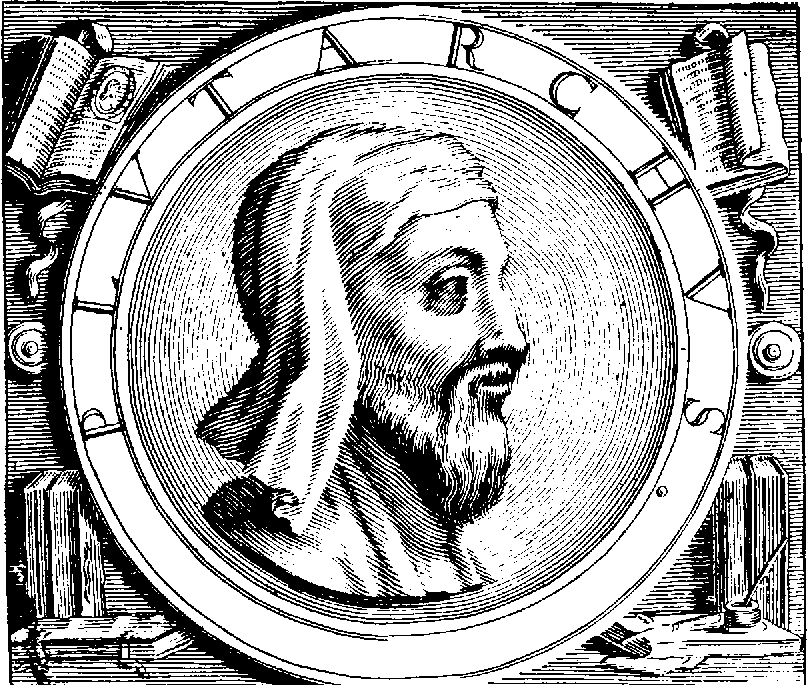
The Ancient Greek historian and philosopher Plutarch is best known for his biographies, but he is also widely recognized for his incisive essays in Moralia, a broad collection of writings, dialogues, speeches, and letters that can, in modern terms, be read as a kind of self-help literature.
The title “Moralia” roughly translates as “moral matters” or “customs,” and its subjects range widely across religion, politics, education, family life, animals, philosophy, and practical ethics. It is not a single, unified book centered around one sole argument. Even so, many of its most memorable works return to a question that feels strikingly contemporary: how can a person become calmer, kinder, wiser, and less governed by destructive habits?
In that sense, it is reasonable to describe parts of Moralia as an early form of self-improvement writing. At the same time, it would be misleading to treat it as the ancient equivalent of a modern self-help book, as Plutarch does not promise personal success, wealth, productivity, or unbounded confidence. Ancient Greek values, after all, were not those of the 21st century. His aim was moral formation. He wanted readers to cultivate character so they could live rationally, fulfill obligations to family and community, and become better people. In short, Moralia offers self-improvement, but it is not about optimizing the self in a modern sense. It is about forming the soul.
A variety of vital and relevant subjects in Plutarch’s collection of self-help essays
The first point to make is that Moralia is not a carefully designed manual. It is a collection assembled from Plutarch’s surviving non-biographical writings. Modern editions span many volumes, and the works range from “Greek Questions” and discussions of the oracle at Delphi to essays such as “On the Control of Anger,” “On Tranquillity of Mind,” “How to Tell a Flatterer from a Friend,” and “How a Man May Become Aware of His Progress in Virtue.” The Loeb edition alone highlights the breadth of the material, including advice on education, friendship, marriage, grief, health, wealth, envy, public life, and the management of emotions.
This diversity matters. Plutarch was not writing a single, modern-style program of the “Become Your Best Self in Ten Steps” variety. Some essays were addressed to named friends, others emerged from philosophical debate, and still others likely began as speeches or reflections for educated audiences. Yet their shared concern is clear: human beings do not become “good” simply by learning definitions of virtue. They must learn to recognize their faults, correct their habits, judge situations properly, and practice good conduct consistently over time.
One of Plutarch’s compositions most focused on personal improvement is “How a Man May Become Aware of His Progress in Virtue.” The title alone could sit comfortably on a contemporary psychology shelf. Plutarch assesses how an individual can determine whether moral effort is actually working. His answer is not that one should feel proud, popular, or successful. Progress exhibits itself instead in changed behavior such as less vanity and anger as well as greater steadiness and an ability to act virtuously when no one is watching.
He warns readers against confusing talk with transformation. A person may enjoy philosophical conversation, quote impressive notions, and still fall short morally in everyday life. The real test is conduct. As Plutarch writes: “The proof of a philosopher’s progress is not in his beard, nor in his cloak, but in his manner of life.” It is a demanding standard. Philosophy is not a costume or an intellectual hobby but something that should reshape the person.
Anger control
This point remains powerful because Plutarch comprehends a familiar human weakness: people often mistake knowing what is right with actually doing it. Reading about patience is easier than being patient when insulted. Admiring honesty is easier than telling an uncomfortable truth. Plutarch’s practical question is therefore not, “What do you believe?” but “What kind of person are your habits making you?” This perspective brings his moral writing close to modern discussions of character, emotional intelligence, and habit formation.
In “On the Control of Anger,” Plutarch offers an even clearer example. For him, anger is not solely an unpleasant feeling but a force capable of distorting judgment, damaging relationships, and undermining dignity. He does not recommend merely overlooking anger, however. Instead, he urges readers to recognize its earliest signs before it takes control. This amounts to a practical psychology of self-observation.
Plutarch describes anger as something that grows when fed by harsh words, wounded pride, and the desire for retaliation. His advice includes delaying reaction, recalling earlier moments when anger led to regret, and avoiding people or situations that make loss of control more likely. He also emphasizes gentleness in correction. The aim is not weakness but mastery. A person who governs anger is freer than one who is governed by it.
A characteristic passage captures the spirit of his advice: “Anger is not extinguished by anger but by gentleness.” The sentence is simple, but its ethical reach is broad. It applies not only to private disputes but also to parenting, friendship, and public life. Plutarch’s concern is that anger often reproduces the very harm it seeks to punish. Anyone striving for moral improvement must refuse that cycle.
Peace of mind
Plutarch’s essay “On Tranquillity of Mind” is perhaps the closest composition in Moralia to a direct guide for inner peace. It was written for a friend, Paccius, who appears to have been burdened by a busy and unsettled life. The essay starts off with the mention of a practical circumstance: Plutarch explains that he searched through his notes for material that might help his friend regain composure. As the Loeb introduction observes, he says he had “rummaged among his note-books” in haste to find advice for Paccius.
Plutarch’s idea of tranquility is not an escape from responsibility. He does not advise readers to withdraw from society, avoid grief, or deny hardship. Instead, he argues that much human misery comes from the judgments people attach to events. They compare themselves constantly with others, dwell on what they lack, and treat every disappointment as evidence that life has failed them.
His remedy is grounded in gratitude, proportion, and attention to what remains “good.” In one memorable passage, he writes: “We must not be like children, who, when they have fallen, sit crying and hold on to the place where they fell, but we must get up and go on.” The image is simple and practical. Pain is real, but it should not become a permanent posture. The person who recovers is not someone untouched by misfortune. It is someone who refuses to let misfortune define the entirety of life.
“On Moral Virtue”
This does not mean that Plutarch is simply a Stoic thinker. He draws on several philosophical traditions, especially Platonism, and he often engages critically with Stoic positions. While he shares with Stoic thinkers an emphasis on self-command and rational judgment, he does not argue that emotion itself must be eliminated. In “On Moral Virtue,” he presents moral life as reason shaping the emotional side of the soul rather than suppressing it. The composition offers a complex discussion of Aristotelian and Platonic psychology, and its modern editor notes that it draws extensively on Aristotelian thought.
This distinction is crucial. Plutarch’s ideal person is not cold or detached. He values affection, friendship, family loyalty, and grief expressed with dignity. His “Consolation to His Wife,” written after the death of their young daughter, is especially powerful because it does not deny sorrow. Instead, it seeks to make sorrow bearable without allowing it to turn into hopelessness. Self-improvement, in this sense, is not emotional numbness but the ability to feel without being overwhelmed by feeling.
The Ancient Greek thinker also views other people as essential to moral improvement. While modern self-help often treats the self as an isolated project in which individuals are encouraged to optimize routines, goals, confidence, and mindset, Plutarch’s moral world is more social. A good friend can correct us; a flatterer can corrupt us; a spouse, child, neighbor, or fellow citizen provides opportunities to practice justice and kindness. In “How to Tell a Flatterer from a Friend,” he warns that flattery is dangerous because it leads people to love their own faults. A true friend is not merely agreeable but helps one recognize what needs correction.
Self-help is only the beginning for Plutarch
In Moralia, Plutarch encourages individuals to improve themselves, but the self is never the final goal. Character matters because it inevitably affects other people. Anger harms families, greed damages communities, and vanity leaves a person vulnerable to manipulation. A ruler without education or self-control can bring harm to an entire city. Becoming a better person, therefore, also means becoming a more decent member of society. The collection includes political advice such as “Precepts of Statecraft” and “To an Uneducated Ruler,” reflecting the idea that private virtue and public responsibility cannot be separated.
Plutarch’s vision of self-improvement in Moralia extends beyond the individual. By bettering themselves, people become more valuable members of their families, communities, and societies. Moralia is far more demanding than modern self-improvement books. It does not promise that readers will become happier simply by thinking positively. Instead, it calls on them to become just, restrained, generous, and responsible—not only for themselves but also for the benefit of everyone around them.
See all the latest news from Greece and the world at Greekreporter.com. Contact our newsroom to report an update or send your story, photos and videos. Follow GR on Google News and subscribe here to our daily email!

