



Everyone knows Alexander the Great and Leonidas, figures familiar not only from ancient history but also from their frequent reinvention in film and popular culture. Ancient history has a small group of names that circulate widely in documentaries, video games, and movies, shaping how the past is popularly imagined. Timoleon of Corinth, however, is not one of them.
And that is a genuine shame because by most honest measures, he was more impressive than several of the previously mentioned historical figures—and it wasn’t for the extent of the lands he conquered but for what he refused to keep. He pulled off a military stunt that should have collapsed and then did something almost no general in history has managed. He won and then walked away.
A brother, a tyrant, and a funeral no one wanted to attend
Timoleon came from the aristocracy of Corinth, but his real inheritance was an instinctive resistance to one-man rule. He treated opposition to tyranny as self-evident, much like gravity itself—not a matter of opinion but of political reality.
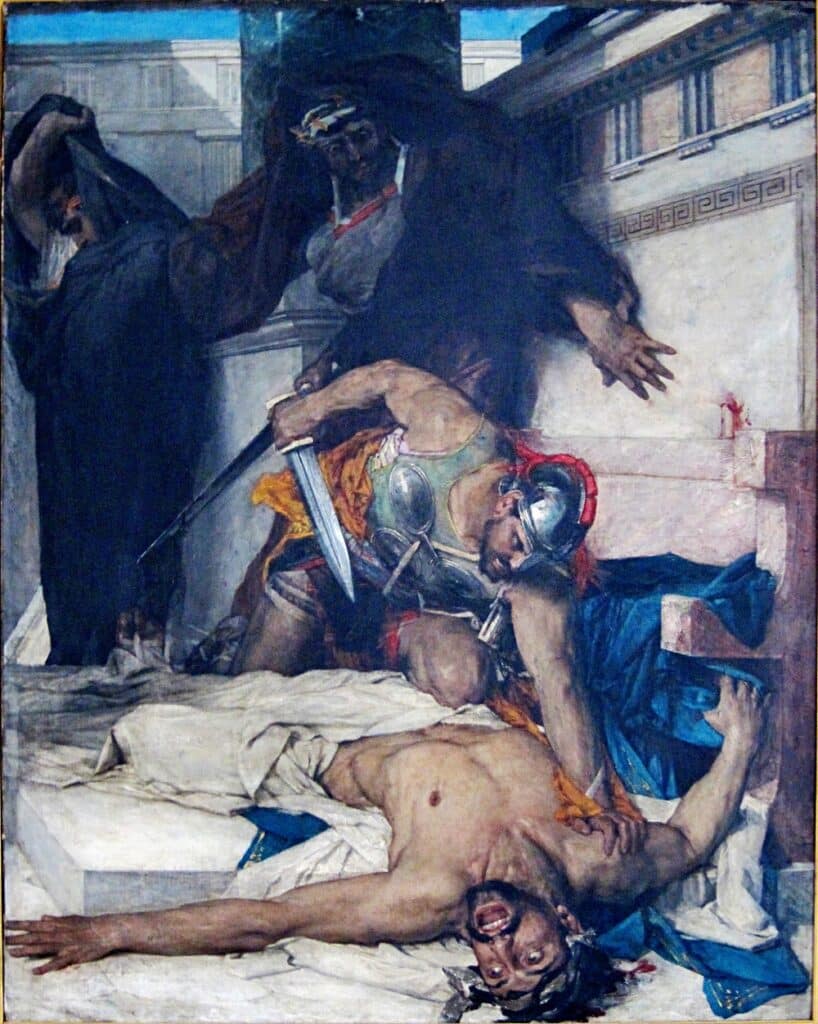
His older brother Timophanes was not of like mind. Charismatic, ambitious, and apparently unbothered by irony, Timophanes used his command of Corinth’s mercenaries to seize the city as a tyrant. Timoleon pleaded with him to stand down, but familial loyalty could not overcome political rupture.
When Timophanes refused, Timoleon’s companions did what he couldn’t bring himself to do while he stood by in tears as they killed his brother to save the city he loved more than his own family. Some called him a patriot. His mother called him something else entirely, and barred him from her house. Timoleon took the verdict to heart and spent the next twenty years quietly disappearing into the countryside.
Sicily calls for a man with nothing left to lose
By 344 BC, Corinth’s colony of Syracuse in Sicily was in trouble, and there was no easy solution. The tyrant Dionysius II had run the city into the ground, and Carthage was massing for what looked like a final invasion of the island. Syracuse sent a plea to its mother city of Corinth, requesting that either a general be sent or nothing at all—because there would be no Syracuse left to save otherwise.
No serious commander wanted the job. It looked less like a campaign and more like a funeral with extra steps. Hence, the Corinthian assembly turned to the one man with a reputation eccentric enough to fit the mission. He was a man who had nothing left to lose anyway. Timoleon agreed and sailed for Sicily with seven ships and seven hundred mercenaries. For context, that is roughly the military equivalent of showing up to a wildfire with a garden hose.
It got worse before it got any better, which is usually how the good stories work out. Timoleon moved fast, outmaneuvering Dionysius II so thoroughly that Syracuse fell without the grinding siege everyone expected. There was no brutal bloodbath but rather speed, nerve, and a tyrant who ran out of options.
Then came the real test. In 339 BC, Carthage landed an army of roughly 70,000 men in Sicily. This was an actual war machine, built to eradicate Greek presence on the island for good. Timoleon met them with barely 6,000 troops. According to the math should not have been survivable, but he caught the Carthaginian force mid-crossing at the Crimissus River, half their men still wading through water, formation scattered, and momentum gone.
Then, as if the gods had read the script and decided to help, a sudden hailstorm swept in, driving straight into the Carthaginians’ faces. Blinded, soaked, and pinned up against the riverbank, the larger army broke, and Timoleon won.
However, this unexpected victory at the Crimissus isn’t what makes Timoleon worth remembering. It is what happened next.
Sicily owes much to Timoleon of Corinth
Timoleon now held Sicily in the palm of his hand. There was no rival and there were also no rules or anyone left to go against him. The obvious move—the move nearly every other successful general in history has made—would be to crown himself king and call it destiny. Everyone would have believed him.
However, it’s not what Timoleon did. He instead drafted a democratic constitution and resettled the island with new citizens to replace the population tyranny had wiped out. Brick by brick, so that the next ambitious man wouldn’t have anywhere to start, he tore down the fortresses tyrants had erected to control their cities. Then he disbanded his army, forfeited every title he had rightly earned, and retreated to the countryside to a peaceful and quiet existence as a private citizen.
Timoleon of Corinth lived out his final years in Syracuse. By then, he was blind, and others would lead him by hand into the assembly whenever the city needed advice. They didn’t summon him as a former ruler, but, instead, people asked him questions the way you would ask a father or a grandfather.
That’s the whole lesson, really. Plenty of men in history have known how to win, but almost none of them have known how to stop.
The extraordinary funeral of Timoleon of Corinth
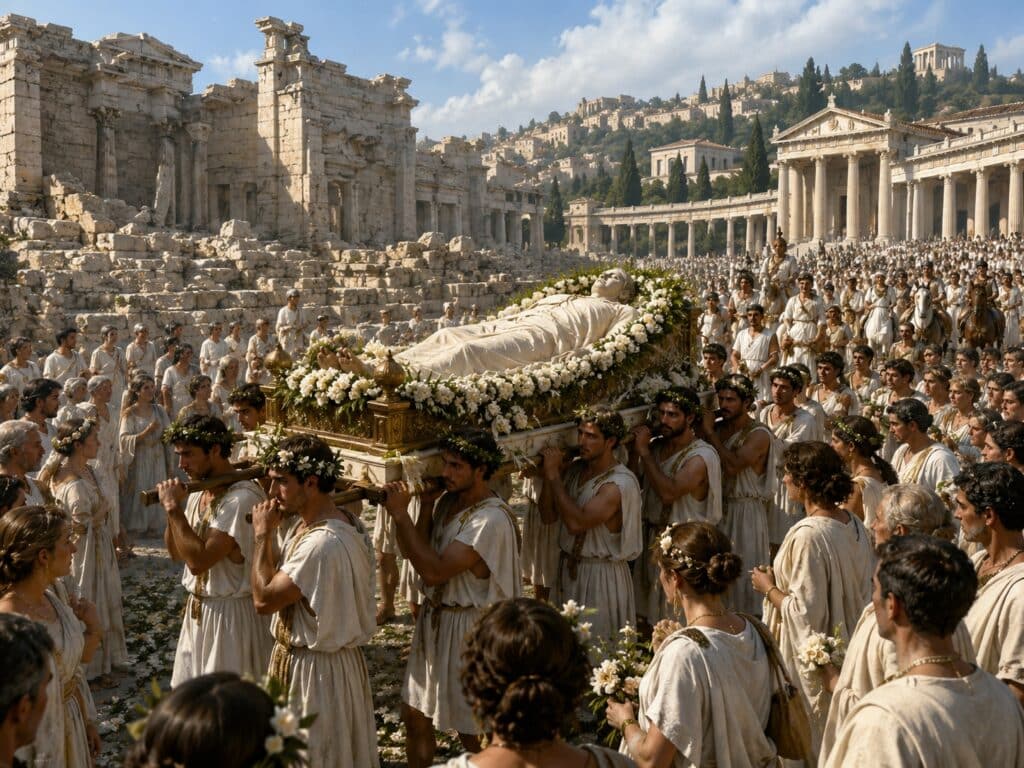
Timoleon’s funeral became one of the most momentous scenes of his entire story.
Plutarch reveals that the Syracusans granted the city several days for preparations, allowing people from across Magna Graecia as well as outside visitors the chance to gather before the ceremony took place. When the time finally arrived, young men chosen by lot carried his funeral bier through the very grounds where the tyrants’ palace had once stood. This was the same palace Timoleon had ordered to be torn down. The city decided to parade him, quite literally, over the wreckage of the system he had dismantled.
Thousands of Syracusans, men and women, turned out wearing white robes and garlands, dressed for what looked more like a festival than a funeral. Plutarch is explicit that this wasn’t performative grief or some box-ticking civic obligation. Instead, he describes it as genuine sorrow mixed with gratitude.
A herald named Demetrius, apparently the loudest-voiced crier in Sicily at the time, read out the official decree: the people of Syracuse were burying Timoleon, son of Timodemus of Corinth, at the public expense of two hundred minae, and granting him annual musical, equestrian, and athletic games in perpetuity for overthrowing the tyrants, defeating the Carthaginians, repopulating their devastated cities, and restoring their laws.
They buried his ashes right in the agora, the heart of the city, later enclosed the site with porticoes, and built a gymnasium around it. The entire complex was named the “Timoleonteum.” In this way, his grave was transformed into a place where young Syracusans trained and gathered generation after generation.
See all the latest news from Greece and the world at Greekreporter.com. Contact our newsroom to report an update or send your story, photos and videos. Follow GR on Google News and subscribe here to our daily email!

