



Clay tablets, papyrus scrolls and organized archives gave rise to the largest libraries the ancient world had ever seen. From Mesopotamia to the Mediterranean, early civilizations built and guarded repositories that preserved knowledge, solidified power and shaped future generations.
These libraries were more than buildings. They were strategic tools for governance, scholarship, and cultural influence.
From clay tablets to papyrus, Mesopotamia built the first libraries of the ancient world
The earliest libraries were established in Mesopotamia over five thousand years ago. Sumerians developed cuneiform writing by pressing marks into wet clay. These tablets contained records on trade, law, rituals and literature. Stored in temple rooms and palaces, they were grouped by subject and carefully archived.
The Assyrians advanced this system, and King Ashurbanipal of Nineveh built a vast royal library with thousands of tablets in the 7th century BC. These included manuscripts on religion, medicine, and science. His collection, organized by topic, is one of the oldest discovered in archaeological history.

A major turning point came with the use of papyrus scrolls in Egypt. Lighter and more portable than clay, papyrus allowed collections to grow in size. The new format enabled broader distribution of texts and helped libraries expand across the ancient world.
Libraries of Persia and Assyria as guardians of culture, law, and empire
In the ancient Near East, libraries held both spiritual and administrative importance. Persian rulers integrated libraries into royal courts. The Achaemenid Empire preserved legal codes, religious texts, and historical records. These archives helped maintain order across a diverse and multilingual empire.
Assyria’s greatest legacy was Ashurbanipal’s library at Nineveh, a vast collection of thousands of clay tablets covering medicine, astronomy, literature, and more.

Ashurbanipal viewed knowledge as a tool of control and culture. His efforts helped preserve Mesopotamian heritage for future generations. Cultural exchange carried these texts far beyond their regions of origin. Greek scholars translated many works, merging Near Eastern traditions with Hellenistic thought. In this way, the great libraries preserved and transmitted intellectual life through centuries of conflict and empire.
The Great Library of Alexandria and the ambition to collect all human knowledge
The Library of Alexandria, founded around 283 BC by Ptolemy I in Egypt, aimed to gather every written work known at the time. Located within the Musaeum, a research center devoted to the arts and sciences, the library was supported by powerful rulers who dispatched agents across the world to acquire texts.
Scrolls were taken from ships arriving at the port. Originals were copied and the duplicates returned. The collection spanned literature, philosophy, astronomy, and medicine.
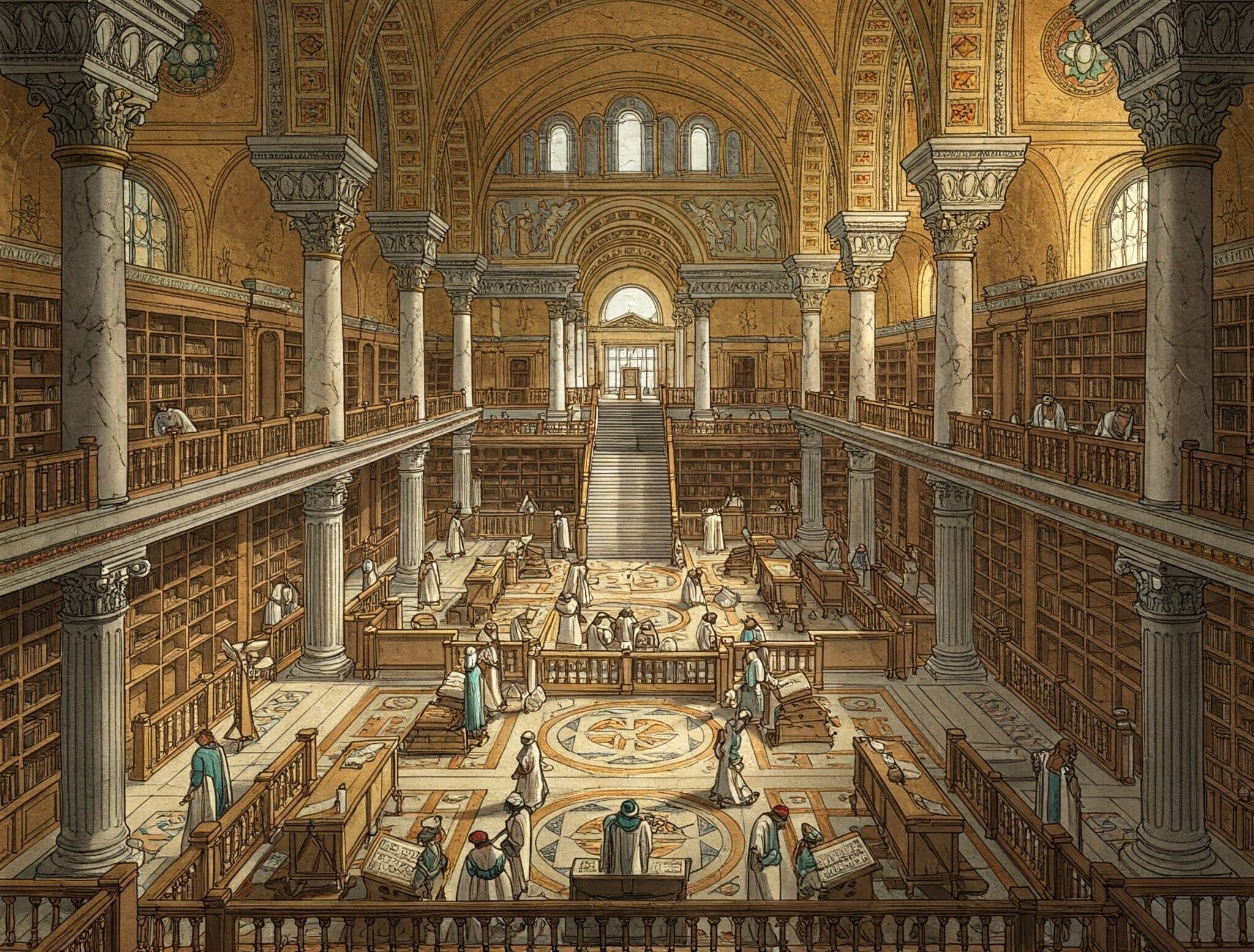
Scholars such as Euclid and Archimedes studied there. Librarians developed early cataloging systems and edited standardized versions of key texts.
The library suffered damage during Julius Caesar’s campaign in 48 BC, and its decline continued through later invasions and internal unrest. Despite its fall, the model it established influenced libraries in Pergamum, Rome, and beyond.
Ancient Greek libraries as public learning hubs and private intellectual sanctuaries
Ancient Greek libraries shifted knowledge from private temples to public life. Athens and other city-states built libraries open to scholars and citizens. One early example is Aristotle’s personal collection, which became a foundation for later public institutions.
Private libraries also flourished. Wealthy individuals and philosophers curated collections for study and teaching. Plato, for instance, used their libraries to support schools such as the Academy. These libraries helped preserve philosophy, science, and literature and played a central role in Greek intellectual life.

Public libraries enabled wider access to knowledge in the ancient world, while private collections fostered personal study and debate. Together, they formed a system that allowed Greek thought to spread across the Mediterranean.
Roman libraries as instruments of power, education, and governance
Rome expanded the library model throughout its empire. In 39 BC, Gaius Asinius Pollio opened the first public library in the capital. Emperors like Augustus followed, building libraries in temples and forums. These became cultural landmarks and centers for learning.
Roman libraries preserved works in both Latin and Greek, encompassing law, science, literature, and official records. They served not only administrative needs but also public education, fostering literacy and stimulating scholarly debate throughout the empire as access expanded.

Wealthy Romans maintained private collections. These libraries, often run by scribes and servants, became symbols of status. Imperial libraries, meanwhile, preserved state records and reinforced the authority of the emperor.
By preserving Greek and earlier texts, Roman libraries established a bridge between ancient and medieval scholarship, leaving behind a lasting legacy for Europe.
Collapse of ancient libraries and the long survival of their knowledge
Ancient libraries faced repeated threats. Fires, wars, and natural disasters wiped out entire collections. The Library of Alexandria was damaged during civil war, then weakened by centuries of neglect. With the fall of the Roman Empire, invasions, political turmoil, and shifting religious forces accelerated the decline of these repositories of knowledge.
In the Near East, the Library of Ctesiphon was destroyed during the Arab conquests. At Herculaneum, the eruption of Mount Vesuvius buried the Villa of the Papyri beneath volcanic ash, both preserving and damaging hundreds of scrolls.
However, fragments survived. In medieval Europe, monasteries preserved knowledge by copying ancient texts by hand. Across the Islamic world, scholars translated Greek, Roman, and Persian works into Arabic, safeguarding ideas that had vanished elsewhere. These efforts carried the legacy of antiquity into the Renaissance and, ultimately, the modern era.
The fall of ancient libraries marked the end of an era but not the end of their influence. Their legacy endures in today’s institutions, which continue the timeless mission of collecting, preserving, and sharing human knowledge.
See all the latest news from Greece and the world at Greekreporter.com. Contact our newsroom to report an update or send your story, photos and videos. Follow GR on Google News and subscribe here to our daily email!

