



A small clay figurine, broken and seemingly unremarkable, may hold one of the earliest known examples of numerical notation in the ancient world. Researchers studying a Guatemala figurine have found what appears to be an early form of Mesoamerican writing on its surface, potentially pushing back the timeline of symbolic notation in the region by centuries.
The artifact comes from the Middle Preclassic site of La Blanca in San Marcos, Guatemala. It dates to roughly 750 to 650 BC and features 11 small dots arranged into three vertical columns on what appears to be its headdress.
Julia Guernsey of the University of Texas at Austin led the study, published in Latin American Antiquity. Researchers argue these dots may represent the number 11 in an early dot-based numerical system.
La Blanca was once a major urban center on the Pacific Coast of Guatemala, reaching its peak between 1000 and 900 BC. It controlled a large regional system and was marked by significant social stratification and some of the largest Middle Preclassic architecture in Mesoamerica.
Eleven dots on ancient artifact hint at number system
The artifact belongs to what researchers call the “tab” type, a recurring form at La Blanca in which a tapered, abstract projection replaces a naturalistic human head.
More than 300 such figurines have been found at the site. What sets this one apart is the presence of 11 impressed dots, split into one column of three and two columns of four.
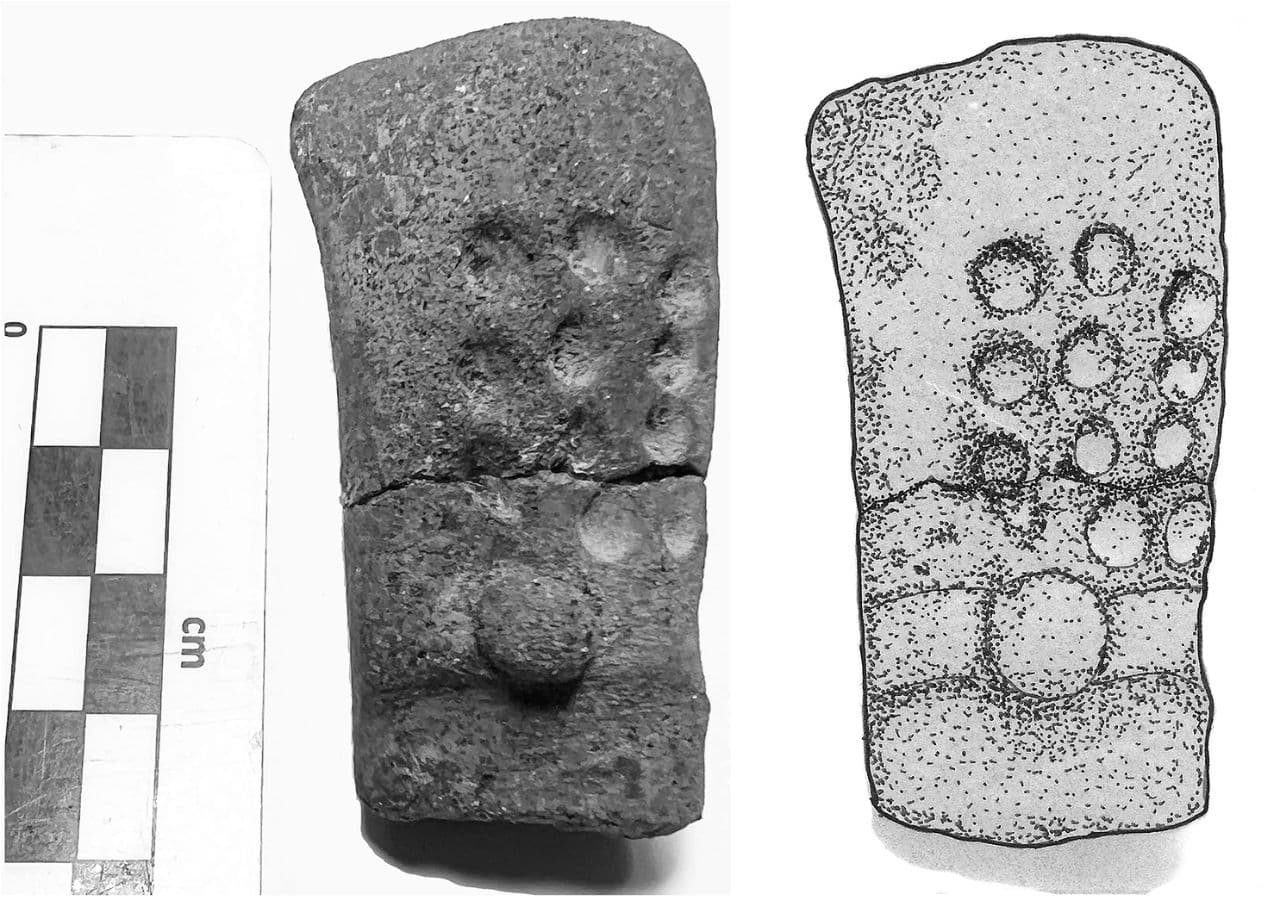
Guernsey notes that the dots were pressed into the clay before the figurine was fired, pointing to deliberate planning by the maker. Their placement in the head region also carries meaning.
Across ancient Mesoamerica, the head and headdress served as the primary space for conveying identity. Symbols placed there often carried names, calendar dates, or other markers tied to personhood.
Guatemala figurine pushes back the timeline of Mesoamerican writing
Numbers were deeply connected to the human body in ancient Mesoamerican cultures. The K’iche’ Maya word for “person” also means 20, a reflection of the 10 fingers and 10 toes at the core of their counting system. Calendar dates at birth often determined a person’s destiny and character, according to the study.
Guernsey argues the figurine from Guatemala stands as the earliest securely dated example of potential dot-based Mesoamerican writing or numeration found anywhere in the region.
While the dots lack an accompanying calendar glyph, their odd total and deliberate grouping hint at numerical intent.
Purely decorative motifs in early Mesoamerican art typically favored symmetry and even numbers, making this arrangement difficult to dismiss as mere decoration.
See all the latest news from Greece and the world at Greekreporter.com. Contact our newsroom to report an update or send your story, photos and videos. Follow GR on Google News and subscribe here to our daily email!

