



A stone game board carved inside a medieval bathhouse in Morocco could rewrite what historians know about board games in early Islamic North Africa.
The discovery, published in the journal Libyan Studies, pushes back evidence for a game still played today by several centuries and sheds new light on social life in one of the region’s earliest Islamic settlements.
Tim Penn of the University of Reading led the study examining a previously unpublished game board at Walila, the site of ancient Roman Volubilis in Morocco. The board was carved into a stone step leading into a cold plunge pool inside a bathhouse, or “hammam,” built in the late eighth or early ninth century.
The structure was abandoned by the tenth or eleventh century. That narrow window gives researchers a rare, secure date for the board, something that is extremely difficult to establish for carved game boards found at ancient sites.
Morocco bathhouse yields a precisely dated medieval game board
The bathhouse was part of a larger complex that researchers believe served as the residence of Idrīs I, the founder of the Idrisid dynasty and one of the earliest Islamic rulers in North Africa.
Idrīs I arrived at Walila in 788 after fleeing the Hijaz and was declared imam by a local Berber tribe. The complex included a domestic building, a reception hall, and a storage compound, all built in a courtyard style more common to the Levant than North Africa.
The game board itself measures roughly 34 by 9.5 centimeters (13.4 by 3.7 inches) and consists of three rows of at least 13 small, shallow holes carved into the stone.
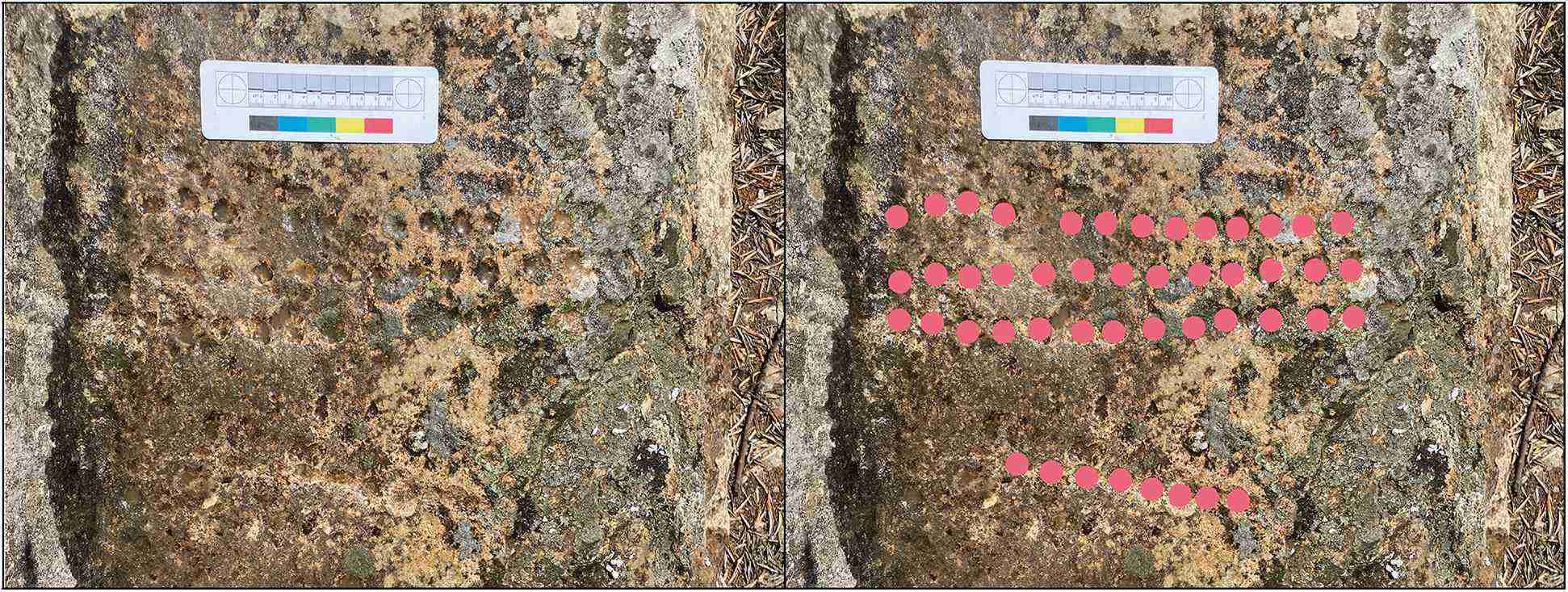
Researchers identified it as most likely used for “tab/sig,” a running-fight game in which two players move pieces across the board from opposite sides, trying to capture each other’s pieces. The game is still played in parts of North Africa, the Middle East, and Turkey today.
Tab identified as Walila’s ancient running-fight game
The identification matters because the first known written reference to tab appears in the work of Egyptian author Ibn Daniyāl, who died in 1310.
The Walila board predates that reference by roughly 400 to 500 years, suggesting the game has a far longer history in the region than texts alone would indicate.
Researchers also ruled out mancala, another widely played ancient game, because the Walila board’s holes are too shallow and too small to hold multiple playing pieces, which mancala requires. The odd number of holes per row also makes the mancala rules impractical.
Similar boards from the early Islamic period have been found in Arabia, the Middle East, and Portugal, but none had previously been confirmed anywhere in North Africa.
The broad distribution of these boards across the early Islamic world, and as far as Scandinavia, where a closely related game called “daldos” or “sahkku” was played, points to the game traveling through trade and cultural networks.
From Arabian trade routes to Scandinavian shores
At Walila, those connections to the east are well documented. Imported coins, glassware, and a wine jar from Egypt and the Levant were all recovered at the site.
The bathhouse itself uses a dry-heat system more closely linked to Levantine construction than to the Roman bathing tradition, further reinforcing ties to the Middle East. Researchers suggest the game may have arrived in Morocco with Idrīs I or members of his entourage.
The board sat at the center of the steps into the plunge pool, fully visible to anyone in the changing room or entering the water. Researchers noted that its prominent placement suggests gaming was openly accepted as part of the social experience of bathing.
Bone dice recovered from nearby buildings at the site further confirm that a range of games, including games of chance, were played at Walila during the early medieval period.
The study calls on archaeologists working across North Africa and the broader Mediterranean to document game boards more systematically, noting that carvings of this kind are routinely left out of excavation reports.
See all the latest news from Greece and the world at Greekreporter.com. Contact our newsroom to report an update or send your story, photos and videos. Follow GR on Google News and subscribe here to our daily email!

