



Archaeologists have uncovered Teotihuacan-era tombs in Mexico near the town of Ignacio Zaragoza in the Tula region, revealing eight human burials alongside 47 miniature ceramic vessels inside a single shaft-like tomb. The discovery is part of ongoing salvage excavations tied to the Mexico City-Queretaro Passenger Train construction project.
The National Institute of Anthropology and History, known as INAH, announced the findings this week. Excavations began in September 2025, with a team led by archaeologist Victor Heredia Guillen working across a 2,400-square-meter (25,833-square-foot) area along the planned rail route.
Researchers identified five shaft-like tombs and other burial types within what appears to be a pre-Hispanic residential complex. The structures date primarily to the Tlamimilolpan phase (225-350 AD) and the Xolalpan phase (350-550 AD) of the Teotihuacan period.
47 miniature vessels found alongside eight human burials
Inside a shaft tomb on the north side of one residential room, researchers found remains of eight individuals, mostly adults. Six were placed in a seated position with ceramic offerings arranged near their feet.
The other two had disturbed remains, a sign that the tomb was reused over time. When a new burial was added, the previous occupant’s remains were moved aside to make room.
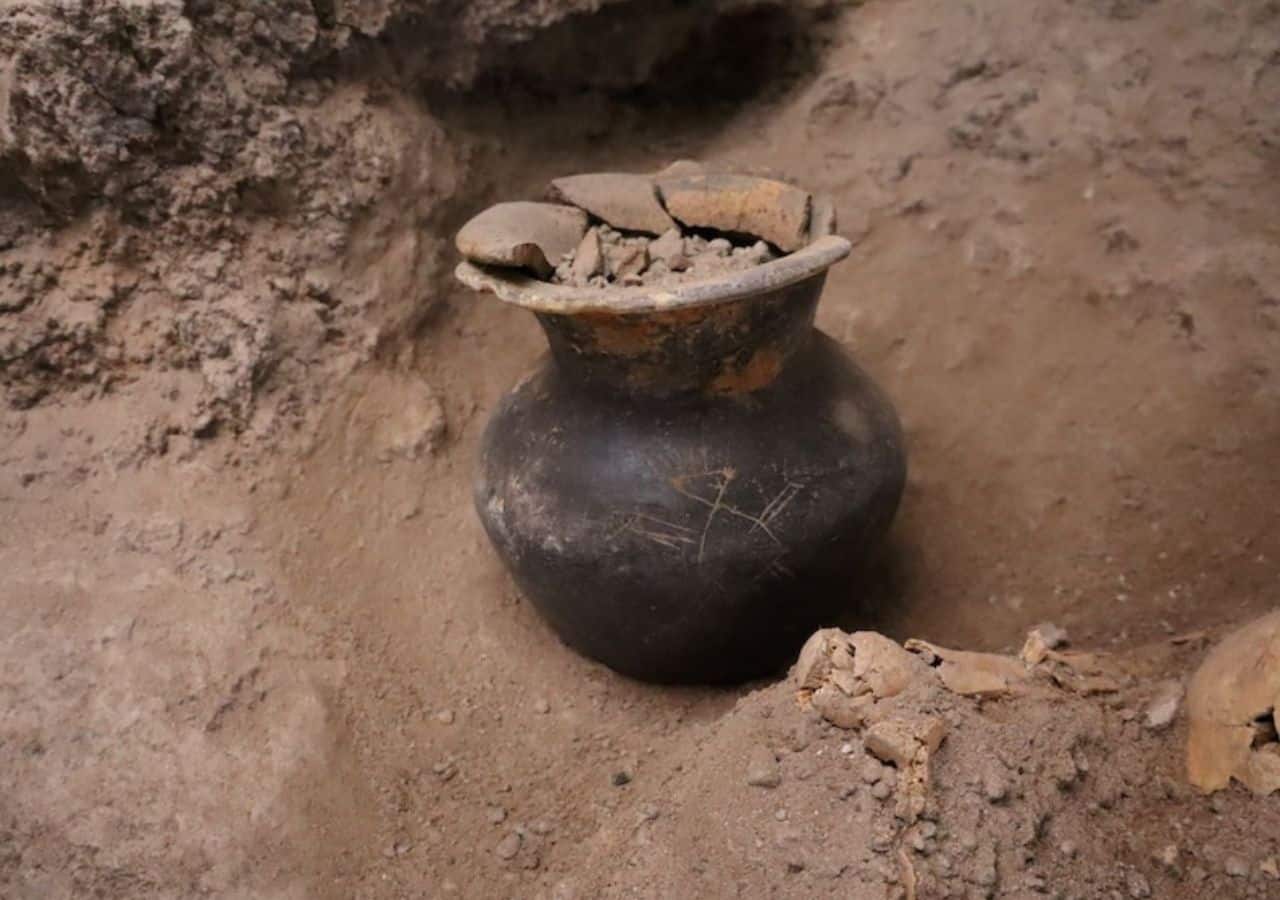
The 47 miniature vessels found in the north tomb stand out as a key find. One burial also included a small shell ornament and fragments of a semi-circular mother-of-pearl pendant.
A second nearby tomb contained engraved vessels that were removed with the surrounding soil intact for later micro-excavation in a lab.
Field director Laura Magallon Sandoval said the burials span different age groups. Physical anthropologists Jose Manuel Cervantes Perez and Abril Machain Castillo identified children, including at least one between 8 and 11 years old, as well as juveniles and adults among the recovered remains.
Teotihuacan-era tombs shed light on Mexico’s lime trade
Archaeologist Jonathan Velazquez Palacios pointed out that the site has been mined for lime since pre-Hispanic times. That lime was likely a critical material for stucco surfaces on buildings in Teotihuacan, located roughly 90 kilometers (56 miles) away.
These ancient tombs in Mexico, situated near Teotihuacan’s sphere of influence, offer a clearer picture of regional exchange and social life during the Classic period.
Mexico’s Culture Secretary Claudia Curiel de Icaza said the Tula findings show how infrastructure development can move forward alongside serious archaeological work and heritage protection.
Researchers caution against viewing the site in isolation. The northern Tula area holds multiple Classic-period settlements, with Chingu identified as a regional hub of Teotihuacan expansion. Nearby sites, including El Tesoro, Acoculco, El Llano, and La Malinche, will be part of future regional studies.
See all the latest news from Greece and the world at Greekreporter.com. Contact our newsroom to report an update or send your story, photos and videos. Follow GR on Google News and subscribe here to our daily email!

