



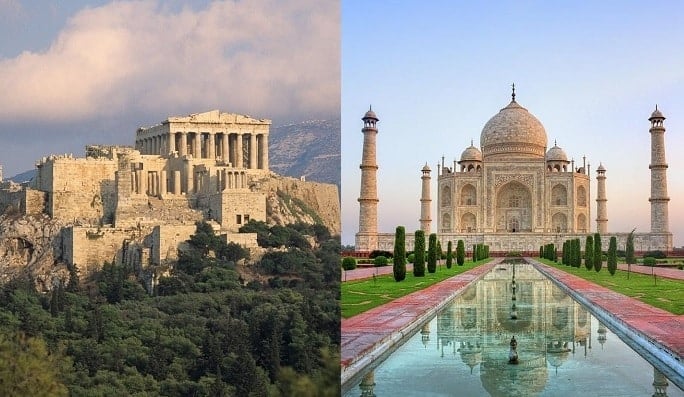
The global debates surrounding Greece and its civilization are expanding. Alongside its historical and spiritual connections to the liberal democracies of the West, Greece is now garnering cultural, economic, and geopolitical interest from emerging Asian powers such as India and China.
By Bruce Clark*
The Greek politician Evangelos Venizelos once described his country as a cultural superpower. That view is seemingly confirmed by the crowds from every corner of the globe who throng the archeological sites and museums of Athens. It’s noticeable that the rising middle class of the Asia-Pacific region forms an ever-increasing share of visitors.
Still, being a superpower of any sort will always involve holding some delicate strategic balances, and that applies more than ever to the cultural politics of Greece. In addition to its strong but occasionally strained spiritual ties with the liberal democracies of the West, Greece is now being wooed – culturally as well as economically and geopolitically – by the emerging Asian powers, India and China.
India and China join the global debate on Greece
A milestone event occurred in November with the opening in Athens of a Chinese School of Classical Studies – the city’s first such school sponsored by an Asian country.
The new establishment joins the venerable archaeological research bodies that were set up by Western nations in the 19th century and form a familiar part of the city’s physical and intellectual landscape. In terms of resources and prominence in the field of archaeology, the doyen of these older institutions is the American School of Classical Studies.
Α program of cooperation already links four Greek universities and four Chinese ones; as one result, scholars at the University of Crete will soon host a symposium with their Chinese counterparts, and the University’s publishing arm is publishing a series of books about Chinese culture and history.
Meanwhile, Kyriakos Mitsotakis is preparing to pay his second visit to India, sealing a tie that has a strong cultural dimension in addition to growing cooperation in fields like shipping, port technology, data processing and (at least cautiously) defense.
Encouraged by their governments, Greek and Indian scholars have held three set-piece gatherings in as many years, and they find plenty to discuss – from the diplomatic links between India and Byzantium to the excited descriptions of India’s wealth penned by Herodotus. (The only precondition, understood by everybody involved, is that the topic of Alexander the Great and what some call his civilizing mission is avoided.)
Greece’s cultural world and the West
These new relationships are unlikely in the unforeseeable future to challenge the huge and intricate web of cooperation that exists between Greek academia, and the Greek cultural world, and all corners of the Western world.
With so many scholars, writers and artists pursuing bi-cultural or multi-cultural lives and careers, the old model of arm’s length cooperation between academic institutions in Greece and their counterparts in Western countries has given way to a more or less seamless web.
Classical studies in places like Oxford, Cambridge and Princeton are kept alive by Greek philanthropy, and most serious students of any aspect of the Hellenic heritage are likely these days to divide their lives between Greece itself and various places of learning further to the West.
Yet Greece’s cultural relationship with the Western world has never been free of friction. The dream of reunifying the Parthenon marbles is a long-standing point of contention, and more recently the study of classics has been challenged by America’s cultural left as an elitist pursuit that ought to be abolished.
To put it another way, modern Greece has often been challenged by conservatives in the West who insist that they are the real legatees of ancient Athenian democracy, a fact which supposedly makes Britain a proper place for the display of the Parthenon’s treasures. As of recently Greece finds itself similarly challenged by voices on the Western cultural left.
Widening range of the global debates on Greece
Ironically enough, the keen Chinese appetite for the study of ancient Greece seems utterly unaffected by the concerns of Western campus radicals. Nor do China’s cultural authorities show the slightest interest in deconstructing the Greek claim to a continuous history over at least three millennia. On the contrary, celebrating the continuity of Greece’s language and culture is perceived in Beijing as a way of burnishing Chinese pride in a similar continuity.
Cultural exchanges with India have the advantage of a powerful pre-existing tradition – in the form of distinguished Greek scholars of India, starting with Dimitrios Galanos (1760-1833) who translated important texts from Sanskrit and brought them to the attention of researchers in Europe.
For some Indians, the familiar idea that Alexander the Great and his successors decisively influenced Buddhist art – especially in the Gandhara region – is an uncomfortable one, not least because the manifest similarity between Greek and Buddhist sculpture was first noticed by servants of the British empire. Experience has shown that Greek and Indian scholars get along very well once that specific sensitivity has been understood.
As long as the issues are deftly handled, the widening range of cultural and intellectual partners now open to Greece will bring nothing but benefits. Of course, every outside power will carry a specific agenda to the study of Greek history. Western classicists love
the texts in ancient Greek literature which celebrate liberty and free speech. In today’s China, there is more interest in passages that laud deference, respect for authority and
self-restraint.
Among American pundits on world affairs, meanwhile, there has been much focus on a single line from Thucydides which suggests that a well-established world power is bound to feel resentment and hostility to a rising power. Chinese officialdom has adamantly rejected the historical determinism that the American reading of the so-called ‘Thucydides trap’ seems to imply.
In truth, Greek literature and thought present a vast field – and outsiders are bound to pick and choose the bits they like best. The challenge for Greece’s cultural mandarins today is to share that heritage with all comers, and preserve the Athenian tradition of parrhesia or free, even outrageous speech. Ideally, no outsider should have the last word on which bits of the Hellenic heritage matter most. That question should be open to perpetual, open-ended Socratic dialogue.
Bruce Clark will be lecturing at the Benaki Museum, Pireos 138 at 6 pm on January 17 on the topic “From the Parthenon to the Punjab, Thoughts about Greece, India and syncretism”. Entrance is free. The lecture is at the invitation of the Friends of the Benaki Museum and celebrates the name-day of Founder Antonis Benakis.
*Bruce Clarke is an author, lecturer and journalist. As a journalist for Reuters, the Times, the Financial Times and the Economist he traveled numerous times to Greece. His command of modern Greek enables him to delve deeply into the politics, society, culture and history of the country.
See all the latest news from Greece and the world at Greekreporter.com. Contact our newsroom to report an update or send your story, photos and videos. Follow GR on Google News and subscribe here to our daily email!

