



Archaeological excavations at the Kolona Hill site on the island of Aegina, Greece, yielded a collection of exceptional gold artifacts, the Greek Ministry of Culture announced on Wednesday.
The finds were discovered within a large stone structure situated immediately adjacent to the defensive wall that protected the Middle Bronze Age settlement’s outer precinct. The items, which remain in excellent condition and date back to the first half of the 2nd millennium BC, likely formed part of an elaborate gold necklace or pendant.
The gold artifacts found on Aegina
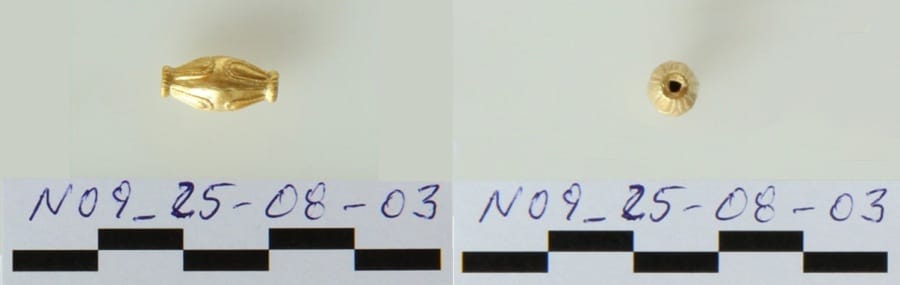
- Eight bipartite discoid pendants: Detailed gold ornaments characteristic of the era
- One additional gold discoid pendant
- Seven biconical gold beads: Finely crafted gold spheres
- One cylindrical gold bead
- Eight decorative gold foil lamellae: Thin gold plates used for adornment
- Seven carnelian spherical beads: A vibrant contrast to the gold, likely part of the same jewelry set
In addition to the gold, archaeologists unearthed twelve copper fragments—likely remnants of small knives—and a single pin or needle. Although evidence suggests the area was disturbed at an unknown point in history, researchers hypothesize that these items were funerary offerings (grave goods) associated with a Middle Bronze Age burial, even though no physical remains of a tomb were identified.
The design of these gold ornaments, particularly the pendants, bears striking similarities to the famous “Aegina Treasure,” a prehistoric collection of precious jewelry illicitly removed from the island and housed at the British Museum since 1892.
A site of historical layers
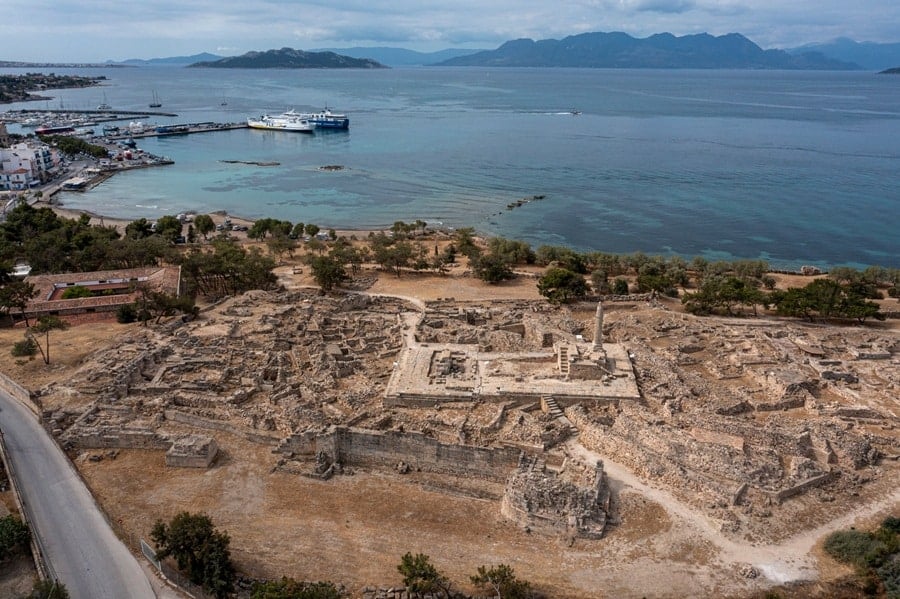
Kolona Hill, located on the northwest side of Aegina near the modern port, is a site of immense historical depth, that served as a prehistoric settlement, a classical-era sanctuary, an ancient acropolis, and eventually a Byzantine habitation.
Dominating the hill’s landscape is the iconic Temple of Apollo, a landmark dating to the 6th century BC. Standing as a testament to the island’s former naval and commercial power, the temple was originally a grand Doric structure. Today, a single, solitary column remains standing—the “Kolona” (column) from which the hill gets its name. This architectural relic served as a vital navigational landmark for ancient mariners approaching the island, and its presence underscores the hill’s enduring role as the heart of Aegina’s public and religious life across centuries.
The latest findings are the result of ongoing research conducted by the University of Salzburg and led by Professor Alexander Sokolicek under the supervision of the Ephorate of Antiquities of Piraeus and Islands. This discovery confirms that despite decades of intensive study, the site of Kolona still holds significant secrets yet to be revealed.
Related: Swimming Among the Ruins of a Glorious Ancient Greek Military Harbor
See all the latest news from Greece and the world at Greekreporter.com. Contact our newsroom to report an update or send your story, photos and videos. Follow GR on Google News and subscribe here to our daily email!

