



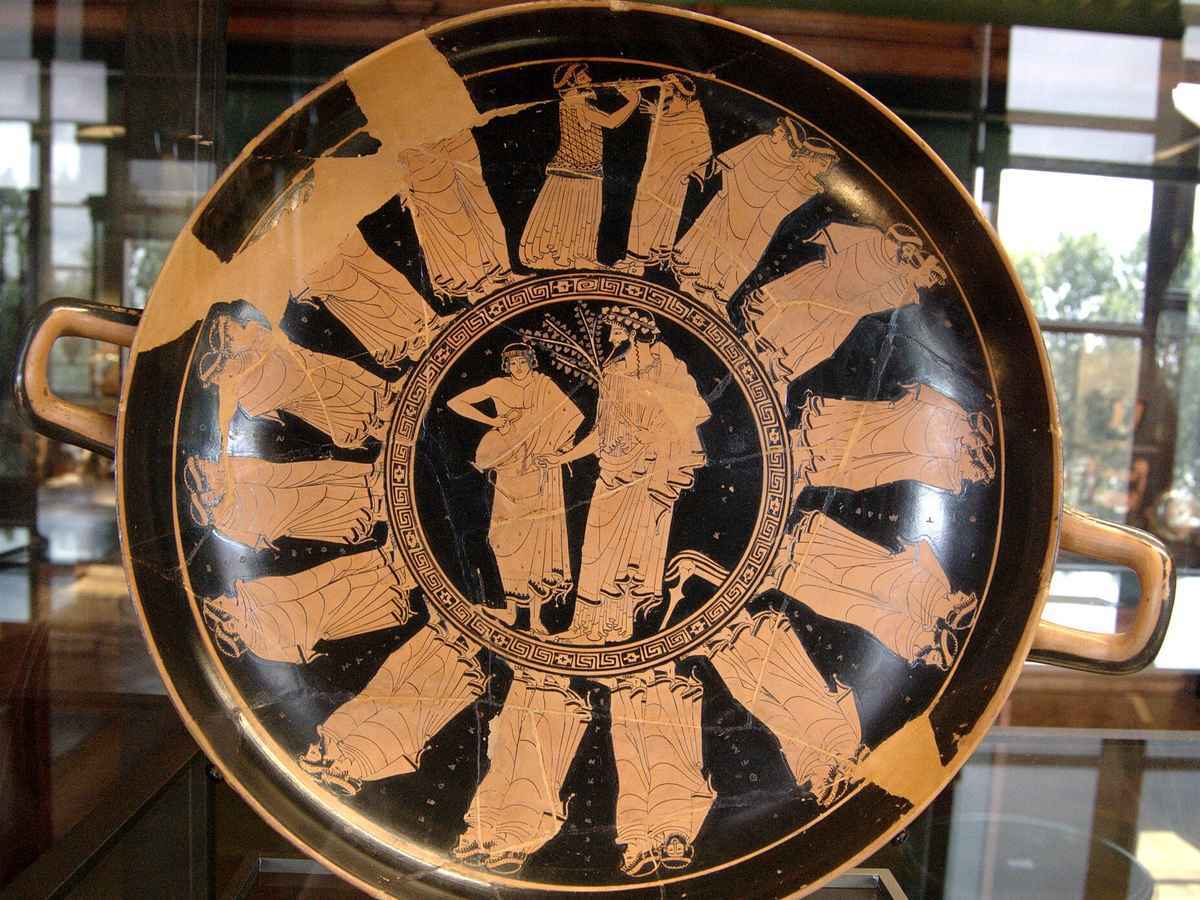
Apaturia was a central festival in Ancient Athens, devoted to Zeus Phratrios and Athena Phratria. The festival lasted three days and followed a carefully structured program. During this period, members of each phratria, or kinship brotherhood, came together to perform sacrifices, share communal meals, and carry out formal registrations. Fathers presented their sons to the assembled phratores, or clan members, who confirmed their lineage and citizenship rights.
Through these rituals, Apaturia linked private family life to public responsibility, blending religious devotion with civic law. The festival was held annually in the month of Pyanepsion, roughly corresponding to mid-October through mid-November. It was observed throughout all Ionian towns with the exception of Ephesus and Colophon.
The name Apaturia derives from the Greek term for “common relationship,” reflecting the gathering of phratries. Folk etymology, however, connected it to apate (ἀπάτη), meaning “deceit,” referencing a legendary battle said to have taken place around 1100 BC. In this story, Melanthus, acting on behalf of King Thymoetes of Attica, defeated King Xanthus of Boeotia by pretending to have divine assistance.
The three days of Ancient Athens’ Apaturia festival: Banquets, sacrifice, and civic rites
According to the story, Melanthus claimed that a man clad in a black goatskin, associated with Dionysus, aided him during the fight. Although the tale may seem anecdotal, it underscores the festival’s deeply-rooted cultural significance and its connection to both religious symbolism and historical memory.
The first day of the festival, known as Dorpia (otherwise Dorpeia), centered on communal banquets. These meals were held either in the meeting spaces of each phratria or in the private homes of its members. The gatherings provided kinship groups with an opportunity to come together socially to discuss shared concerns. While the day carried religious undertones, its primary emphasis was on fellowship and solidarity within the phratria. The evening feasts also strengthened the cohesion of the clan, reinforcing each member’s awareness of shared obligations and status.
The second day, Anarrhysis, focused on ritual sacrifice. Families offered oxen to Zeus Phratrios and Athena, with the expenses covered collectively. The purpose of the ritual was to honor the gods while demonstrating the phratries’ shared responsibility to both divine authority and civic order. Sacrifice thus served a dual function, acting as a spiritual offering to the deities and as a public affirmation of social and familial integrity. Through their participation, each family reaffirmed its commitment to the gods and to the wider community.
The third day, Kureōtis, was the day of the festival’s most formal civic role. Fathers and guardians presented children born since the previous Apaturia to the phratores. An oath was sworn to confirm the children’s legitimacy, and the family offered a goat or sheep, known as the meion (μείον). Boys who had reached puberty presented wine to Hercules.
The civic significance of the festival
The third day also featured educational and cultural activities. School-age boys recited poetry and competed for prizes, adding a performative dimension to the proceedings. In this way, Kureōtis represented the continuity of lineage and the incorporation of younger generations into civic life.
The name Kureōtis may derive from kouros (κοῦρος), meaning “young man,” which reflects the day’s emphasis on children coming of age. Alternatively, it may stem from keiro (κείρω), “to shear,” referring to the ritual cutting of hair as an offering to the gods. By presenting children, carrying out sacrifices, and taking part in communal activities, families reinforced their legal standing, social ties, and cultural identity within the city.
According to the lexicographer Hesychius, a fourth day known as epivda (ἐπίβδα) followed the three principal days. However, epivda was a general term used to denote the day after any festival rather than a distinct ceremonial addition. Its mention highlights the careful structuring of the festival and the importance Athenians placed on ritual order and precise timing.
Membership in a phratria was essential for access to civic privileges, voting rights, and participation in the political life of Athens. These standards were actively upheld by fathers and fellow members, making Apaturia both a family-centered tradition and a key civic institution.

Cultural, educational, and civic dimensions of Apaturia
The festival also reflected broader Greek values. In Ancient Athens, people understood family, religion, and civic duty as deeply interconnected. Apaturia illustrated how private life, public identity, and divine oversight could converge within a single event. Communal meals, sacrifices, and registration rites fostered solidarity, while cultural practices such as poetry recitations reinforced education and civic participation. Through Apaturia, Athenians connected the present to the past, children to their ancestors, and the human sphere to the divine.
At the same time, the structure of the festival emphasized inclusivity within the phratria while remaining selective in matters of citizenship. Apaturia gradually came to function as a mechanism of social regulation, ensuring the proper recognition and recording of legitimate citizens. Only children born to acknowledged citizens could be enrolled, underscoring the festival’s dual role as both a religious celebration and a regulatory institution.
By requiring public verification of lineage, the integrity of the citizen body was maintained, and the social and political fabric of the city was preserved. In this way, the festival also allowed Athenians to navigate the complex relationship between family, religion, and the state, ensuring that social hierarchy and civic participation remained clearly defined and enforceable.
In addition, Apaturia carried significant educational and cultural importance. Poetry recitations and the awarding of prizes encouraged the development of public speaking skills, literary knowledge, and healthy competition among young participants. These activities reflected the broader Greek emphasis on cultivating well-rounded citizens capable of contributing meaningfully to civic life.

Reinforcing lineage, citizenship, and social cohesion through the Apaturia festival
Apaturia was a multifaceted festival in Ancient Athens that brought together religion, civic duty, and social cohesion. It provided a structured framework for verifying lineage, enrolling citizens, and celebrating a shared identity. The three main days—Dorpia, Anarrhysis, and Kureōtis—were organized opportunities for feasting, sacrifice, registration, and cultural engagement. These procedures balanced public accountability with private devotion. In this way, Apaturia stood as a cornerstone of Athenian society, preserving lineage, reinforcing civic belonging, and honoring the cultural and religious foundations of the city.
Generally speaking, Apaturia demonstrated how a festival could function as an essential civic institution. By integrating public accountability, social regulation, and cultural education, it helped maintain the integrity of the citizen body, ensured the continuity of family lines, and reinforced the shared identity that bound the polis together.
See all the latest news from Greece and the world at Greekreporter.com. Contact our newsroom to report an update or send your story, photos and videos. Follow GR on Google News and subscribe here to our daily email!

