



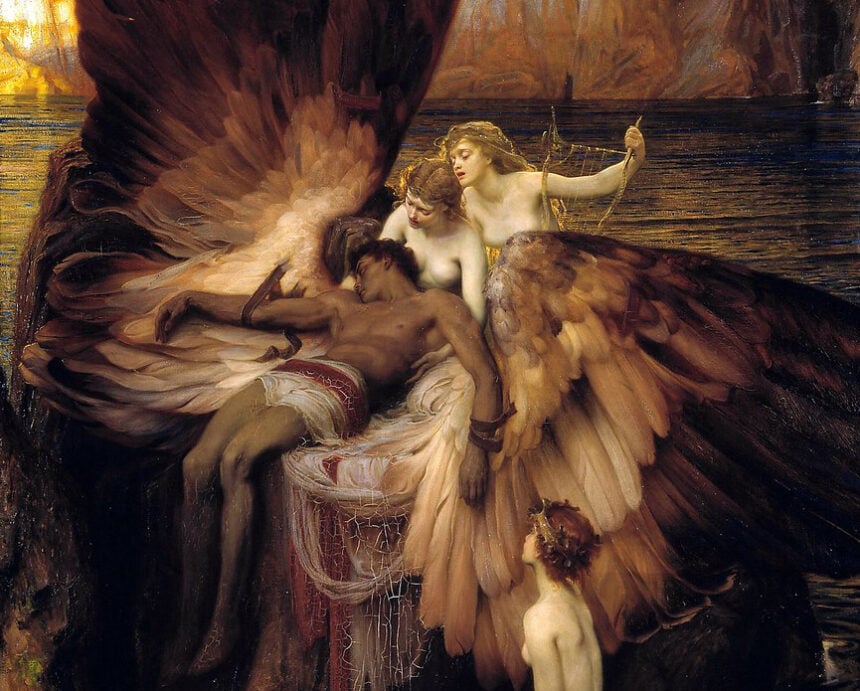
From Archimedes’ screw to Leonardo da Vinci’s aerial experiments, Ancient Greek mechanics helped inspire the idea of the first helicopter during the Renaissance. Archimedes designed the screw to lift water, but its spiral motion hinted at a broader potential— rotation could create upward movement, a principle that would capture the imagination of later inventors.
Centuries later, Leonardo da Vinci transformed this idea into a vision for human flight, imagining a device that could rise into the air. From water to the sky, the path from Archimedes’ mechanical ingenuity to da Vinci’s inventive designs shows how observation, creativity, and simple principles can combine to spark some of humanity’s most ambitious dreams.
From water to air: How Archimedes’ insights and his screw paved the way for da Vinci’s vision of flight
At the heart of this story is Archimedes, one of antiquity’s greatest minds. Living in the third century BC in the city of Syracuse, he transformed mathematics, engineering, and physics. However, Archimedes went beyond abstract formulas and explored practical problems. He sought to understand how forces move objects and how simple machines can amplify human effort.
One of his most famous inventions, the Archimedean screw, reflects this mindset. The device consisted of a spiral enclosed within a cylinder. When rotated, it lifted water from a lower level to a higher one. Farmers used it to irrigate fields, and engineers employed it to drain flooded areas. Though simple in design, the screw demonstrated a profound principle, namely that rotation, when harnessed correctly, could produce upward movement.
This principle was not limited to water. It suggested a broader conceptual possibility. If a rotating spiral could lift liquid, might a similar motion lift air? Ancient Greek thinkers believed in the consistency of nature and the order of geometry, trusting that motion in one domain could translate into another.
Greek philosophy further encouraged this type of reasoning. Thinkers such as Archytas did not separate science from imagination. They studied mechanics alongside metaphysics and examined how invisible forces shape visible outcomes. This intellectual environment nurtured bold ideas, encouraging thinkers to ask not only what exists but also what could theoretically exist.
From ancient insight to Renaissance vision: Leonardo da Vinci’s aerial screw and the path to flight
Centuries after Archimedes, Greek texts and ideas circulated across the Mediterranean, eventually reaching Renaissance Europe. Scholars studied them closely, translating, debating, and expanding on the ancient knowledge. Among those inspired was Leonardo da Vinci, a man whose curiosity and observational skill knew no bounds.
Da Vinci approached the world with meticulous attention. He dissected bodies, analyzed water currents, and sketched machines, seeking to uncover the patterns that governed nature. Like Archimedes, he focused on motion, asking how forces interact and how structures respond.
During his investigations, da Vinci encountered the principle of the screw and recognized its mechanical potential. He did not limit it to moving water. Instead, he imagined a device in which a spiral could push against the air, generating lift. Inspired by Archimedes’ screw, he designed his famous aerial screw which was a large helical surface intended to spin rapidly, compressing the air beneath it to create upward force and in essence, the machine would rise vertically, much like a first form of helicopter.
Leonardo da Vinci’s sketches reveal both creativity and precision. He calculated proportions carefully, considered materials, weight, and motion, and even accounted for the crew needed to operate the device. Yet the technology of his time proved to be a barrier, as materials were too heavy, and human power alone could not generate sufficient rotation. As a result, the aerial screw remained a vision on paper rather than a flying machine.
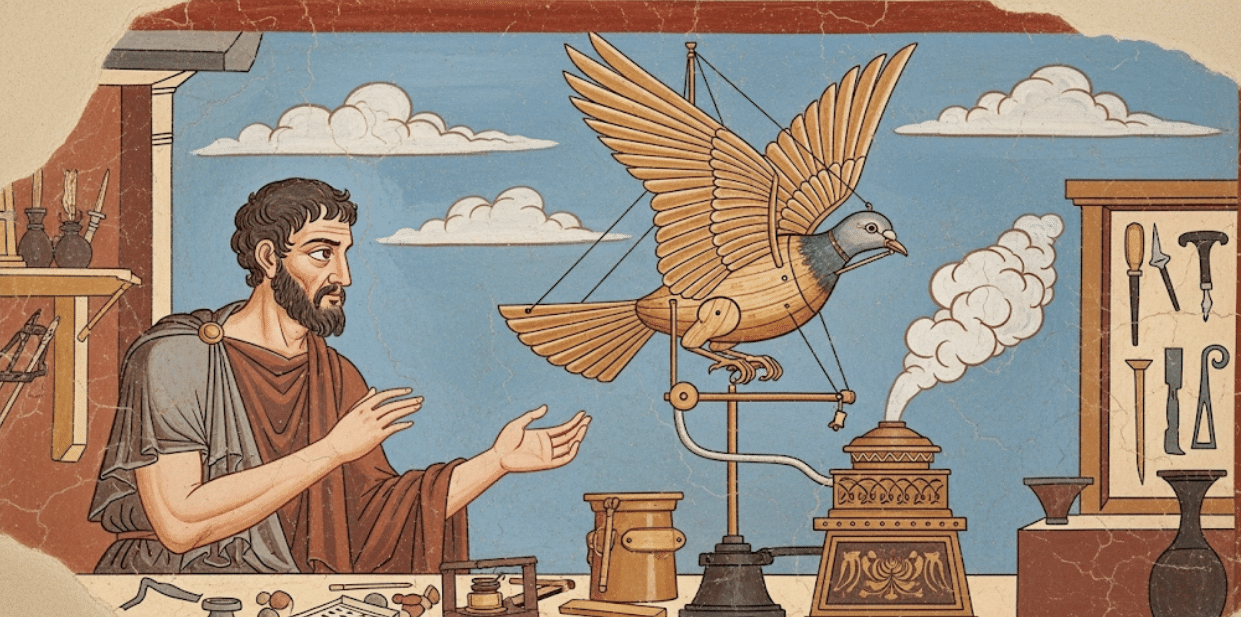
Ancient wisdom soared into Renaissance innovation
The idea itself marked a turning point. Leonardo da Vinci did not invent practical flight, but he transformed an ancient mechanical principle into an aerodynamic vision. Drawing on Archimedes’ screw, he extended the logic of rotation into the air, bridging classical antiquity with Renaissance creativity.
This connection also highlights the continuity of human thought. Knowledge does not emerge fully formed but evolves through dialogue across generations. Archimedes explored rotation and lift in water, and centuries later, da Vinci reimagined that motion in air. Later engineers would refine these concepts further, eventually developing engines capable of sustained flight.
The story also reflects the broader truth about innovation that breakthroughs rarely emerge in isolation. They arise from combining existing knowledge with new ideas. Archimedes provided the mechanical insight, while da Vinci contributed the visionary leap, establishing a chain of innovative ideas for the periods in question.
Cultural context played a role as well. Ancient Greece prized inquiry, logic, and experimentation. These were values that shaped the Western scientific tradition. When Renaissance thinkers rediscovered Greek ideas and manuscripts, they not only preserved them but revitalized them, applying classical knowledge to new challenges with renewed energy. Da Vinci fully embodied this spirit. He treated ancient knowledge as a foundation, respected it, and yet challenged it. His aerial screw reflects this mindset, honoring Archimedes while pushing ideas into uncharted territory.

From Spiral to Sky: How Archimedes’ Screw Inspired the First Helicopter in Leonardo da Vinci’s Vision
The aerial screw symbolizes humanity’s enduring desire to transcend limits. For centuries, flight seemed impossible. Birds ruled the sky, while humans remained bound to the earth. Yet thinkers refused to accept this boundary. They observed nature closely and searched for patterns that might reveal the secrets of flight.
Geometry played a central role in this quest. Greek mathematicians such as the Pythagoreans believed that shapes held universal truths, with circles, spirals, and proportions governing both the heavens and the earth. Leonardo shared this perspective. His aerial screw reflects a geometric solution to a physical challenge, turning the spiral into a tool for transformation.
Eventually, technology caught up with imagination. Centuries after da Vinci, engineers developed engines capable of sustained flight. Helicopters, in particular, rely on rotating blades to generate lift. While modern designs differ greatly from Leonardo’s concept, the underlying principle remains strikingly similar. Rotation interacts with air, producing upward force.
The legacy of Archimedes and da Vinci continues to shape modern engineering, but their influence goes deeper than mechanics and machines. They show us how innovation often begins with curiosity and imagination. Archimedes wondered about what might happen if rotation could lift water, and he answered with his screw. Centuries later, Leonardo sought to determine whether rotation could lift air. Though his design was never fully realized, it pointed the way forward.
The connection between Archimedes and Leonardo da Vinci illustrates the enduring power of human imagination. Ancient Greek mechanics provided the foundation, and Renaissance creativity expanded it. Together, they inspired one of humanity’s most ambitious dreams. Leonardo’s first “helicopter,” inspired by Archimedes’ screw, remained a sketch, yet its roots reach deep into antiquity—and from those roots, the future of flight began to rise.
See all the latest news from Greece and the world at Greekreporter.com. Contact our newsroom to report an update or send your story, photos and videos. Follow GR on Google News and subscribe here to our daily email!

