



The death of Alexander the Great in 323 BC led to half a century of fierce military and political competition between the Diadochi (successors) who carved up his empire amongst themselves. During this period of turmoil emerged some of the great powers of the day, namely Antigonid Macedon, the Seleucid Empire, and the Ptolemaic Kingdom in Egypt. However, the vacuum of power and political instability resulting from Alexander’s death also provided opportunities for smaller players to claim a piece of the pie. One such figure was Philetaerus of Pergamon, the unlikely leader of an ancient Greek city-state in Asia Minor.
Through his cunning, strategic foresight, and political acumen, Philetaerus was able to successfully navigate the treacherous world of Hellenistic power politics and cement Pergamon’s position as an affluent and respected regional power.
The uncertain origins of Philetaerus
Little is known about the early life of Philetaerus, although he was probably born sometime around 343 BC. According to Strabo, he was from Tium (Greek: Τῖον), an ancient Greek settlement in northern Anatolia.
His father was Attalus, who was perhaps a Macedonian or came from another part of Greece. It is also possible that he was Paphlagonian from the Black Sea coast who had taken a Greek name.
The mother of Philetaerus may have been called Boa according to Carystius of Pergamon, although his account is considered unreliable. Boa was purportedly a Paphlagonian “flute girl” and hetaera – in other words, a courtesan.
What is most striking about Philetaerus is that he was a eunuch. This means that he would have been castrated. This may be because of his connection to the cult of Cybele, a Mother Goddess of Asia Minor whose priests were often eunuchs.
Another theory is that as a child Philetaerus was trapped in a crowd crush and his genitals were irreparably damaged, causing him to become a eunuch. Whatever the truth, the ancient Greeks tended to look down on eunuchs, making Philetaerus’ later rise to power even more extraordinary.
Although Philetaerus could not have children, he did have two brothers and several nephews with whom he would work together to establish a dynasty when he came into power.

Philetaerus is appointed governor of Pergamon
In 301 BC, Pergamon, as well as much of Asia Minor, came under the control of Lysimachus. Lysimachus had served under Alexander the Great, and now, with the Macedonian king dead, sought a slice of his empire for himself. Having just defeated Antigonus Monopthalmus, another of Alexander’s generals, at the Battle of Ipsus, Lysimachus was one of the most powerful remaining Diadochi.
Fortunately for Philetaerus, Lysimachus appointed him as governor of Pergamon. At this time, the city was insignificant, but the steep valleys and cliffs surrounding its acropolis at the top of a tall rocky hill made it nearly impossible to attack successfully. For this reason, Lysimachus chose the city to function as his treasury.
Under Persian rule, Pergamon had not risen to prominence despite enjoying several geographical advantages. The city was situated in a commanding position over the Caicus Valley. This fertile plain was perfect for agriculture and was protected by surrounding mountains. The River Caicus also granted the Pergamese access to the sea which was just 30 km away and could be seen on a clear day from Pergamon’s acropolis.
Philetaerus had been granted governorship over a city with immense potential and it could not have come at a better time. The intense competition between the Diadochi produced opportunities for ambitious figures like Philetaerus to fill the small vacuums of power that emerged from the political chaos.
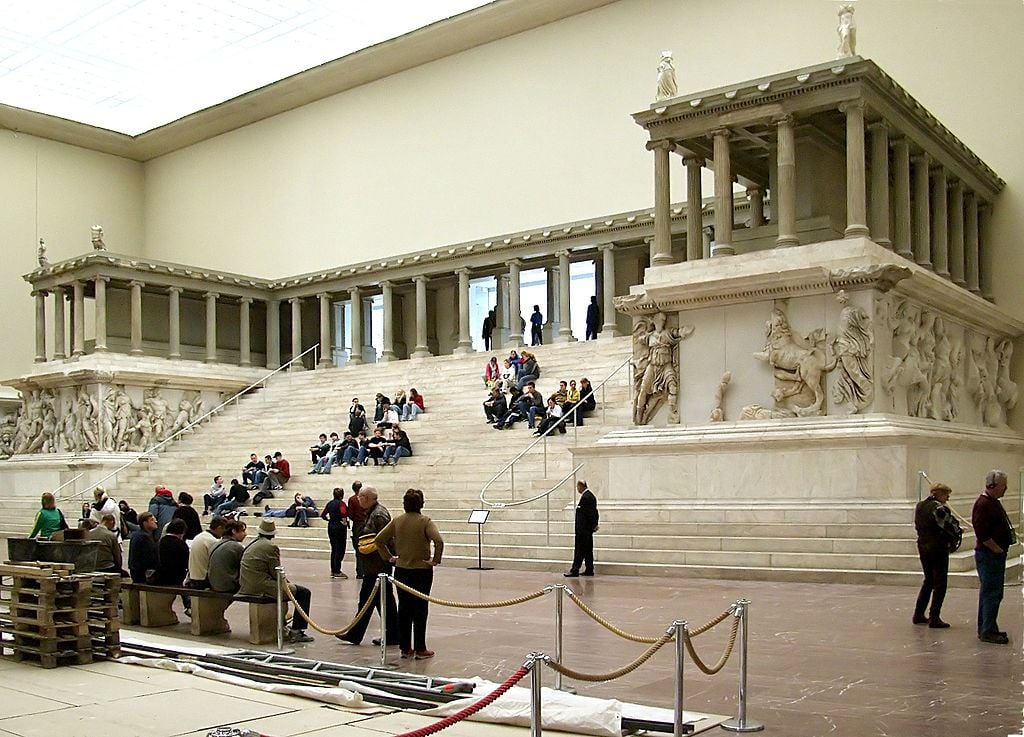
Pergamon’s ancient Greek Machiavelli?
Lysimachus came to the height of his power in the early decades of the 3rd century BC before a sudden and sharp fall. In 297 BC, Cassander, his main rival and the king of Macedon, died. In the years between 288 and 285 BC, he used this opportunity to invade Macedon and incorporate it into his own territory.
However, Lysimachus was not without rivals. Seleucus controlled the largest of the Successor States, stretching from Syria to the northwestern fringes of India. Ultimately though, it would be internal intrigue that would undermine the rule of Lysimachus. Agathocles, the eldest son and heir of Lysimachus was – probably falsely – accused of plotting against his father. Lysimachus responded by putting his son to death.
The execution of Agathocles shocked and disgusted the Hellenistic world and resulted in a wave of defections and rebellions across Lysimachus’ territory. Philetaerus was the first to defect in either 283 or 282 BC and his decision to join Seleucus emboldened others to do the same.
Seleucus marched against Lysimachus and defeated and killed him at the Battle of Corupedium in 281 BC. However, Seleucus was murdered soon thereafter as he marched towards Macedon by Ptolemy Ceraunus, a son of Ptolemy I.
Philetaerus again saw an opportunity to advance his position. He bought the body of Seleucus from Ptolemy Ceraunus for a considerable sum and cremated it. He then returned the ashes to Antiochus I, the son and heir of Seleucus who now ruled over the mighty Seleucid Empire.
As one of the instigators of Lysimachus’ downfall, Philetaerus’ status had exceeded that of a mere governor and treasurer. He was now a major player in Hellenistic power politics and had ingratiated himself with both the Seleucids and the Ptolemies.
Pergamon becomes an important center of the ancient Greek world
Philetaerus was nominally a subject of Antiochus I but he enjoyed a significant degree of autonomy and strategic freedom to rule as he saw fit. The Seleucid Empire was vast and Antiochus I was too preoccupied to curb the incremental steps Philetaerus was taking to increase his own authority.
The vast wealth that Lysimachus had left in the treasure certainly helped. Philetaerus had approximately 9,000 talents of silver at his disposal which he spent on major projects, such as the construction of temples to Athena and Cybele. He also enhanced his prestige by making donations to important religious sites like Delphi, demonstrating his piety and cultural patronage.
Philetaerus also had a keen mind for defense and expanded the walls of Pergamon to increase the city’s fortifications. In 277 BC, the Galatians – a Gallic/Celtic people – invaded Asia Minor and posed a major threat to the Greek cities there. Few sources survive that tell us much about the war but the Greeks evidently triumphed and it is likely that Philetaerus cooperated with Antiochus to see off the threat. What is certain is that he incorporated this success into his propaganda to present himself as a bulwark of Greek culture against invading barbarians.

Legacy
After Philetaerus’ death in 263 BC, his heir and nephew Eumenes succeeded him. When Eumenes also passed away in 241 BC, Attalus, the son of another one of Philetaerus’ nephews became Pergamon’s new ruler.
During his lifetime, Philetaerus had been careful not to style himself as a king to avoid attracting the ire of one of the more powerful rulers of the Successor States, although around 270 BC he had begun to mint coins bearing his portrait in the style of a monarch.
In 238 BC, however, Attalus declared himself king. The Attalid Dynasty, as it came to be known, ruled over Pergamon until 133 BC, when it was bequeathed to the Roman Republic by its final ruler, Attalus III.
Philetaerus had succeeded in establishing a strong ancient Greek polity in Pergamon that would continue to punch above its weight long after his death. His heirs and family continued to play an important part in the Hellenistic power struggles that defined Mediterranean geopolitics between the death of Alexander the Great and the rise of Rome.
Under the Attalids, Pergamon became an important cultural and economic center of the ancient Greek world, its acropolis, cultural output, and architectural splendor even rivaling that of Athens.
See all the latest news from Greece and the world at Greekreporter.com. Contact our newsroom to report an update or send your story, photos and videos. Follow GR on Google News and subscribe here to our daily email!

