



Aristotle’s defense of slavery is a controversial aspect of his legacy, standing in stark contrast to his reputation as the founding figure of Western political philosophy. Examining his argument helps explain how ancient social hierarchies were justified and why such beliefs endured well into later periods.
Rooted in the social structure of classical Athens, Aristotle’s position addresses not only who should rule but also what constitutes a fully flourishing human life. Within this framework, he presented slavery as a supposedly natural institution, integrated into his broader understanding of political and ethical order.
Aristotle and slaves
In Book I of Politics, Aristotle argues that some people are “slaves by nature,” claiming that those who lack the rational capacity for deliberation benefit from the guidance of a master whose reason governs the household for the common good.
Aristotle distinguishes between bodily strength and rational foresight, envisioning a partnership in which the master provides reason while the slave provides labor. He presents this relationship as mutually beneficial rather than solely coercive or exploitative. This distinction reflects his broader hierarchy of associations, from household to city, framing command and obedience as natural relations rather than merely products of social convention.
At the same time, Aristotle is not blind to abuse. He criticizes enslavement through war capture if it does not align with what he perceives as natural. While this caveat raises doubts about many real-world instances of slavery in his time, it functions less as an abolitionist argument than as a theoretical filter: it permits slavery in principle while casting suspicion on many practices. Through this framework, Aristotle maintains that society will flourish under the belief that some individuals are genuinely suited to be slaves, provided they meet certain criteria.
This tension between an idealized “natural” slavery and the empirical brutality of the institution is one of the most debated contradictions in the Politics. It prompts the enduring question of whether Aristotle’s theory can withstand scrutiny when applied to actual social practice.
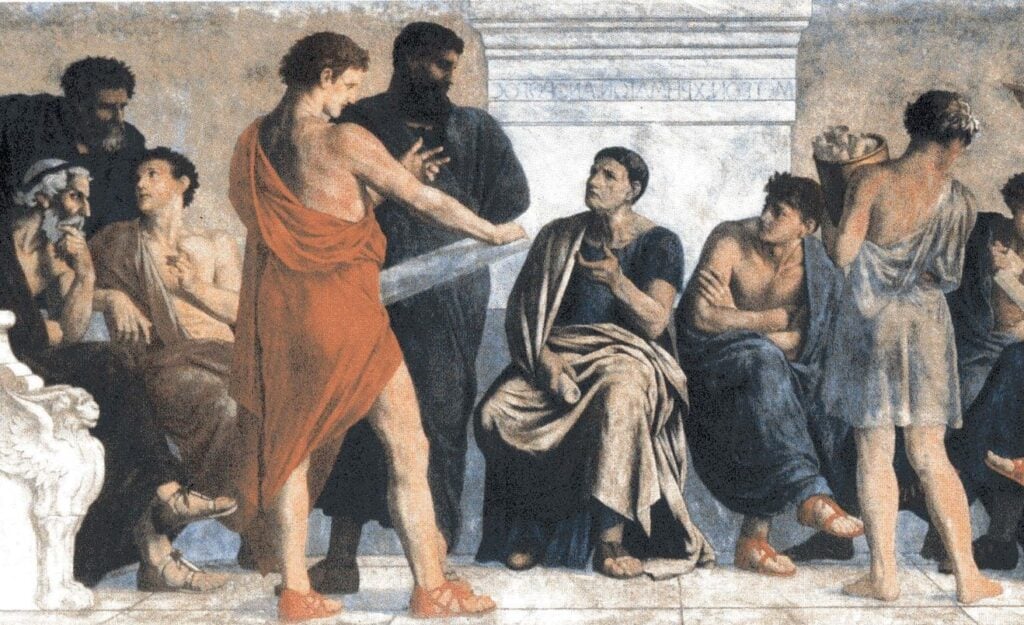
The origins of Aristotle’s beliefs on slavery and its critique
The roots of Aristotle’s argument lie in his teleology, the view that all beings have natural ends or functions, with reason as the defining feature of humanity and political life as the culmination of human nature.
Aristotle contends that some humans share in reason only to the extent of recognizing it in others, and that their telos (purpose in life) is fulfilled not through independent deliberation but by participating in another’s rational governance within an ideal society. He analogizes this relationship to the body’s dependence on the soul. Critics, both ancient and modern, argue that this analogy risks turning differences of education or circumstance into essential differences of kind, effectively disguising social domination as a natural order. In this way, it serves to perpetuate societal hierarchies that primarily benefit the elite.
Modern scholarship has highlighted three major critiques that challenge Aristotle’s defense of slavery. The first is the epistemic problem: there is no reliable method to identify “natural slaves” without reproducing prejudice or circular reasoning, since perceived incapacity is often the result of oppression rather than proof of an innate deficiency.
The second is the practical problem: historical mechanisms of enslavement in the Greek world—including war capture, piracy , and debt bondage—rarely align with the rational criteria Aristotle proposes, rendering the institution he endorses largely indistinguishable from total injustice in practice. The third is the normative problem: even if unequal capacities exist, differences do not logically entail domination, since education, legal rights, and social supports can cultivate individual agency without resorting to permanent slavery.
Consequences then and now
Aristotle’s prestige ensured that his opinions traveled far beyond the Lyceum, influencing medieval commentaries across Europe and providing language later used in early modern debates about conquest and colonization. While some scholastic and humanist writers invoked the idea of “natural slavery” to justify subjugation, others highlighted Aristotle’s caveats regarding unjust capture to challenge the legitimacy of enslavement, demonstrating the interpretive flexibility of his texts in ideological disputes.

In the Western world, defenders of slavery often relied on classical authority to rationalize racially-based servitude, yet critics pointed out that Aristotle’s requirement—that slavery correspond to genuine incapacity—could never justify hereditary systems. The influence of Aristotle’s theory also shaped the development of modern social science by prompting clearer distinctions between descriptive hierarchies and normative justification. This distinction helped lay the groundwork for arguments in favor of universal legal personhood, decoupling rights from contested measures of rational capacity.
For contemporary readers, Aristotle serves as a cautionary example of how sophisticated theories can support unjust institutions when empirical scrutiny and moral reflection are insufficient. At the same time, engaging carefully with his arguments reveals seeds of critique: the tension between his idealized notion of “natural” slavery and the brutal reality of historical practice exposes fundamental weaknesses in the defense of the institution itself.
See all the latest news from Greece and the world at Greekreporter.com. Contact our newsroom to report an update or send your story, photos and videos. Follow GR on Google News and subscribe here to our daily email!

