



The Battle of Ipsus in 301 BC ended any hope of imperial unity and eliminated the last man who attempted to rule the empire Alexander had left behind. Alexander’s empire effectively collapsed upon his death.
His generals swore loyalty to his heirs, yet each sought the crown for themselves. Their rivalries turned the greatest empire in history into a war zone. Four brutal wars reshaped the map of the ancient world before one final clash ultimately decided the fate of the empire Alexander the Great had established.
A world consumed by the Wars of the Diadochi
The First War of the Diadochi began the cycle. Perdiccas attempted to enforce central authority and hold the empire together, but Ptolemy resisted, setting Egypt on its own path. Perdiccas ultimately fell, and the victors divided power again at Triparadisus, a settlement that created more enemies than allies.
The Second Diadochi War followed almost immediately. Antigonus Monophthalmus emerged as a rising force. He defeated Eumenes, who fought on behalf of Alexander’s dynasty. Their struggle included the sieges of Babylon, where Antigonus attempted to crush Seleucus. Seleucus lost the city and fled to Ptolemy for safety.
The Third Diadochi War escalated the chaos. Antigonus pushed into Asia Minor, Syria, and the Levant, while his son Demetrius challenged Ptolemy at sea. Demetrius won at Salamis, shattering the Egyptian fleet. Antigonus now appeared unstoppable and demanded recognition as regent of the empire. His rivals refused, viewing him as a threat greater than any external enemy. Alexander’s empire now had two centers of gravity: Antigonus in Asia and the coalition forming against him.
Seleucus then shifted the balance. He returned to the east and reconquered Babylon in a fierce campaign. The Babylonian War marked his resurgence. He now controlled the eastern regions, gaining access to wealth and manpower that rivaled any king. Antigonus tried again to remove him but failed, setting the stage for the final confrontation.
The Fourth Diadochi War began as Antigonus grew too powerful. Cassander feared him in Macedonia, Lysimachus in Thrace, Seleucus in the east, and Ptolemy in Egypt—all threatened by his dominance. They formed an alliance and marched to stop him. Ipsus became the decisive battlefield of a twenty-two-year struggle.
The path to the decisive confrontation
Antigonus controlled the largest territory, holding Asia Minor, Syria, and much of the Eastern Mediterranean. His armies moved swiftly and acted with confidence. He believed he could win another war by defeating his rivals one by one.
The coalition adopted a different strategy. Cassander and Lysimachus invaded Asia Minor from the west, aiming to force Antigonus north and delay his advance. Seleucus marched from the east with a massive army and hundreds of war elephants imported from India. These elephants provided him with a weapon that no Macedonian general had ever commanded on such a scale.
Demetrius arrived with elite cavalry. Both sides recognized his skill: his charges had won battles that had seemed impossible. His presence created dread among the coalition leaders, who devised a counterstrategy specifically aimed at neutralizing him. The armies finally met in central Phrygia. The plain near Ipsus offered open space for cavalry maneuvers, and both sides understood the importance of the terrain—neither wanted to retreat. The battle would determine the future of the empire.
Both armies likely formed in the classic Macedonian pattern, placing their phalanx at the center, with light infantry on the flanks and in front. These skirmishers screened the heavy infantry and probed for early openings. Cavalry held both wings, though each army reserved its best squadrons for the right.
Antigonus positioned Demetrius on that wing. Demetrius commanded elite horsemen who had won victories across the Aegean. Antigonus himself stood behind the phalanx with his bodyguard, ready to steady the line if needed. Seventy-five elephants guarded the Antigonid front, each supported by infantry screens.

The opening clash
The exact deployment of the allied forces remains unclear. According to the biographer Plutarch, Antiochus, the son of Seleucus, held the allied left—a wing traditionally weaker, designed to delay rather than break the enemy. Sources do not reveal who commanded the allied right, nor the specific positions of Seleucus, Lysimachus, or Pleistarchus.
Seleucus placed some elephants in front of the line, though their number is unknown. The historian Diodorus Siculus claims he held a major elephant reserve, possibly one hundred or more. However, scholars Bob Bennett and Mike Roberts argue that such a reserve would have been unprecedented and tactically wasteful. The “elephant problem” remains central to every modern debate about Ipsus.
The fighting began with the elephants. Diodorus asserts that both sides fielded beasts of equal courage and strength, suggesting a balanced match, though the numbers remain disputed. Behind this screen, Demetrius launched the first decisive stroke. He maneuvered his cavalry around the elephants and struck Antiochus’s horsemen, breaking the allied left. Antiochus’s wing fled the field, and Demetrius pursued them with his usual aggression.
The pursuit proved to be a mistake. Demetrius drove too far and isolated his cavalry, removing the only force capable of protecting the Antigonid right or striking the rear of the allied phalanx. When he tried to return, he found his path blocked by a massive barrier of elephants—possibly three hundred. Ancient horses feared elephants, avoiding both their scent and their trumpeting calls. Demetrius could not break through or ride around such a wall. This decisive maneuver changed the course of the war. Whether it resulted from a planned reserve or battlefield improvisation remains unknown.
The turning of the phalanx and its effect on Alexander’s empire
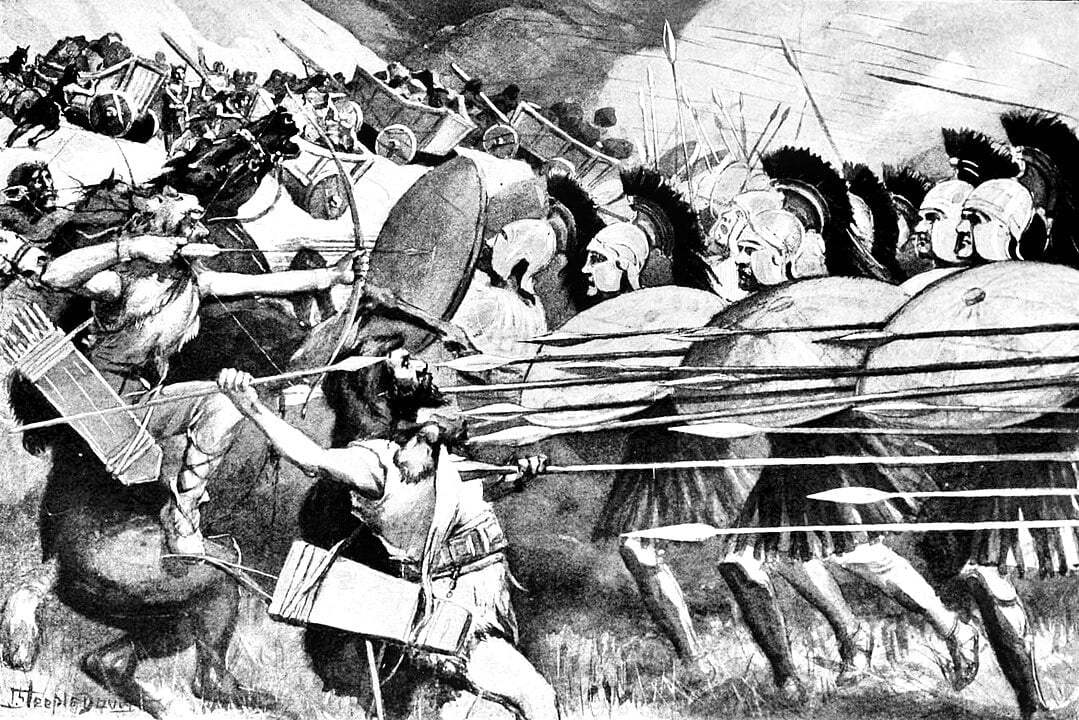
As Demetrius struggled to regain the field, the phalanxes collided. Bronze shields locked together, and sarissas jutted forward like a forest of steel, while the fighting grew brutal and chaotic. The Antigonids expected Demetrius to strike the allied flank or return to protect their own—but instead, their right flank remained exposed.
Seleucus seized the moment. He rode alongside the Antigonid phalanx, threatening a charge without ever fully committing. This tactic exploited the fear of attack more than the attack itself. His cavalry included mounted archers, likely from the Iranian highlands, skilled in firing while in motion. They released volleys of arrows into the dense Antigonid ranks. Phalangites could not break formation without exposing their flanks, and they endured the barrage helplessly.
Morale collapsed. Some soldiers fled, while others defected to the allied side. Antigonus tried to rally the center, standing exposed and hoping for Demetrius’s return, but his pleas failed to steady the line. Allied skirmishers closed around him, and a storm of javelins struck him down. The old king fell where he fought, refusing to retreat. His death shattered the cohesion of his army. The Antigonid line dissolved, and with it, the battle came to an end.

The price of defeat for Alexander’s empire
The death of Antigonus destroyed the last real claim to imperial unity. Demetrius escaped, but he lost nearly all his power. His bases collapsed, his allies deserted him, and his dream of ruling the empire Alexander the Great had left behind vanished.
The victors reshaped the world to suit their interests. Seleucus gained Syria and most of the Asian provinces. His kingdom stretched from the Aegean to the borders of India—no Hellenistic ruler commanded a larger or more diverse realm. Lysimachus received western Asia Minor and strengthened his grip on Thrace. Meanwhile, Cassander maintained control of Macedonia and Greece, securing his political dominance in the west.
The empire no longer existed as a single entity. Ipsus forced a permanent division into several large states, each ruled by a king who no longer pretended to serve the Argead dynasty. The Seleucid, Ptolemaic, Antigonid, and eventually Attalid kingdoms would dominate the Hellenistic world. Their borders would shift over time, but the world they inherited was shaped decisively at Ipsus.
Ipsus stands as the dividing line between Alexander’s empire and the Hellenistic age. Strategy overcame heroism. Elephants overcame cavalry. A coordinated alliance defeated the last Macedonian titan who attempted to rule alone.
Most importantly, Ipsus destroyed the vision of a united empire that Alexander had dreamed of. The battlefield scattered his legacy into three great realms that would shape the Mediterranean for centuries. Antigonus died fighting for unity, while Seleucus, Lysimachus, and Cassander built states that accepted division. Alexander had conquered the world, and Ipsus buried his dream.
See all the latest news from Greece and the world at Greekreporter.com. Contact our newsroom to report an update or send your story, photos and videos. Follow GR on Google News and subscribe here to our daily email!

