



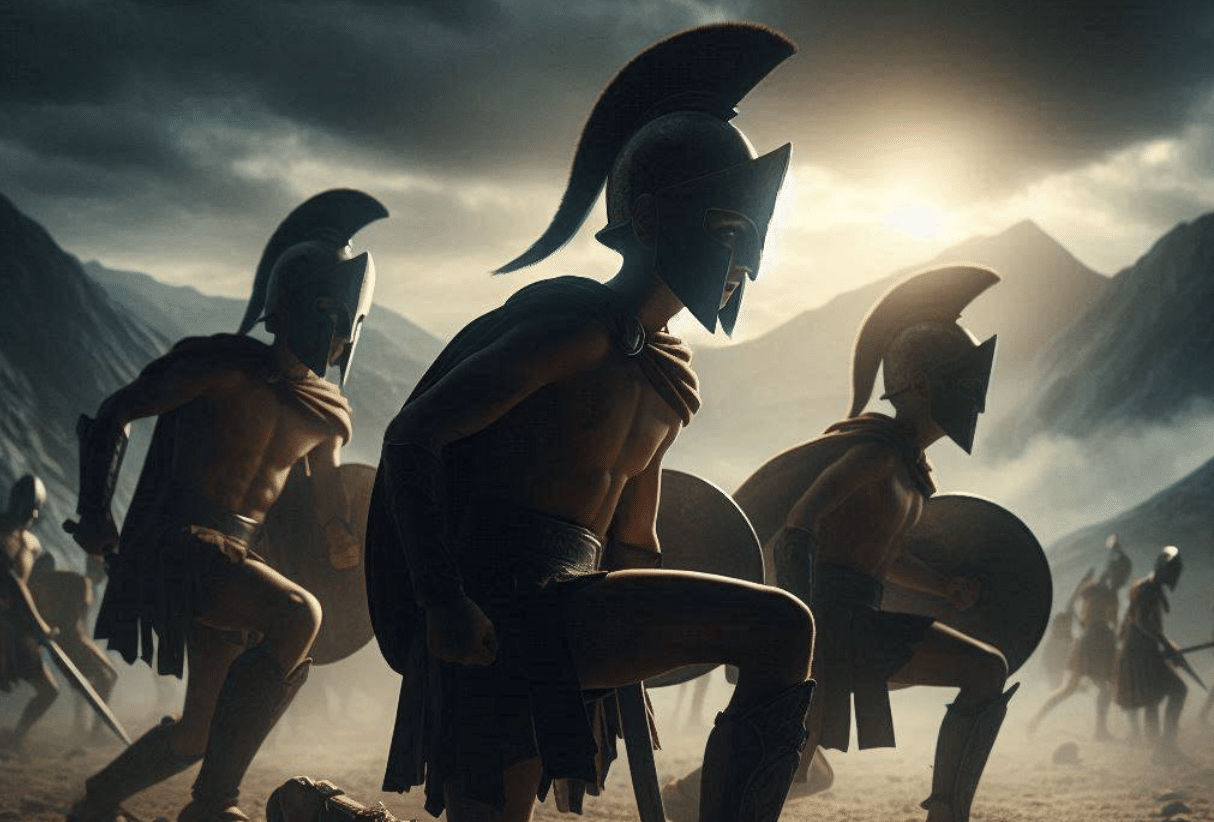
In ancient Sparta, the Parthenians emerged as a unique group, born to Spartan women who had relations with non-Spartan men outside of marriage. Their existence reflected the intersection of social, political, and military dynamics, offering a rare glimpse into the complexities of Spartan society.
History of the Parthenians, Sparta’s illegitimate children
The Parthenians emerged during the First Messenian War (ca. 743–724 BCE), a protracted conflict between Sparta and the neighboring region of Messenia.
The population of Sparta was never large, and this was a constant threat to the Spartans, who needed many descendants—particularly soldiers—to secure their dominance over the Perioikoi (free non-citizen inhabitants) and Helots (enslaved people), as well as to maintain their status as a formidable military force in Greece.
During the First Messenian War, many Spartan men lost their lives in battle. Meanwhile, back in the city, no children were being born, as the fertile men were absent. The risk of the population shrinking was significant at the time, and it appears that, by decision of the Senate, they ordered Spartan women and widows that would not marry to have sexual relations with the Perioikoi (and, according to some sources, also with the Helots) to produce offspring.
The Spartan children born from these unions were indeed illegitimate but were nonetheless children conceived by decree of the Senate. They did not consider Spartan women to have lost their honor. They were required to obey the Senate for the good of the city. For this reason, these women were thought to have “remained virgins” in the symbolic sense. Their children were referred to as “Partheniai,” meaning “children of virgins.”
The Spartan mothers later married as usual and gave birth to legitimate Spartan children, further solidifying the unique role the Parthenians played in Spartan history.
Role in Spartan society
The Parthenians occupied a liminal position within the Spartan social hierarchy. They were not slaves like the Helots, nor did they enjoy the status of full citizens. Exclusion from political rights and the Spartan military elite created resentment among the Parthenians, especially as they had Spartan ancestry but were denied full inclusion.
Discontent reached a boiling point after the war ended, as the Parthenians reportedly felt betrayed and abandoned by the Spartan state. Historical accounts suggest they became a destabilizing force in Spartan society, leading to tensions within the already stratified social system.
The founding of the city of Taras (Tarentum)

The city convened the Parthenians and formally dispatched them to establish a colony in southern Italy, appointing one of their own, Phalanthos, as leader.
Thus, Sparta was freed from the tumultuous claimants without conflict or bloodshed. The Parthenians departed for southern Italy in 706 BCE and founded Taras. Taras would become one of the most important colonies in Greater Greece.
Taras became a great colony with a strong cultural, economic and military presence. By 500 BCE, it was one of the largest cities of the time, with a population of 300,000. Famous philosophers, generals, writers and athletes, such as Archytas, Aristoxenos, and Livios Andronikos, were born there.
During Roman times, the city retained its charm. The poet Horace, in one of his odes, expressed his desire to retire there in his old age. He described it as a place where spring lasts long, winter is mild and the earth yields its bounties abundantly.
Taras became one of the most successful Greek colonies in the Western Mediterranean, renowned for its naval strength, vibrant economy and cultural achievements. Today, it is on of the largest mainland cities in southern Italy, home to sophisticated steel and iron foundries, chemical plants, oil refineries, shipyards and processed food factories.

Phalanthos named the colony after his son, Herakles Tarantas. From this name, we derive the tarantula dance and the tarantula spider.
Thus, the once-despised and outcast Parthenians, the illegitimate children of Sparta, gave humanity an illustrious and historic city. Taras continues to flourish after 2,700 years.
The Parthenian Legacy
The story of the Parthenians highlights the rigid nature of Spartan society. It also shows its unwillingness to adapt its citizenship rules, even in times of demographic crisis. It also underscores the tensions between strict social hierarchies and practical needs during times of war and instability.
While their exile marked a loss for Sparta, the Parthenians’ establishment of Taras ensured that their legacy endured, contributing to the spread of Greek culture and influence in the Western Mediterranean. Today, their story serves as a reminder of the complex social dynamics in one of the most unique city-states of ancient Greece.
See all the latest news from Greece and the world at Greekreporter.com. Contact our newsroom to report an update or send your story, photos and videos. Follow GR on Google News and subscribe here to our daily email!

