



Far from being a simple royal figure, Cleopatra was a brilliant intellectual shaped by the city of Alexandria and the traditions of Greek education. She did not merely inherit a throne; before her reign, she was molded within the city’s famous lecture halls and libraries.
Her mind was a product of a full Hellenistic curriculum—a rigorous Greek training that blended philosophy, science, and rhetoric with the art of governing a state. This well-rounded education endowed Egypt’s last active monarch with a remarkable intellect, an eloquent speaking style, and a sharp political intuition that drew as much from scholarly learning as from her Greek royal heritage.
A Greek education in an Egyptian palace
The Ptolemies rooted Macedonian ways deeply in Egyptian soil, and Cleopatra was the most refined result of that process. The Greek education she received—the paideia—was far more than ordinary schooling; it trained her judgment and shaped her worldview. Moral philosophy, including ethics and practical reasoning, stood alongside grammar, history, mathematics, music, and astronomy. In Alexandria, scholars painstakingly edited Homer, charted the heavens, debated virtue, and challenged each other over a symposium. Picture a scene where someone explains why the good life demands balance—neither too much nor too little—while young Cleopatra imagines how to apply this wisdom when she becomes queen.
In that vibrant intellectual world, Cleopatra learned to treat philosophy as a practical toolkit rather than a tedious school subject. Ancient writers celebrated her command of languages and her poise; Plutarch noted she seldom needed an interpreter and praised the melody of her voice. More than mere flattery, this offers a glimpse into her method: to persuade, one must first understand the person before you. Unlike her predecessors, she took the time to learn Egyptian, allowing her to speak directly with priests and scribes as easily as with Greek officials. This was a deliberate political move that strengthened her reputation as a unifying leader of Egypt.
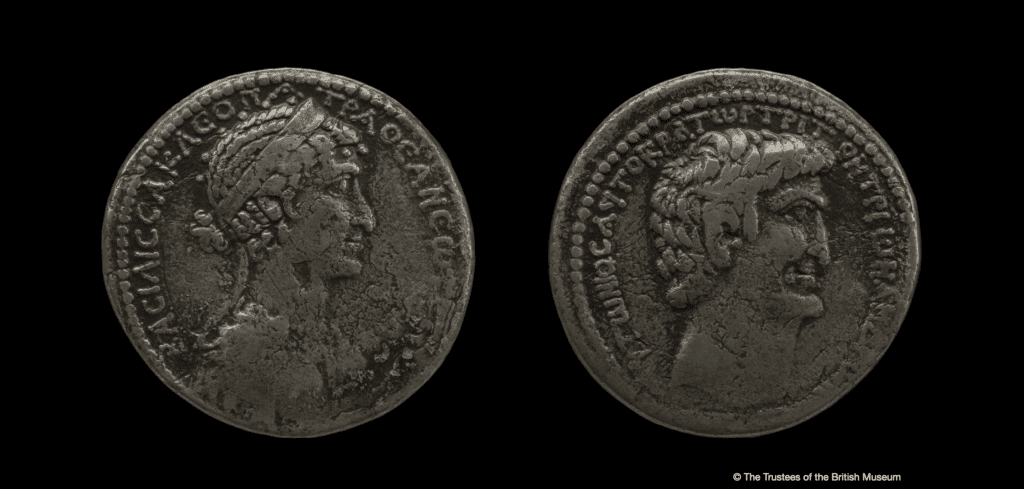
The philosophers of her time did not remain confined to lecture halls. Stoics taught self-control; Epicureans advised moderation and freedom from fear; and Peripatetics cultivated phronēsis—Greek for practical judgment—through close readings of history. Cleopatra’s court included astronomers and physicians who built upon the discoveries of Aristarchus, Eratosthenes, and Herophilus. Her advisers stood among Greek thinkers whose ideas had evolved for centuries. Even her coinage was deliberately part of this dialogue: pieces stamped ΒΑΣΙΛΙΣΣΑ ΚΛΕΟΠΑΤΡΑΣ (Queen Cleopatra) proclaimed her Greek identity, while Egyptian sacred symbols appeared in the design—a deliberate blend of cultures that symbolized her dual legacy.
Rhetoric as a way to rule
Greek education instilled the classic triad of ethos, logos, and pathos—and Cleopatra wielded all three with a mastery of performance that doubled as political strategy. Her legendary meeting with Julius Caesar and her later theatrics with Mark Antony were not mere displays of charm but visual arguments in themselves. Consider her entrance into Tarsus on a perfumed barge. It served as a statement of ideology, a royal message translated into spectacle. Aligning herself with Venus and Aphrodite, she signaled to the Roman general the kind of divine legitimacy he might be seeking.
Moreover, the Donations of Alexandria in 34 BC, when Cleopatra and Antony divided the eastern kingdoms among their children, was a bold and undeniably risky move. Yet the ceremony framed this geopolitical gamble within the familiar language of Greek kingship and the order of the oikoumene, or known world. It was both a performance and political act, animated by the philosophical idea that images can teach and ceremony can leave a lasting impression on the public. During the Alexandrian War, the court had to negotiate with Roman commanders, calm an uneasy city, and continue collecting taxes from an exhausted land.
In that high-pressure environment, Stoic self-possession, Epicurean calm, and the Aristotelian habit of matching action to circumstance became Cleopatra’s daily instruments of rule. Surviving coins, decrees, and temple dedications reveal a monarch fluent in both Greek civic ideals and Egyptian sacred traditions. This intentional bilingualism of values allowed her to project legitimacy on two stages at once—Greek and Egyptian.
Cleopatra’s Greek schooling also carries a modern resonance. She embodied how intellectual synthesis can evolve into effective governance: Macedonian by blood, Egyptian by throne, and Alexandrian by culture, she turned her layered identity into political strength. In an age marked by mass migration and blended identities, her example remains timely—a reminder that unity and adaptability can triumph even as nationalism rises.
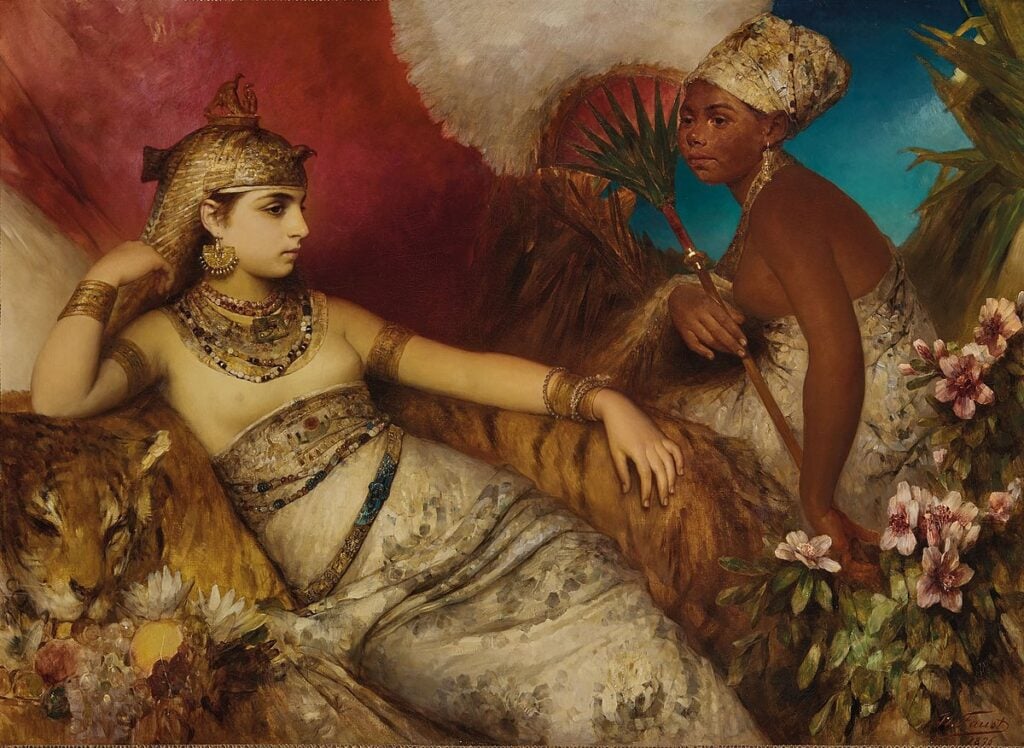
Her example also dispels a stubborn myth—that ancient women stood outside the sphere of politics. Cleopatra read, reasoned, and ruled, proving that intellect and leadership were not bound by gender. You don’t need to romanticize her to recognize the point.
Of course, not all her gambles succeeded. Her final bet against Octavian unraveled at Actium (modern-day Aktion in Greece). Yet the mindset behind those risks remains impressive. We can still read her arguments struck in silver: tetradrachms with Greek inscriptions asserted dynastic continuity, while Egyptian cult titles anchored her to local loyalties—precisely the kind of hybrid language modern leaders still employ. We can also hear her eloquence in Plutarch’s portrait of a tongue “like an instrument of many strings,” a musician’s metaphor for a ruler-philosopher whose intellect played across many registers.
And we can still trace the curriculum that shaped her in the city that taught it: a bustling port where ships unloaded grain and ideas at the same docks, where surveyors measured the earth while librarians weighed words, and where a young woman learned to turn thought into policy. Cleopatra’s story may invite the glamour of a soap opera, but her life and Greek education were far richer and more profound than legend suggests.
See all the latest news from Greece and the world at Greekreporter.com. Contact our newsroom to report an update or send your story, photos and videos. Follow GR on Google News and subscribe here to our daily email!

