



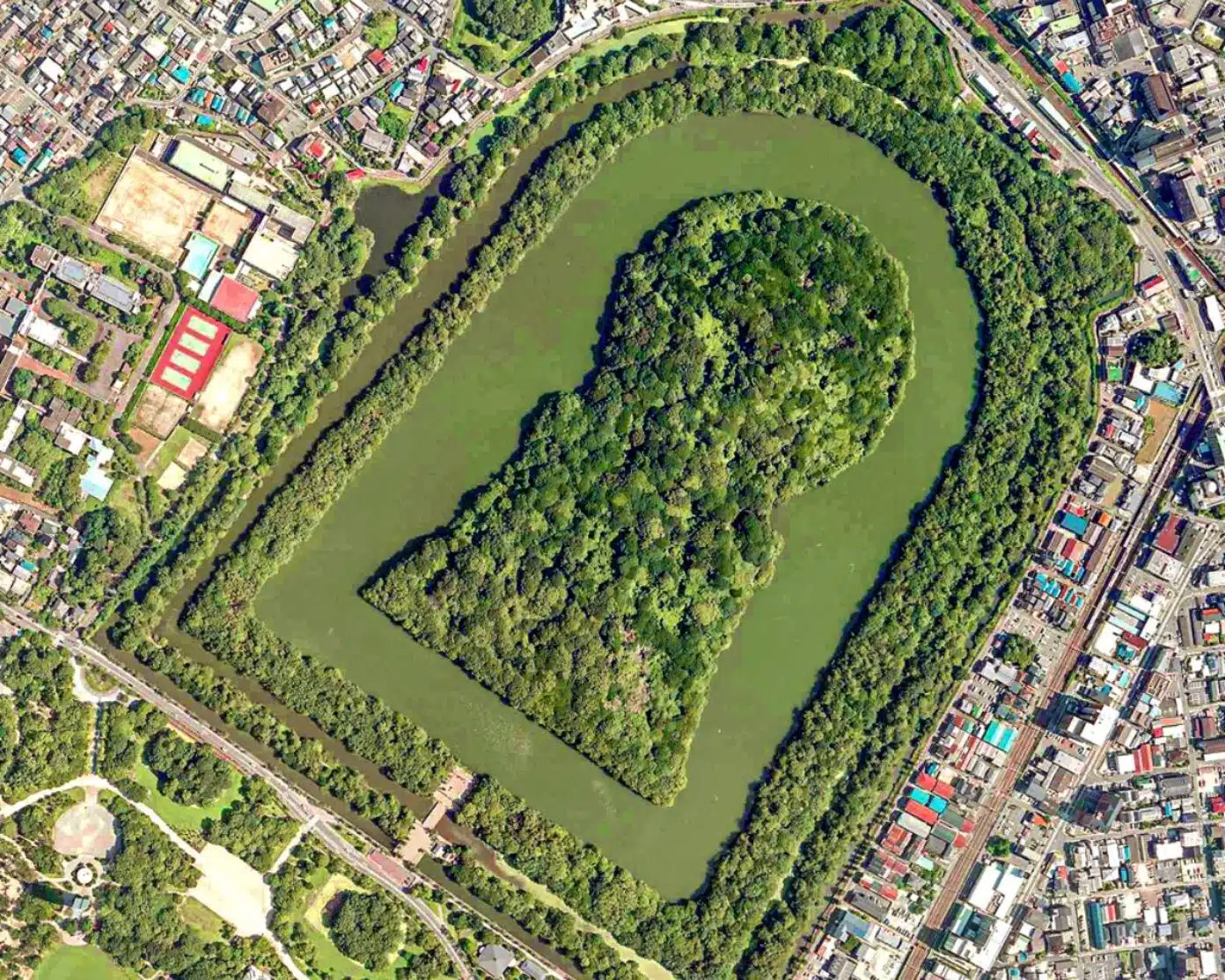
Two long-lost artifacts believed to be treasures from Emperor Nintoku’s burial mound have been recovered and confirmed as grave goods from the Daisen Kofun, a monumental tomb tied to the 5th-century ruler.
The knife and armor fragments, considered missing for more than 150 years, are the first authenticated items from the site, marking a rare breakthrough in Kofun-period archaeology.
Sakai City and Kokugakuin University Museum released the findings on June 19. The discovery offers a direct glimpse into one of the country’s largest and most closely guarded imperial tombs.
Traces of a forgotten excavation
The items were first recorded in 1872 after a landslide exposed part of the tomb’s front. Kaichiro Kashiwagi, a builder and early cultural conservationist, led a preliminary survey and created detailed sketches of the objects before they were reportedly reburied. For decades, those illustrations stood as the only evidence of what had been uncovered.
That changed when the artifacts were acquired by Takashi Masuda, the founder of Mitsui & Co. and an art patron with known ties to Kashiwagi.
Still wrapped in paper marked with Kashiwagi’s seal and handwritten notes, the items were acquired from an art dealer last year by Kokugakuin University.
Knife and armor reveal craftsmanship and ritual purpose
The examination revealed that the knife—identified as a tōsu—had a sheath crafted from Japanese cypress and coated with gold-plated copper. Silver rivets fastened the piece.
The iron blade, now split into two parts measuring 6.9 and 3.7 centimeters (2.7 and 1.5 inches), is believed to have originally measured approximately 15 centimeters (5.9 inches).
Experts concluded it served a ceremonial purpose rather than as a tool or weapon. No similar gold-plated knives from other fifth-century Kofun tombs have been confirmed.
Armor fragments found alongside the knife also underwent analysis. Measuring 3 to 4 centimeters (1.2 to 1.6 inches) each, they were revealed to be made of iron coated with gold, disproving earlier beliefs based on 19th-century drawings that suggested they were made of gold-plated copper.
The findings reflect advances in scientific testing that continue to refine knowledge of early Japanese metalwork.
Taro Fukazawa, an archaeologist from Kokugakuin University, said the objects were not functional arms. He explained they were likely burial offerings made for high-status individuals, underlining the authority and wealth of the Nintoku court.
Massive tomb still wrapped in mystery
The Daisen Kofun, located in Osaka, measures 486 meters (1,594 feet) in length and 34 meters (112 feet) in height. Encircled by three moats, it stands as the largest keyhole-shaped mound in Japan.
The structure belongs to the Mozu–Furuichi Kofun Group, which was recognized as a UNESCO World Heritage Site in 2019 for its significance to early Japanese state formation during the 3rd to 6th centuries.
Despite the tomb’s traditional attribution to Emperor Nintoku, there is no official confirmation of the occupant’s identity. The Imperial Household Agency enforces strict control over the site, allowing only limited and non-invasive research, which continues to fuel academic debate.
See all the latest news from Greece and the world at Greekreporter.com. Contact our newsroom to report an update or send your story, photos and videos. Follow GR on Google News and subscribe here to our daily email!

